By Dr. Asnat Raziel, bariatric surgeon specializing in obesity treatment, metabolic health and healthy longevity; Director of the Multidisciplinary Center for Obesity Treatment, Assia Medical, Assuta Ramat HaChayal, Tel Aviv
Bariatric surgery after GLP-1 drugs: there is a way forward
Bariatric surgery after GLP-1 drugs that did not work is a question I hear almost every week. Patients come to me after Wegovy or Mounjaro, frustrated. Some could not tolerate the side effects, and some simply did not lose weight. A new Cleveland Clinic study gives them an encouraging answer: surgery still works, and works well.
The study was published in Annals of Surgery. The researchers found meaningful weight loss two years after surgery, even in people the drugs did not help. In other words, a weak response to medication is not destiny.
Why the drugs are not right for everyone
Drugs such as semaglutide and tirzepatide have changed obesity care. Still, not everyone responds to them in the same way. Some patients have nausea, vomiting or constipation until they stop. Others persist, yet the scale barely moves.
Until now it was unclear what happens to these people after surgery. Would someone who did not respond to the drug also respond less to surgery? The new study looked at exactly this question. I have written before about bariatric surgery in the drug era.
What the study on bariatric surgery after GLP-1 drugs examined
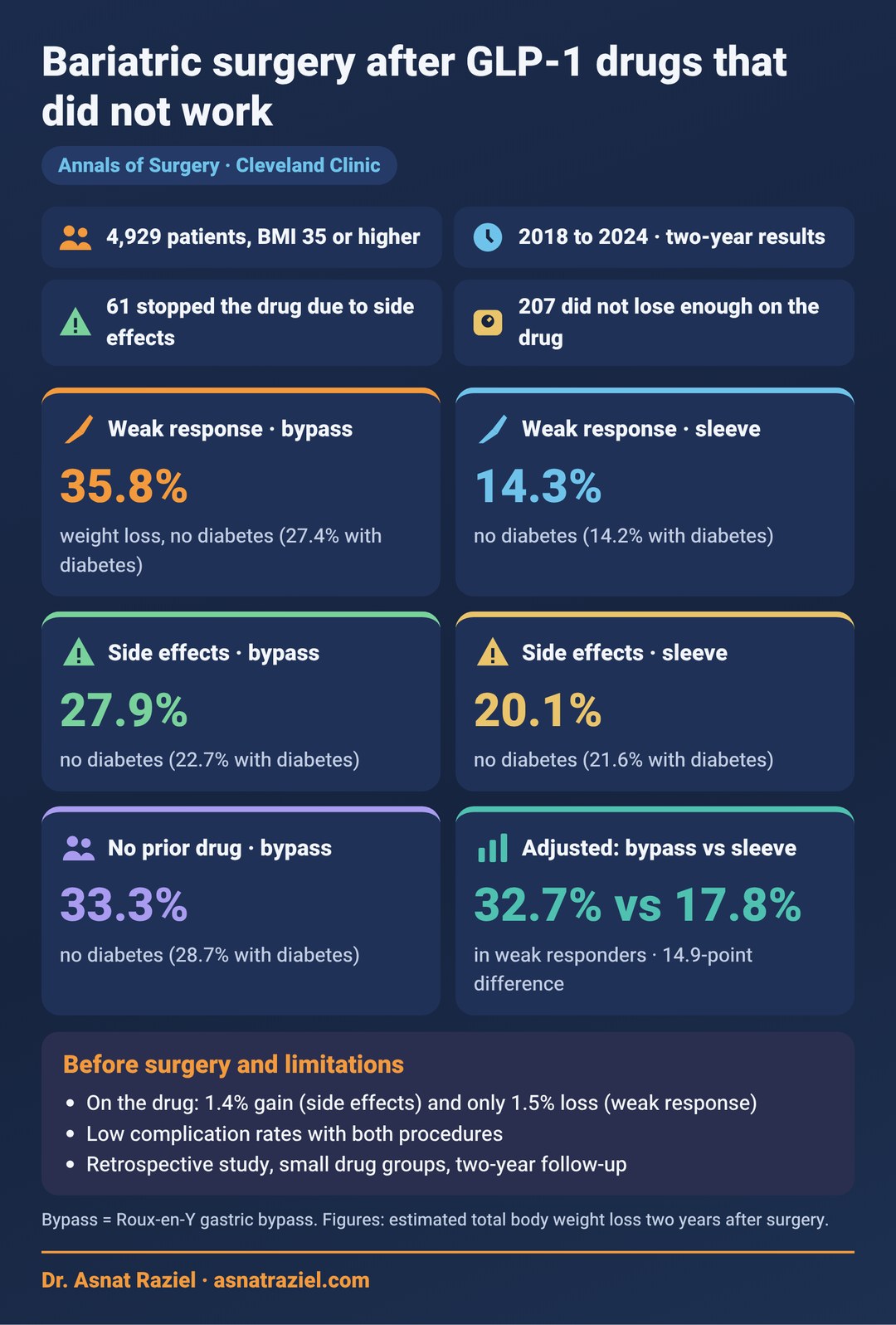
The researchers reviewed the records of 4,929 adults with a BMI of 35 or higher. All had surgery at Cleveland Clinic hospitals between 2018 and 2024. Most of them, 4,661, had not taken semaglutide or tirzepatide before.
In contrast, 61 patients had stopped the drug because of side effects, and 207 had not lost enough weight. Before surgery, the side-effect group gained an average of 1.4% of their weight during drug treatment. The weak-response group lost only 1.5%.
The results: weight loss two years after surgery
The researchers separated two types of surgery: Roux-en-Y gastric bypass and sleeve gastrectomy. They also separated patients with and without type 2 diabetes.
People who stopped because of side effects
After gastric bypass, patients lost 27.9% of their body weight without diabetes and 22.7% with diabetes. After a sleeve, they lost 20.1% and 21.6%, respectively.
People who did not lose enough weight on the drug
Here the results are especially interesting. After gastric bypass, patients lost 35.8% without diabetes and 27.4% with diabetes. After a sleeve, however, they lost only 14.3% and 14.2%.
Comparison with people who never took the drugs
Among people with no prior drug use, weight loss after bypass was 33.3% and 28.7%. After a sleeve, it was 23.6% and 19.9%. So results after bypass were similar even for people the drug did not help.
Bariatric surgery after GLP-1 drugs: bypass or sleeve?
In the adjusted analysis of the weak-response group, bypass led to 32.7% weight loss, compared with 17.8% after a sleeve. The difference was 14.9 percentage points, with a 95% confidence interval of 13.1 to 16.7.
Therefore, for people who did not respond to the drug, gastric bypass may be the better fit. One possible explanation is that bypass works through additional hormonal and gut mechanisms, not only through GLP-1. However, this is an explanation the researchers offer, not a proven conclusion.
Bariatric surgery after GLP-1 drugs: study limitations
This is a retrospective study, not a randomized trial. The drug groups were small, especially the side-effect group. In addition, follow-up lasted only two years, and the researchers could not confirm adherence. On the positive side, complication rates were low with both procedures.
What you can do today
First, if the drug did not help, do not give up. Sometimes it is enough to switch drugs, adjust the dose or manage side effects. I wrote about Wegovy side effects and how to cope. In Israel, Wegovy, the Wegovy pill, Mounjaro and Foundayo are available today, and each suits different patients.
Second, if your weight has not moved after several months at the full dose, it is time to consider bariatric surgery after GLP-1 drugs. The decision is made together: BMI, related conditions, diabetes, reflux and personal preferences. Here I explained the options between medication and surgery.
Finally, preparing for surgery matters as much as the surgery itself. At our center, the dietitian builds a protein-rich plan, the exercise trainer starts strength training, and the psychologist supports the change in habits. After surgery, medication can also help if weight starts to come back, as I described in my article on weight regain after surgery.
Bottom line on bariatric surgery after GLP-1 drugs
Bariatric surgery after GLP-1 drugs that did not work led to meaningful weight loss at two years. For people who did not respond to the drug, gastric bypass gave especially good results. Drugs and surgery are not competitors. They are complementary tools, and there is a path for every patient.
This article provides general information and is not personal medical advice. Any treatment decision should be made with your doctor.
References
Bariatric Surgery as a Rescue Strategy After Semaglutide or Tirzepatide