By Dr. Asnat Raziel, bariatric surgeon specializing in obesity treatment, metabolic health and healthy longevity; Director of the Multidisciplinary Center for Obesity Treatment, Assia Medical, Assuta Ramat HaChayal, Tel Aviv
Alternatives to bariatric surgery: what are the options today?
Many patients today are curious about alternatives to bariatric surgery, and rightly so. Over the past decade, we have gained highly effective medications, endoscopic procedures without incisions and even swallowable capsules. However, each approach has its own advantages, limitations and ideal candidates. In this article, I will explain what the research shows about each option and who it suits.
I want to say this up front: bariatric surgery is still the most effective treatment for large, lasting weight loss. So the question is not “which is better,” but what is right for you now.
Why people look for an alternative to surgery
The reasons vary from person to person. Some people fear surgery and general anesthesia. Others do not meet the criteria, for example when their BMI is below the set threshold. In addition, some patients are older or frail, and their surgical risk is high. In such cases, it is important to assess frailty before bariatric surgery and to consider other approaches as well.
BMI is the body mass index: weight in kilograms divided by height in meters squared. Treatment decisions rely on it, but also on related conditions, weight history and the patient’s preferences.
Alternatives to bariatric surgery: medication
The new medications are the most significant alternative today. They act on the hunger and satiety centers in the brain, reduce appetite and slow stomach emptying. According to the US NIDDK guide to prescription medications to treat overweight and obesity, they are intended for adults with a BMI of 30 or higher, or 27 or higher with a weight-related medical problem.
What the studies show
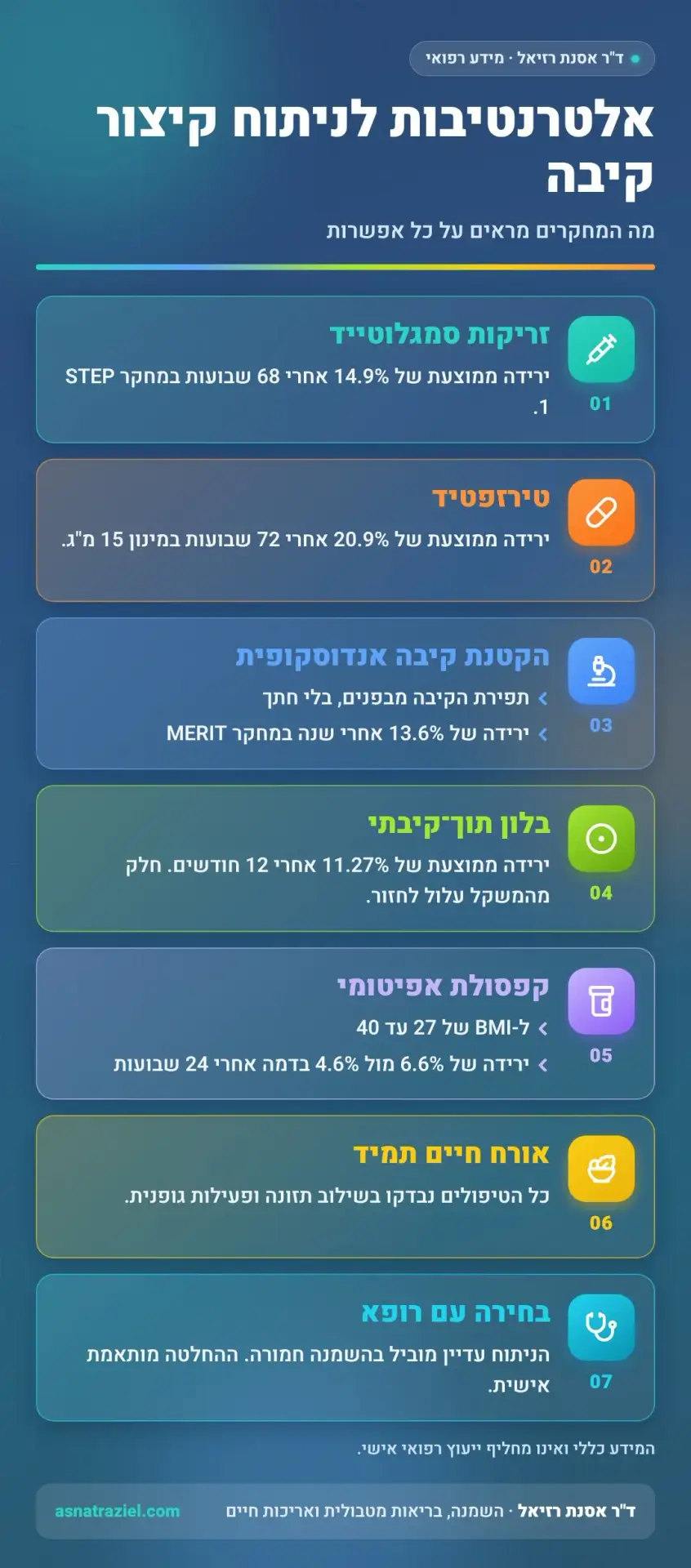
In the STEP 1 trial, patients who received semaglutide 2.4 mg once a week lost an average of 14.9% of their weight after 68 weeks. By contrast, weight loss in the placebo group was only 2.4%. In the SURMOUNT-1 trial, tirzepatide 15 mg led to an average loss of 20.9% after 72 weeks.
In other words, in some patients these drugs come close to the results of surgery. However, when you stop them, the weight tends to return. That is why this is usually a long-term treatment. A broad overview of anti-obesity medications also covers the older drug families. You will find full details on medications for obesity and metabolic disease on this site.
Endoscopic procedures: alternatives to bariatric surgery without incisions
In an endoscopic procedure, the doctor passes a flexible tube through the mouth into the stomach. There are no cuts in the abdominal wall, and recovery is usually quick. In recent years, controlled trials have produced a great deal of data on these methods.
Endoscopic sleeve gastroplasty (ESG)
In ESG, short for endoscopic sleeve gastroplasty, the doctor stitches the stomach from the inside to reduce its volume. The MERIT trial included 209 people with a BMI of 30 to 40. After one year, the ESG group had lost an average of 13.6% of body weight, compared with 0.8% in the group that received lifestyle support alone. In addition, serious side effects occurred in 2% of patients, with no deaths and no need for surgery.
Intragastric balloon
The doctor places a soft balloon in the stomach, where it fills part of the space and increases the feeling of fullness. After a few months, it is removed. According to a meta-analysis by the American Society for Gastrointestinal Endoscopy (ASGE), the average loss after 12 months was 11.27% of body weight. Even so, some of the weight may return after the balloon comes out, so continued follow-up is important.
A swallowable capsule: an alternative without endoscopy
Epitomee is an Israeli capsule that you swallow with water before a meal. In the stomach, it expands into a gel, takes up space and increases fullness. Later, it breaks down and leaves the body naturally. The RESET study included 279 adults with a BMI of 27 to 40. After 24 weeks, the capsule group had lost an average of 6.6% of their weight, compared with 4.6% in the placebo group. Also, 27% of capsule users lost 10% or more, and there were no reported serious device-related side effects.
The capsule is mainly suitable for overweight or mild to moderate obesity. Therefore, it is not a substitute for surgery in severe obesity. You will find more details on my page about the Epitomee capsule.
How to choose between alternatives to bariatric surgery
The choice depends on a few simple questions. First, how much weight do you need to lose, and what is the status of related conditions? Second, are you able and willing to take medication long term? In addition, cost, availability and personal preference all matter. For example, someone who needs to lose 10 kg may benefit from a capsule or a medication. By contrast, a person with a BMI of 45 and diabetes will usually gain more from surgery.
Sometimes we combine approaches. For instance, medication after an endoscopic procedure or after surgery helps maintain the result. You can read more about comparing treatments in my obesity medication guide and in my article on weight regain after bariatric surgery.
Alternatives to bariatric surgery and lifestyle
None of these approaches works on its own. In every study I mentioned, participants also received nutritional guidance and physical activity. In addition, strength training and enough protein preserve muscle mass during weight loss. At our clinic, we build a multidisciplinary plan for every patient, with a physician, a dietitian and regular follow-up.
The bottom line
Today there are more alternatives to bariatric surgery than ever: medications, endoscopic procedures and a swallowable capsule. In studies, the new medications lead to an average loss of about 15% to 21%, ESG to about 14% and the balloon to about 11%. Even so, surgery still leads in long-term results for severe obesity. You and an expert physician should make the right decision together, based on your medical situation and goals.
The information in this article is general and does not replace personal medical advice.
Frequently asked questions
Can medications replace surgery?
For some patients, yes. In studies, tirzepatide led to an average loss of 20.9%. However, treatment continues long term, and when you stop, the weight tends to return.
What is the difference between ESG and sleeve gastrectomy?
In ESG, the doctor stitches the stomach from the inside through the mouth, with no incisions and without removing any part of it. In a sleeve gastrectomy, the surgeon removes a large part of the stomach. Weight loss after a sleeve is usually greater.
Who is the Epitomee capsule for?
The RESET study included adults with a BMI of 27 to 40. So it is mainly suitable for overweight and mild to moderate obesity, combined with lifestyle changes.
Can I combine several alternatives to bariatric surgery?
Yes. For example, you can add medication after an endoscopic procedure to maintain the result. Your physician will tailor the combination with you.
Sources
Once-Weekly Semaglutide in Adults with Overweight or Obesity
Tirzepatide Once Weekly for the Treatment of Obesity
Prescription Medications to Treat Overweight & Obesity
The RESET study was funded by Epitomee Medical, and the MERIT trial was partly funded by Apollo Endosurgery.




