By Dr. Asnat Raziel, bariatric surgeon specializing in obesity treatment, metabolic health and healthy longevity; Director of the Multidisciplinary Center for Obesity Treatment, Assia Medical, Assuta Ramat HaChayal, Tel Aviv
Bariatric surgery in the drug era: personal thoughts on the future of treatment
The place of bariatric surgery in the era of obesity drugs is a question that many patients and doctors are asking today. In recent years, we have witnessed one of the greatest revolutions in the history of obesity medicine. For decades, surgery was the most effective treatment for severe obesity. Then came drugs based on the body’s own satiety hormones, and they changed the rules of the game.
Two drugs lead this revolution. The first is semaglutide, the active ingredient in Ozempic and Wegovy. The second is tirzepatide, the active ingredient in Mounjaro. So many people now ask: will the drugs replace surgery?
What do the new review articles say?
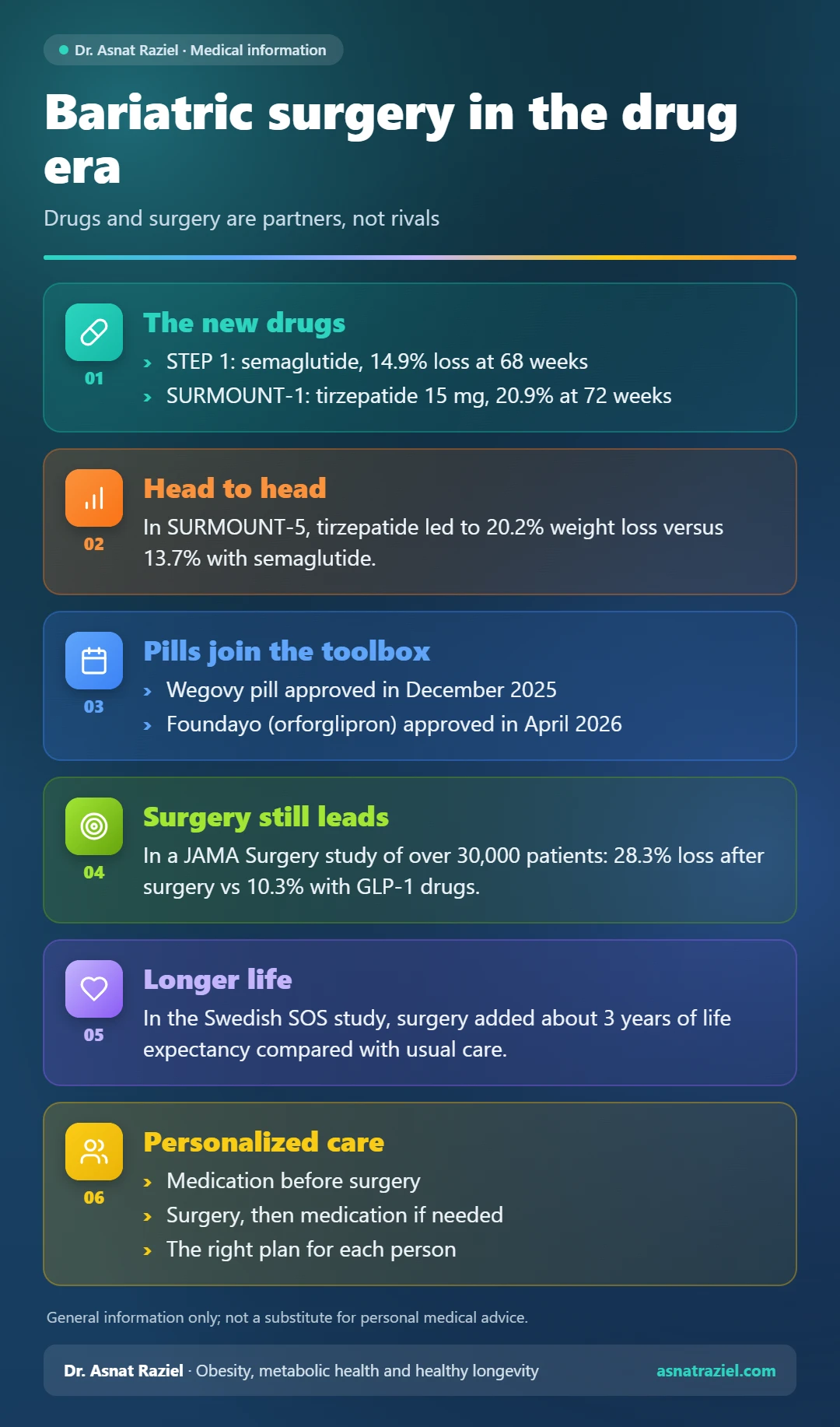
In 2025, several review and opinion articles examined exactly this question. Their answer is especially interesting: no. For example, an opinion article in the journal Endocrine argues that drugs and surgery should not be seen as competing options. Instead, the authors propose combining them in sequence: medication before surgery, then surgery, and sometimes medication afterward as well.
Similarly, a broad review in the journal Medicina proposes a stepwise, personalized approach. In other words, the future belongs neither to surgery alone nor to drugs alone. Instead, it belongs to a smart combination of the two.
How did we reach this turning point?
When I began my career in this field, the options for treating obesity were very limited. Diets failed for most patients in the long run. In addition, the older drugs produced only modest weight loss and sometimes caused significant side effects.
Bariatric surgery brought about the first revolution. It showed the world that obesity is not a problem of willpower but a complex metabolic disease. For the first time, we saw major weight loss and remission of diabetes. We also saw improvements in blood pressure, fatty liver and quality of life. For many years, it was the most effective tool we had.
And then came the new generation of drugs
GLP-1 drugs, and later the dual-action drugs, marked another revolution. In the STEP 1 trial, for example, semaglutide led to an average loss of 14.9% of body weight after 68 weeks. In the SURMOUNT-1 trial, weight loss with tirzepatide at a dose of 15 mg reached 20.9% after 72 weeks.
Since then, important new data have emerged. In the SURMOUNT-5 trial, which compared the two drugs head to head, tirzepatide led to a loss of 20.2% versus 13.7% with semaglutide. Moreover, the Wegovy pill (oral semaglutide) was approved in December 2025, and in April 2026 Foundayo, an orforglipron pill, was approved as well.
For the first time in history, drug treatment has come close to results that were once achieved only with surgery. The implications are enormous. Patients who did not want to hear about surgery, or who were not suitable for it, can now receive effective and less invasive treatment.
Will bariatric surgery disappear in the drug era?
In my personal opinion, absolutely not. Even in the drug era, surgery remains the most effective treatment for many patients. This is especially true in very severe obesity, or when significant metabolic diseases are present.
The data support this. A large study in JAMA Surgery compared more than 30,000 patients with class 2 and class 3 obesity. Among the patients whose weight was recorded, average weight loss over two years of follow-up reached 28.3% after surgery, compared with 10.3% with GLP-1 drugs. Furthermore, the Swedish SOS study followed surgical patients for up to three decades. The researchers estimated that life expectancy among those who had surgery was about 3 years longer than in the usual-care group. For a closer look at the heart, see my article on heart age after surgery.
The unique advantages of bariatric surgery
Surgery offers advantages that are still hard to reproduce with drugs alone:
- Much greater long-term weight loss.
- High rates of type 2 diabetes remission.
- A deep and lasting metabolic effect, without the need for a daily pill or an injection.
- Results proven over decades of follow-up.
At the same time, it is clear that the drugs have shifted the balance. In the past, almost every patient with a high BMI was referred to consider surgery. Today there is another treatment option, and sometimes it is even the better one. If you are weighing your options, you can read my guide to alternatives to gastric bypass and sleeve surgery.
The new bariatric surgeon
This is the part that speaks to me most. In my view, the bariatric surgeon of the future will not be only an operator. Rather, he or she will be an obesity specialist. They will know the drugs in depth and understand the biology of appetite. They will also know how to tailor treatment to each person and will accompany patients over many years. The new articles likewise call for a much closer medical-surgical alliance.
In a sense, this is exactly the path I have taken. After many years in which I operated on thousands of patients, I chose to broaden my practice. Today I also provide medical, metabolic and holistic obesity care.
Bariatric surgery in the drug era as part of personalized medicine
Today, more than ever, I believe there is no one-size-fits-all solution. Some patients will benefit greatly from surgery. Others will achieve excellent results with medication. And many will need a combination of the two, for example drug treatment before surgery, or treatment for weight regain after surgery. An Israeli study also compared sleeve to bypass conversion with medication.
So instead of asking “What is the best treatment for obesity?”, we ask “What is the best treatment for the person sitting in front of me?” Age, underlying conditions and family history all come into play. In addition, we look at eating patterns, body build, muscle status, sleep quality and mental well-being. Finally, the patient’s own preferences are a central part of the decision. I walk through this process step by step in my practical guide to choosing a treatment.
Looking to the future
I believe we are at the beginning of a new era. This is not the end of the surgical era, nor the end of the drug era. It is an era in which obesity is finally recognized as a complex chronic disease. Such a disease requires multidisciplinary, long-term and personalized care.
The new drugs are not a threat to bariatric surgery. On the contrary, they expand our toolbox. Thanks to them, we can help more patients, earlier, with greater precision and less suffering.
The bottom line on bariatric surgery in the drug era
In the drug era, bariatric surgery is not a relic of the past but one tool among several. In the end, the goal is not to choose between a drug and an operation. The goal is to help every person achieve good health, a good quality of life and a long, healthy life.
The information in this article is general and does not replace personal medical advice.
References
Will bariatric surgery survive to the new obesity drugs?
Once-Weekly Semaglutide in Adults with Overweight or Obesity
Tirzepatide Once Weekly for the Treatment of Obesity
Tirzepatide as Compared with Semaglutide for the Treatment of Obesity
Obesity Treatment With Bariatric Surgery vs GLP-1 Receptor Agonists
Life Expectancy after Bariatric Surgery in the Swedish Obese Subjects Study




