By Dr. Asnat Raziel, bariatric surgeon specializing in obesity treatment, metabolic health and healthy longevity; Director of the Multidisciplinary Center for Obesity Treatment, Assia Medical, Assuta Ramat HaChayal, Tel Aviv
Sleeve to bypass conversion or medication? What a new Israeli study shows
Sleeve to bypass conversion is one of the main options when weight comes back after a sleeve gastrectomy. A new Israeli study compared it with obesity medications over an average of 6.4 years. I have written separately about why weight regain after a sleeve happens and how to get back on track. Here, the focus is on one decision: a second operation or medication?
Weight gain after a sleeve has been a familiar challenge for years. The researchers compared conversion surgery with obesity medications to see which helps most. The key message is clear: weight regain is not a personal failure. It is part of the biology of obesity, and there are solutions.
The study was published in May 2026 in the journal Obesity Surgery. It was conducted by a team from Tel Aviv Sourasky Medical Center (Ichilov). The researchers are Dr. Tom Krause, Dr. Adam Abu-Abeid, Dr. Avner Leshem, Dr. Yael Sofer, Prof. Andrei Keidar and Dr. Shai Meron Eldar.
Why does weight come back after a sleeve?
Weight gain after a sleeve does not stem from a lack of willpower. For years, patients who regained weight felt guilt, disappointment and shame. However, the body follows clear rules here. After major weight loss, metabolic adaptation sets in. In addition, hunger and satiety hormones change, and the appetite centers in the brain respond differently. Sometimes the stomach also gradually stretches over the years.
So obesity is not a problem of self-discipline. It is a chronic disease that requires ongoing treatment, follow-up and personalization, as I explain in my article on surgery, medication and whole-person care. The International Federation for the Surgery of Obesity and Metabolic Disorders (IFSO) also takes this seriously. In its international consensus, it set uniform definitions for weight recurrence and for partial response to surgery. This makes it possible to compare studies and plan precise treatment.
What did the researchers examine?
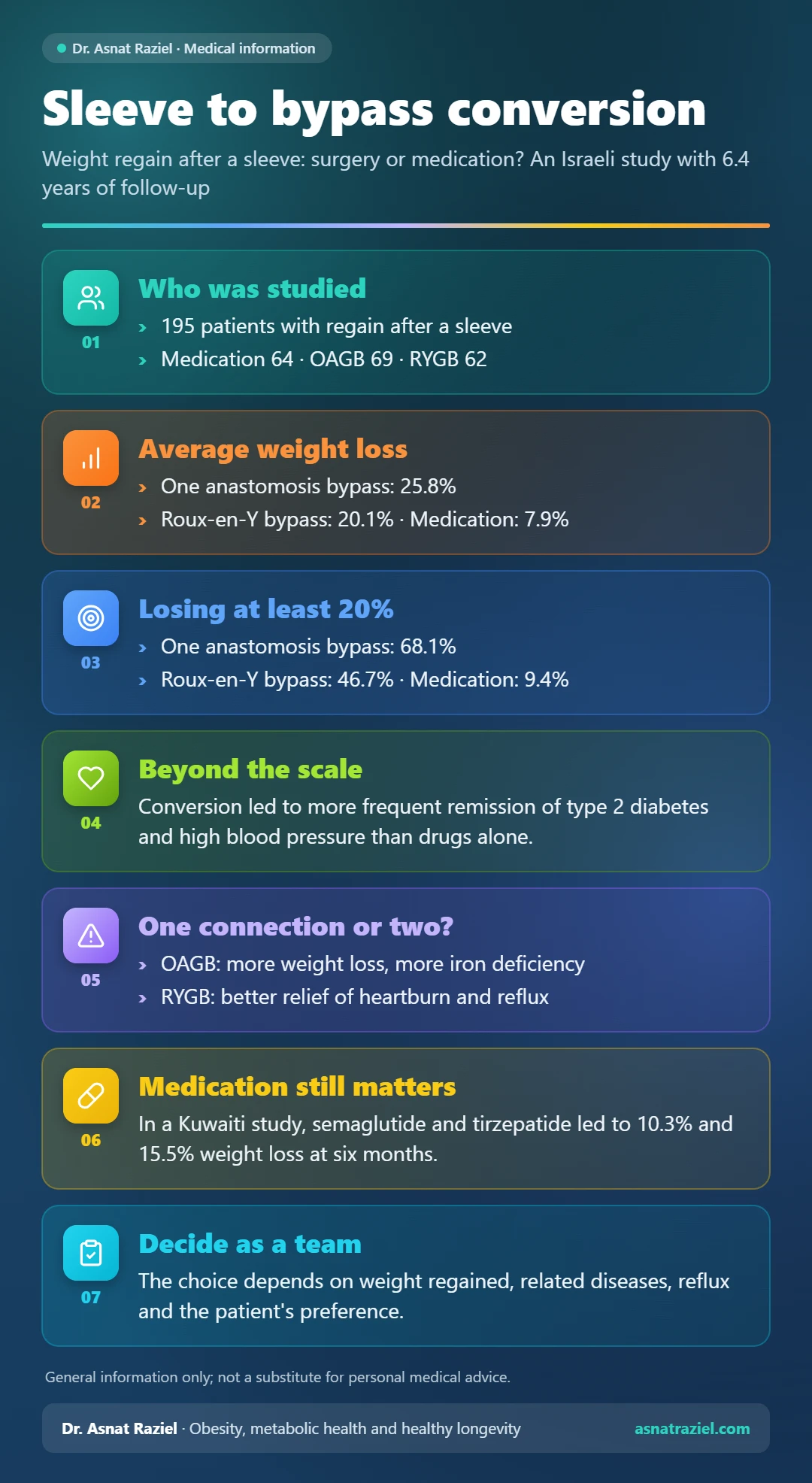
The Israeli study analyzed data from 195 patients. All of them were treated for weight regain after a sleeve gastrectomy between 2014 and 2024. The researchers compared three treatment approaches:
- Obesity medications: 64 patients.
- Conversion to one anastomosis gastric bypass (OAGB): 69 patients.
- Conversion to Roux-en-Y gastric bypass (RYGB), with two connections: 62 patients.
The average follow-up was 6.4 years, which is especially long in this field. Still, it is important to keep the study’s limitation in mind: it is a retrospective analysis of registry data, not a trial in which patients were randomly assigned to treatments.
The results: a clear advantage for sleeve to bypass conversion
In the medication group, patients lost an average of 7.9% of their body weight. By contrast, after one anastomosis bypass the average loss reached 25.8%. After Roux-en-Y bypass, it stood at 20.1%. BMI, the ratio of weight to height, was also lower in the surgery groups. At the end of follow-up, it was 28.3 after one anastomosis bypass and 29.8 after Roux-en-Y bypass, compared with 33.3 in the medication group.
Who achieved truly meaningful weight loss
The researchers also looked at how many patients lost at least 20% of their weight. This target is considered a good response to treatment today. Only 9.4% of patients on medication reached it. On the other hand, 46.7% of patients after Roux-en-Y bypass reached the target. Among patients after one anastomosis bypass, the rate reached 68.1%. In addition, the rate of repeat operations was low and similar in both surgery groups. In this study, then, sleeve to bypass conversion clearly outperformed medication.
One connection or two?
Both types of bypass are now the main choices after a sleeve. A seven-year follow-up study compared them in 109 patients. One anastomosis bypass led to greater long-term weight loss. In contrast, Roux-en-Y bypass resolved heartburn and reflux much better. On the downside, nutritional deficiencies, and especially iron deficiency, were more frequent after one anastomosis bypass. That is why the choice between the operations depends on each patient’s situation.
Not just weight: related diseases improved too
Sleeve to bypass conversion also led to frequent remission of type 2 diabetes and high blood pressure, compared with medication alone. In other words, obesity treatment is not only about the number on the scale. It affects overall health and the risk of heart disease, diabetes and premature death.
Sleeve to bypass conversion or medication: did the drugs fail?
Not at all. The new obesity medications have fundamentally changed the field. The GLP-1 family now includes drugs such as semaglutide and tirzepatide. They offer effective, relatively safe and non-invasive treatment. Sometimes they even delay or prevent another operation.
Moreover, the study included treatments from 2014 to 2024, some of them before today’s powerful drugs reached the market. For example, a study from Kuwait examined 115 patients with weight regain after a sleeve. After six months, patients on semaglutide had lost 10.3% of their weight, and those on tirzepatide 15.5%. However, follow-up there was short, and weight regain after stopping the drug is very common. I discuss the broader picture in my article on bariatric surgery in the drug era.
Sleeve to bypass conversion: questions to ask before deciding
If you are weighing a sleeve to bypass conversion against medication, these questions, based on the data above, can guide the conversation with your team:
- How much weight have I regained, and do I meet the IFSO definition of weight recurrence?
- Do I have heartburn or reflux? Roux-en-Y bypass treats it better.
- What is my risk of nutritional deficiencies, especially iron, after one anastomosis bypass?
- Do I have diabetes or high blood pressure that could improve after conversion?
- Could medication delay or prevent surgery for me, and what happens if I stop it?
There is no right answer for everyone. Still, clear questions lead to a decision that fits your body and your priorities.
Personalized treatment for life
There is no one solution that fits everyone. Some patients will do well with medication alone. Others will need another operation. Many will benefit from a combination of medication, nutritional guidance, physical activity and emotional support. The American Society for Metabolic and Bariatric Surgery also stated in 2026 that every case requires an individual, multidisciplinary decision.
According to the IFSO position statement, the choice depends on many factors. These include the amount of weight regained, related diseases, heartburn and the patient’s preference. That is why the right treatment is built by a multidisciplinary team, not in a one-time decision.
When should you get checked?
If your weight is gradually coming back after a sleeve, do not wait. First, contact your doctor or bariatric team. Next, review your eating, sleep and activity habits together. Sometimes the doctor will also order imaging of the stomach and blood tests. This way, the cause can be identified and the right path chosen. And if fear of the number on the scale is paralyzing you, my article on coping with the fear of weight regain can help.
Weight gain after a sleeve: a message of hope
Ultimately, weight gain after a sleeve is not the end of the road. Obesity medicine today offers more advanced options than ever: innovative drugs, effective and safe conversion operations, and a deep understanding of hunger and satiety mechanisms. The future is not built on guilt and self-criticism. Instead, it is built on science, personalization, compassion and hope.
The information in this article is general and does not replace personal medical advice.




