By Dr. Asnat Raziel, bariatric surgeon specializing in obesity treatment, metabolic health and healthy longevity; Director of the Multidisciplinary Center for Obesity Treatment, Assia Medical, Assuta Ramat HaChayal, Tel Aviv
Severe obesity treatment starts with a health goal
Severe obesity treatment should start with a clear health goal, and only then with the choice of tool. That was the core message of the closing session at ObesityWeek, which focused on people with a BMI above 35. Three experts presented one connected picture: new medicines, drug combinations and bariatric surgery. So the real question is not “medication or surgery?” but which combination will get this patient to their goal.
How much weight do you need to lose to change category?
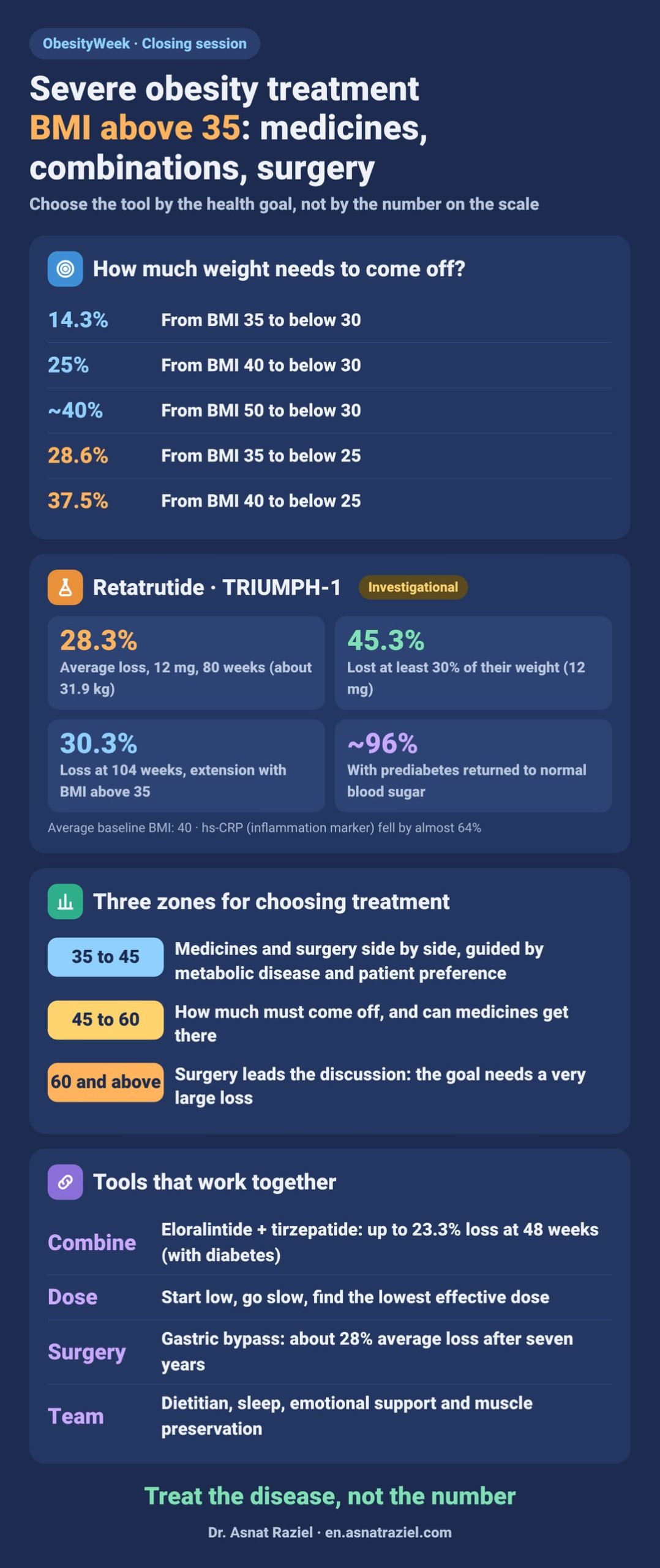
Prof. Ania Jastreboff of Yale University opened with simple arithmetic. To go from a BMI of 35 to below 30, you need to lose about 14.3% of your body weight. From a BMI of 40 you need about 25%, and from a BMI of 50, about 40%.
A target of BMI below 25 is even more demanding. From a BMI of 35 it takes a 28.6% loss, and from a BMI of 40 it takes 37.5%. From a BMI of 50, on the other hand, it means about half of your body weight. In other words, the higher the starting point, the longer the road.
She also reminded the audience that obesity is linked to more than 200 complications. For example, in the All of Us Research Program, the rate of obstructive sleep apnea reached about 40% in the highest range of class 3 obesity. In class 1 obesity it fell below 20%, and in overweight it was 10%.
Retatrutide: an average weight loss of 28.3%
Jastreboff presented the TRIUMPH-1 trial of retatrutide, an investigational medicine that acts on three receptors: GIP, GLP-1 and glucagon. Participants had an average BMI of 40 at the start. On the 4 mg dose, average weight loss reached 19% after 80 weeks. On the highest dose, 12 mg, average weight loss reached 28.3%, about 31.9 kg.
What’s more, on the highest dose 45.3% of participants lost at least 30% of their weight. Nearly two-thirds reached a BMI below 30, and one in three reached a BMI below 25. An extension of the trial included 532 people with a BMI above 35. After 104 weeks, in the highest-dose group, average weight loss reached 30.3%, about 38.5 kg.
Still, Jastreboff stressed that the number on the scale is not the goal. That is why she also showed health measures: improvements in blood pressure, triglycerides and LDL cholesterol. In addition, hs-CRP, a blood marker of inflammation, fell by almost 64%. Nearly 96% of participants with prediabetes returned to normal blood sugar levels.
Severe obesity treatment with drug combinations
Even results like these leave some patients short of their goal. For example, among participants with class 3 obesity, about 60% still had a BMI above 30. That is why Jastreboff sees combination therapy as the future, just as in diabetes and high blood pressure.
One example is the combination of eloralintide and tirzepatide (Mounjaro). Eloralintide mimics amylin, a satiety hormone made by the pancreas. In a phase 2b study of people with obesity and type 2 diabetes, the highest combination led to a 23.3% weight loss after 48 weeks. In the arm where eloralintide was added after 24 weeks of tirzepatide, weight loss reached 16.6%. People with diabetes usually lose less weight, so these results are meaningful.
At the same time, she repeated an important rule: start low, go slow and look for the lowest effective dose. The maximum dose a patient can tolerate is not necessarily the dose they need.
What can be done today?
Prof. Jamie Ard of Wake Forest University presented the case of a 62-year-old with a BMI of 42. Alongside obesity, he has prediabetes, sleep apnea and knee osteoarthritis. Ard suggested a goal of more than 20% weight loss. A useful rule of thumb: losing 10% of body weight lowers BMI by about 4.2 units.
First, the choice of medicine should weigh efficacy, side effects, cost and access. It also has to fit the patient’s daily life. Someone who travels a lot may prefer a pill over an injection that needs refrigeration. On the other hand, a pill that requires half an hour without food in the morning doesn’t suit everyone. Moreover, it is wise to have a backup plan, because insurance coverage or price can change.
Ard also noted that not everyone responds quickly. In an analysis of the SURMOUNT-1 trial, 59% of people who had not lost 5% by week 12 eventually lost at least 10% by week 72. Likewise, less hunger, less Food Noise (intrusive thoughts about food) and less loss of control over eating are real benefits, even when weight comes down slowly.
Severe obesity treatment: when to raise the dose and when to combine?
Next, Ard weighed the gain against the cost of a higher dose. In the STEP UP trial, semaglutide (Wegovy) 7.2 mg led to an average weight loss of 18.7%, compared with 15.6% on 2.4 mg. That is about 3 extra percentage points. However, gastrointestinal side effects became more common, and dysesthesia, an unpleasant skin sensation, rose from 6.0% to 22.9%.
So when a patient is still far from the goal, Ard suggests adding another mechanism of action rather than giving up on treatment. Examples include naltrexone with bupropion, phentermine with topiramate, or adding phentermine to a GLP-1 medicine when cravings return.
Treatment also involves a whole team: managing sleep apnea, a dietitian who helps with side effects and nutrition, and emotional support. Major weight loss changes self-image and the way other people respond. Finally, weight loss may ease knee pain, but it will not always fix structural damage in the joint.
Bariatric surgery as part of the continuum
Dr. Crystal Johnson-Mann, a bariatric surgeon at the University of Florida, presented the surgical side. She said bariatric surgery is very safe: the risk of death is below 1%, and the risk of a leak is well under 1%. Even so, only about 1% of eligible people in the United States have surgery, and many arrive after years of progressive disease.
Johnson-Mann proposed three zones by BMI, while stressing that BMI alone does not tell the whole story:
The three zones
BMI 35 to 45: medication and surgery stand side by side. Metabolic disease and the patient’s preferences guide the choice.
BMI 45 to 60: here the question is how much weight the patient needs to lose, and whether medication can get them there.
BMI 60 and above: surgery should lead the discussion, because the goal requires a particularly large weight loss.
In addition, the joint ASMBS and IFSO guidelines allow surgery to be considered at a BMI of 35 even without other conditions. They also allow surgery to be considered at a BMI of 30 to 34.9 with metabolic disease.
Medicines work while you take them; surgery changes anatomy
Johnson-Mann presented long-term data. For example, seven years after Roux-en-Y gastric bypass, average weight loss was about 28%. By contrast, about two-thirds of patients regained some weight in the year after stopping semaglutide. Her conclusion: a medicine works as long as you take it, while surgery changes the digestive system permanently.
Both surgery and medicines have been shown to reduce heart and blood vessel events. Bariatric surgery is also linked to less obesity-related cancer. However, rapid weight loss can also cost muscle mass, especially at a very high BMI. That is why preserving muscle matters throughout the journey.
Finally, medication can serve as a bridge before surgery, and as help after it, when weight loss is not enough or weight returns.
Who comes for treatment today?
In the discussion after the talks, Johnson-Mann said that 80% to 85% of people who see a surgeon already know what they want. Ard added that many patients arrive with expectations shaped by social media and TV ads. One point from Jastreboff stood out to me: 15 to 20 years ago, the people seeking obesity care were mostly women. Today more men come too, and not only after a diabetes diagnosis or a heart attack scare.
The bottom line on severe obesity treatment
Severe obesity treatment is a long journey, not a single stop. First, the patient and clinician agree on a health goal. Then they choose the tool: one medicine, a drug combination, surgery, or medicine and surgery together. All along the way come nutrition, physical activity, good sleep and stress management. As I wrote about combining medication and surgery, these are not competing tools. In the end, as Johnson-Mann put it, we treat the disease, not the number.
This article is general information and does not replace personal medical advice. Treatment should be tailored with your own physician.
References
Retatrutide, a Triple Hormone Receptor Agonist, for Treatment of Obesity
2022 ASMBS and IFSO: Indications for Metabolic and Bariatric Surgery
ObesityWeek 2026 Symposium: Merging Modalities – A Unified Approach to Treating the Patient with BMI >35