By Dr. Asnat Raziel, bariatric surgeon specializing in obesity treatment, metabolic health and healthy longevity; Director of the Multidisciplinary Center for Obesity Treatment, Assia Medical, Assuta Ramat HaChayal, Tel Aviv
Retatrutide for sleep apnea: what two phase 3 trials found
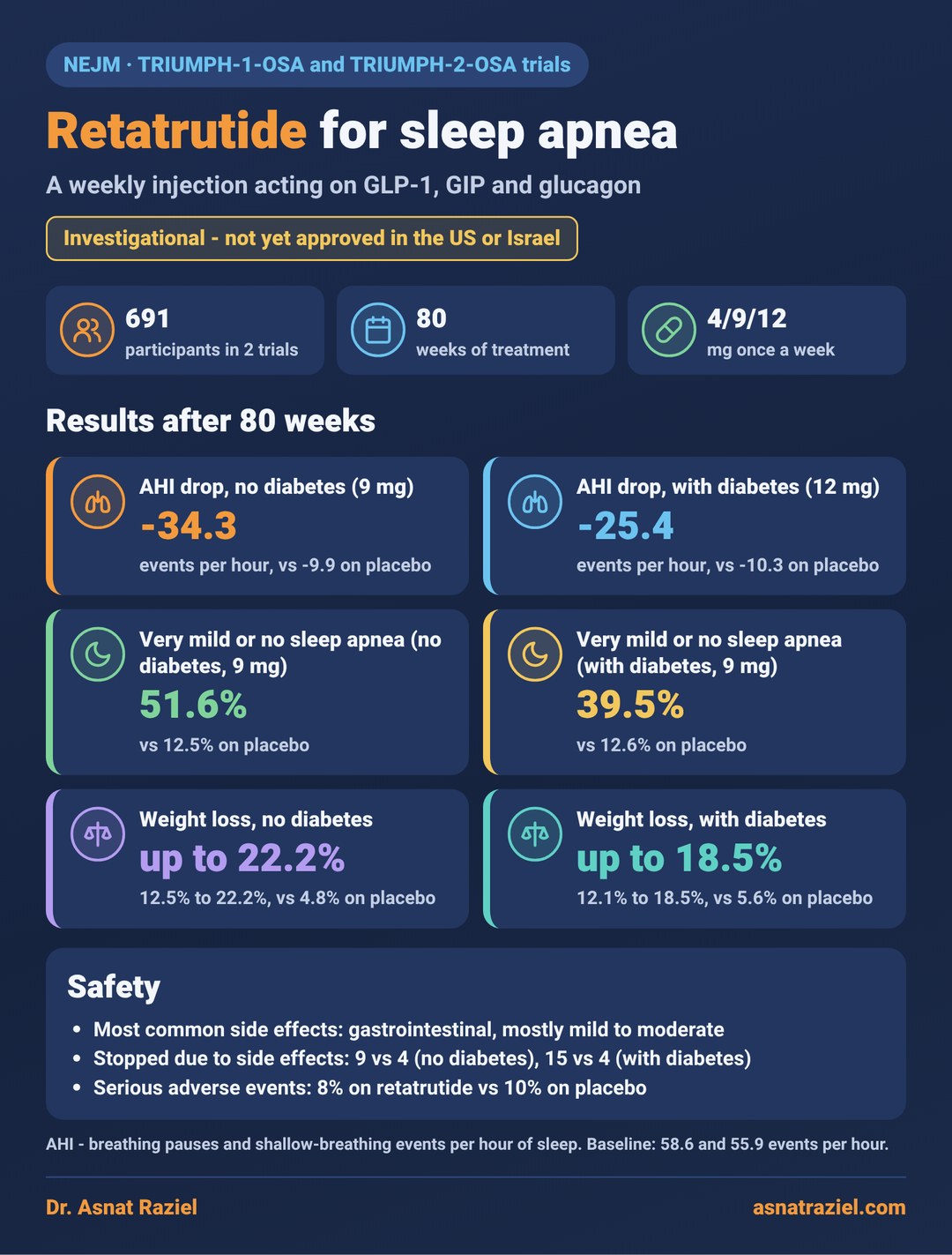
Two large trials tested retatrutide for sleep apnea, and the New England Journal of Medicine published the results. The investigational drug cut the number of nightly breathing pauses roughly in half and led to weight loss of up to 22.2%. The placebo groups, by contrast, changed far less. One important point: regulators have not yet approved retatrutide, either in the US or in Israel.
Sleep apnea and obesity: a close link
In obstructive sleep apnea (OSA), the upper airway closes again and again during sleep. Breathing stops for a few seconds, oxygen levels drop, and sleep keeps breaking. The result is morning fatigue, headaches and trouble concentrating.
Sleep apnea also goes hand in hand with high blood pressure, heart disease and diabetes. Obesity is the main risk factor, as I explain in my article on obesity and sleep apnea. The standard treatment is a CPAP machine, which delivers pressurized air through a mask during sleep. However, many patients find it hard to stick with it over time.
What is retatrutide?
Retatrutide is a once-weekly injection developed by Eli Lilly. It acts on three hormone receptors at once: GLP-1, GIP and glucagon. That is why experts call it a “triple agonist.” In earlier studies it led to substantial weight loss, which I covered in my article on retatrutide side effects and safety.
The trials: retatrutide for sleep apnea with and without diabetes
The researchers ran two double-blind, placebo-controlled trials lasting 80 weeks. Participants were adults with moderate to severe sleep apnea and a BMI of 27 or higher:
- TRIUMPH-1-OSA: 243 participants without type 2 diabetes.
- TRIUMPH-2-OSA: 448 participants with type 2 diabetes.
Participants received retatrutide at 4, 9 or 12 mg once a week, or placebo. Dosing started at 2 mg and rose gradually. The main measure was the AHI (apnea-hypopnea index), the number of breathing pauses and shallow-breathing events per hour of sleep. At the start, the average AHI was 58.6 and 55.9 events per hour, which means severe sleep apnea.
The results: fewer breathing pauses every hour
After 80 weeks, the picture had clearly changed:
- Without diabetes: a drop of 34.3 events per hour on 9 mg and 31.7 on 12 mg, compared with 9.9 on placebo.
- With diabetes: a drop of 24.7 events per hour on 9 mg and 25.4 on 12 mg, compared with 10.3 on placebo.
The researchers also looked at how many people reached very mild or no sleep apnea without significant daytime sleepiness. Without diabetes, this happened in 51.6% on 9 mg and 42.3% on 12 mg, versus 12.5% on placebo. With diabetes, the figures were 39.5% and 38.9%, versus 12.6%.
Retatrutide for sleep apnea: weight and risk factors
At the start, participants weighed an average of 119.6 and 115.9 kg. Without diabetes, weight loss ranged from 12.5% to 22.2%, compared with 4.8% on placebo. With diabetes, it ranged from 12.1% to 18.5%, compared with 5.6% on placebo.
In addition, the researchers saw improvements in blood pressure, blood lipids, fasting insulin and hs-CRP, a blood marker of inflammation linked to heart disease risk. In people with diabetes, HbA1c (average blood sugar over the past three months) and fasting glucose also improved.
Side effects
The most common side effects were gastrointestinal, mostly mild to moderate, and mainly during dose escalation. Without diabetes, 9 people on retatrutide stopped treatment because of side effects, versus 4 on placebo. With diabetes, the numbers were 15 versus 4. Serious adverse events, however, were similar: 8% on retatrutide versus 10% on placebo.
What you can do today
Retatrutide is still in clinical trials, but there is no need to wait for it. First, tirzepatide, the active ingredient in Mounjaro, already has US approval for sleep apnea with obesity. Second, the daily pill Foundayo has also shown good results, as I described in my article on Foundayo for sleep apnea. In Israel, both drugs are available by prescription, and obesity treatment with them is self-paid.
- A sleep study: if you snore, wake up tired or doze off during the day, consider a sleep test.
- CPAP: do not stop your machine without talking to your doctor. These medications work alongside it.
- Nutrition and activity: losing weight by any route eases breathing, and strength training helps protect muscle.
- Sleep habits: regular hours and enough sleep affect appetite and weight, as I describe in my guide to healthy sleep.
At our center, we treat sleep apnea and obesity together: a dietitian, a psychologist, physical activity, medication, and bariatric surgery when it is the right fit.
Bottom line: retatrutide for sleep apnea brings real hope
In the TRIUMPH-OSA trials, retatrutide for sleep apnea reduced both sleep apnea severity and body weight, including in people with diabetes. Still, this investigational drug does not have approval yet. Effective treatments already exist today, and the decision about them is always made together with your doctor.
This article is general information and is not a substitute for personal medical advice.
References
Retatrutide Once Weekly for Treatment of Obstructive Sleep Apnea
TRIUMPH-OSA: Retatrutide reduces sleep apnea severity in OSA plus obesity
The trials were funded by Eli Lilly.