By Dr. Asnat Raziel, bariatric surgeon specializing in obesity treatment, metabolic health and healthy longevity; Director of the Multidisciplinary Center for Obesity Treatment, Assia Medical, Assuta Ramat HaChayal, Tel Aviv
Healthy sleep: what I heard today at LM2026
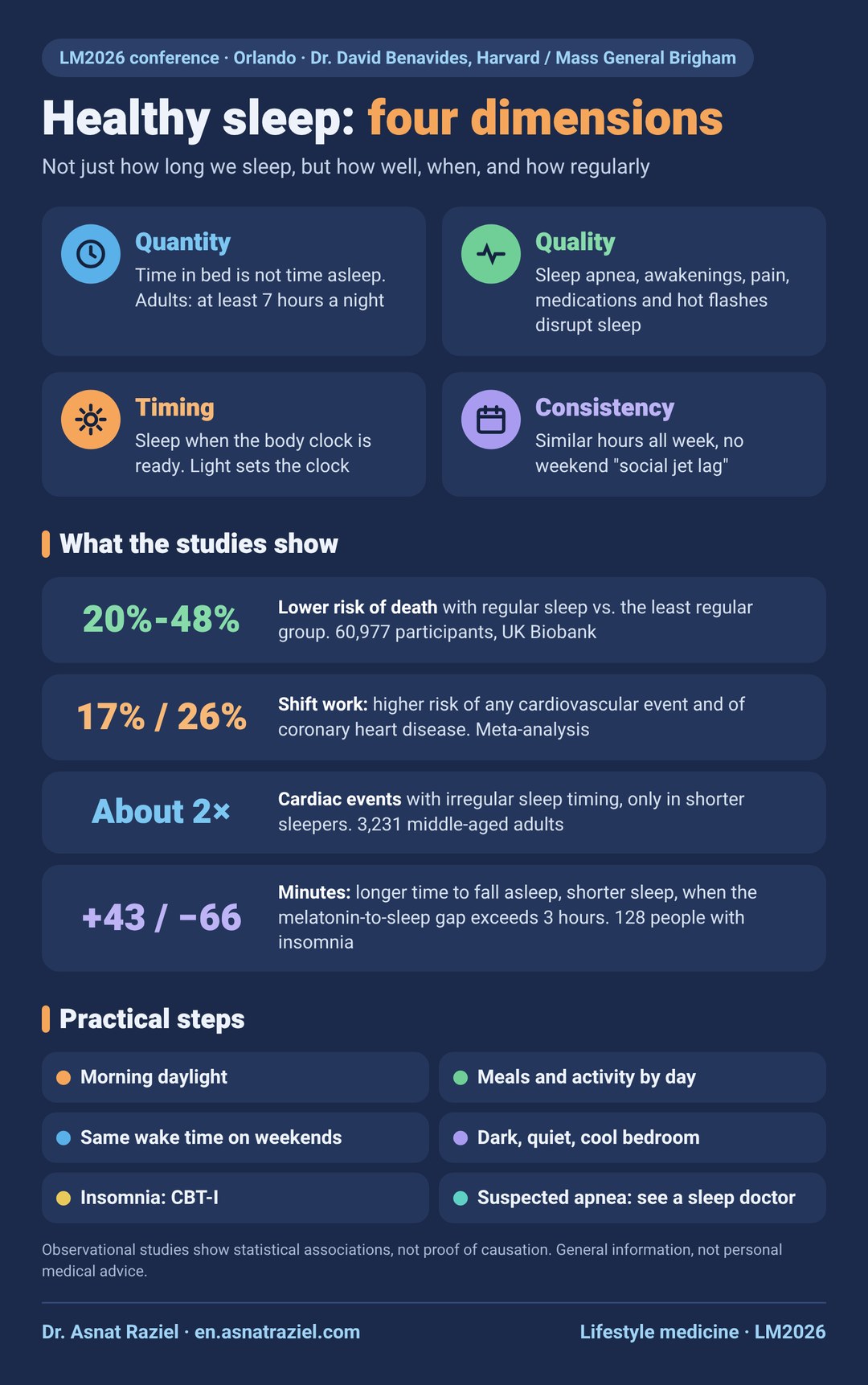
Healthy sleep is about much more than the number of hours you spend in bed. That was the message of one of the best lectures I attended today at the LM2026 Lifestyle Medicine conference in Orlando. The speaker suggested assessing every patient across four dimensions: quantity, quality, timing and consistency. In his view, a clinician who checks only one of them often misses the real problem.
In this article I summarize the key points of the talk. I also checked the studies he presented and linked to them. So you can see what is well established and what is still emerging.
Who spoke, and about what
The speaker was Dr. David Benavides, a sleep medicine physician at Mass General Brigham. He works in the Division of Sleep and Circadian Disorders. He is also clinical faculty at Harvard Medical School and founder of Sleepspan. His work focuses especially on the link between sleep and heart disease, including arrhythmias. The talk was titled “A Four-Dimensional Framework for Evaluating Sleep in Lifestyle Medicine.” This is another article in my series from the conference, following my piece on lifestyle medicine as a standard of care.
He opened with an observation I know well from my own clinic. Doctors ask “How many hours do you sleep?”, perhaps order a sleep apnea test, and recommend sleep hygiene. Each of these steps, however, looks at only one part of the picture.
The four dimensions of healthy sleep
Dr. Benavides calls his model QQCC, an acronym of four English terms. A similar approach appears in the American Heart Association scientific statement on multidimensional sleep health. The statement lists duration, continuity, timing, regularity, daytime functioning and the absence of sleep disorders.
- Quantity – how many hours we actually sleep.
- Quality – what happens in the body during those hours.
- Clock alignment – whether we sleep when the body is biologically ready for sleep.
- Consistency – how similar our sleep and wake times are from day to day.
Quantity: time in bed is not time asleep
First, we need to separate the opportunity to sleep from the sleep that actually happens. One person lies in bed for ten hours but sleeps only six. Another sleeps almost all of the seven hours they set aside. A simple sleep diary therefore helps locate the gap. Sometimes the schedule is simply too tight; sometimes insomnia, noise or heat cut sleep short.
For adults, the joint consensus recommendation of the American Academy of Sleep Medicine is at least seven hours a night. Dr. Benavides stressed that no single number fits everyone. For example, people with chronic illness sometimes need a longer recovery period. On the other hand, he rejected the claim that most people do well on five or six hours. People get used to short sleep and feel fine, he said. But their performance and health still suffer.
Quality: what happens inside those hours
Seven hours of sleep do not guarantee good sleep. Many things damage sleep quality. Examples include oxygen drops in sleep apnea, frequent awakenings, medications and chronic pain. Night-time urination and menopausal hot flashes do too. In other words, the patient sleeps “enough,” but the body does not recover. This is also where obesity comes in. Sleep apnea is very common in people with excess weight. I have written before about drug treatment for sleep apnea.
Timing: the body clock behind healthy sleep
The most fascinating part of the lecture dealt with the internal clock. As early as 1729, the French scientist de Mairan studied the mimosa plant. Its leaves kept opening and closing even in complete darkness. In the 1960s, the geologist Michel Siffre went into a cave without daylight. He found that humans, too, have an internal cycle that is not exactly 24 hours. In both cases, light is what resets the clock. The 2017 Nobel Prize in Physiology or Medicine recognized the discovery of the molecular mechanism of this clock.
The master clock sits in the hypothalamus, in a cluster of cells called the SCN (suprachiasmatic nucleus). Light reaches it through specialized cells in the retina. From there it coordinates the timing of every organ. Dr. Benavides compared it to a stadium manager. The manager makes sure each team takes the field at its own time.
Moreover, the clock affects far more than sleep. In animal studies, many genes show a daily rhythm in at least one tissue. The share was 43% in mice and 81.7% in baboons. He emphasized that these are not direct human figures. Still, they explain why alertness, hunger, body temperature and hormones change across the day. For example, he said, a meal eaten at 3 a.m. stays in the stomach longer. The body also handles it differently. Late eating also increases reflux. This fits well with research on intermittent fasting and the biological clock.
Consistency: the average can hide the week
Two people can sleep the same number of hours on average and still live on completely different schedules. Someone who goes to bed and wakes up late on weekends experiences “social jet lag.” The body clock and sleep pressure have to readjust again and again.
To explain this, he described two processes. Process S is sleep pressure. It builds up in the brain during waking hours, like sand filling a jar. Process C is the circadian clock, which opens a “window” for sleep. Good sleep comes when the two line up. That is why a three- or four-hour daytime nap empties the jar. Then it is hard to fall asleep at night.
Why timing and consistency matter for health
This part of the talk presented some striking data. In a UK Biobank study, activity trackers measured the sleep of 60,977 participants for a week. Regular sleep was linked to a 20% to 48% lower risk of death from any cause. The comparison was with the least regular group. According to the researchers, sleep regularity predicted mortality risk better than sleep duration did.
In a Finnish study of 3,231 middle-aged adults, irregular sleep timing roughly doubled the risk of cardiac events, but only among people who slept less than the group’s median. Likewise, a meta-analysis found that shift work is associated with a 17% higher risk of any cardiovascular event and a 26% higher risk of coronary heart disease. The US Nurses’ Health Studies linked years of rotating night shifts to a small but significant rise in coronary heart disease risk.
As for cancer, the World Health Organization’s cancer agency classifies night shift work as “probably carcinogenic” (Group 2A). A Chinese cohort study linked sleeping less than six hours a night to a 41% higher risk of cancer. Dr. Benavides was careful to note that these are statistical associations, not proof that sleep is the cause.
Healthy sleep, diabetes and weight
As a physician who treats obesity, I found this part the most important. In a small controlled experiment with 13 participants, shifting sleep a few hours earlier or later changed sleep architecture. In the delayed condition, less REM (dream) sleep was linked to fasting insulin levels. It was also linked to insulin resistance (HOMA-IR) and to the cortisol response to lunch.
Another study of 128 people with insomnia measured when melatonin release began. When the gap between melatonin onset and falling asleep exceeded three hours, it took 43 minutes longer to fall asleep and total sleep was 66 minutes shorter. In addition, the American and European diabetes associations’ guidance already places sleep alongside nutrition and physical activity in the care of type 2 diabetes. This also connects to my article on diabetes remission through lifestyle.
Four questions to assess healthy sleep
Dr. Benavides asked clinicians to cover four questions in every conversation about sleep:
- How much? The amount of sleep that actually happens, and whether there is enough time to sleep.
- How well? Snoring, breathing pauses, awakenings, pain or hot flashes.
- When? Does sleep happen when the body is ready for it?
- How variable? Is the schedule similar on weekdays and weekends?
Before anything else, ask about safety. Anyone who falls asleep while driving or at work needs urgent evaluation. He also warned against prescribing a sleeping pill before checking for sleep apnea. A sedating drug can worsen breathing pauses. When sleep apnea is suspected, the right step is a referral to a sleep physician.
What works, and what is not yet proven
Treatment should match the problem that was found, not start with a supplement. For true insomnia, cognitive behavioral therapy for insomnia (CBT-I) is the first-line treatment for most adults. Treating sleep apnea, allowing enough time for sleep, well-timed light exposure and exercise also rest on good evidence.
By contrast, acoustic stimulation during sleep and similar technologies are still experimental. Sleep-stage scores from smartwatches, saunas, peptides and “detox” supplements need much better human evidence. Alcohol is misleading too. It may help you fall asleep, but it harms sleep quality, mainly in the second half of the night.
Practical steps toward healthy sleep
Instead of a list of rules, Dr. Benavides suggested thinking in terms of a daily routine. Light is the most important timekeeper, but not the only one. Meals, activity, temperature and darkness also set the clock.
- Get outside into daylight in the morning, even for ten minutes.
- Eat and exercise mainly during the day.
- Keep a similar wake-up time, weekends included.
- Dim screens and lights in the hour before bed.
- Keep the bedroom dark, quiet and cool.
- Avoid long naps of several hours.
- Calm the evening with breathing or mindfulness practice.
The bottom line on healthy sleep
Healthy sleep rests on four pillars. These are enough hours, continuous good-quality sleep, hours that match the body clock, and a steady routine. Ultimately, my takeaway from the conference is that sleep is not an “add-on” to nutrition and activity. It is part of the same 24-hour day, and it affects hunger, blood sugar, the heart and longevity. In our clinic we will keep asking not only “How long did you sleep?” but also “When, how well and how regularly?”
This article provides general information and is not personal medical advice. Before changing your treatment, consult your doctor.
References
Association Between Rotating Night Shift Work and Risk of Coronary Heart Disease Among Women
Circadian Rhythm Timing and Associations With Sleep Symptoms in People With Insomnia
The effect of alcohol on subsequent sleep in healthy adults: A systematic review and meta-analysis
The Nobel Prize in Physiology or Medicine 2017 – Press release