By Dr. Asnat Raziel, bariatric surgeon specializing in obesity treatment, metabolic health and healthy longevity; Director of the Multidisciplinary Center for Obesity Treatment, Assia Medical, Assuta Ramat HaChayal, Tel Aviv
Foundayo for sleep apnea: what the new trial found
Lilly tested Foundayo for sleep apnea in a large phase 3 trial and released the results today. The once-daily pill reduced the number of breathing pauses at night and lowered body weight by about 11%. In the placebo group, by contrast, the changes were small. One important caveat: the FDA has not yet approved Foundayo for sleep apnea, and Lilly plans to file with the FDA by the end of 2026.
What is obstructive sleep apnea?
In obstructive sleep apnea (OSA), the upper airway closes again and again during the night. As a result, breathing stops or becomes shallow for a few seconds, blood oxygen drops and sleep keeps breaking off. The next morning brings fatigue, headaches and trouble concentrating.
Mayo Clinic’s guide to obstructive sleep apnea symptoms adds loud snoring and excessive daytime sleepiness to this list.
Moreover, sleep apnea goes hand in hand with high blood pressure, heart disease and diabetes. Obesity is the main risk factor, so the link between obesity and sleep apnea comes up in my clinic almost every day. The standard treatment is a CPAP device, which delivers pressurized air through a mask during sleep. However, many patients find it hard to stick with.
How do doctors measure sleep apnea severity?
The main measure is the AHI (apnea-hypopnea index): the number of breathing pauses and shallow-breathing episodes per hour of sleep. A value of 30 or more means severe sleep apnea. In addition, the researchers looked at hypoxic burden, which reflects how deep and how long oxygen levels drop during the night.
The ATTAIN-OSA trial: Foundayo for sleep apnea in two parallel studies
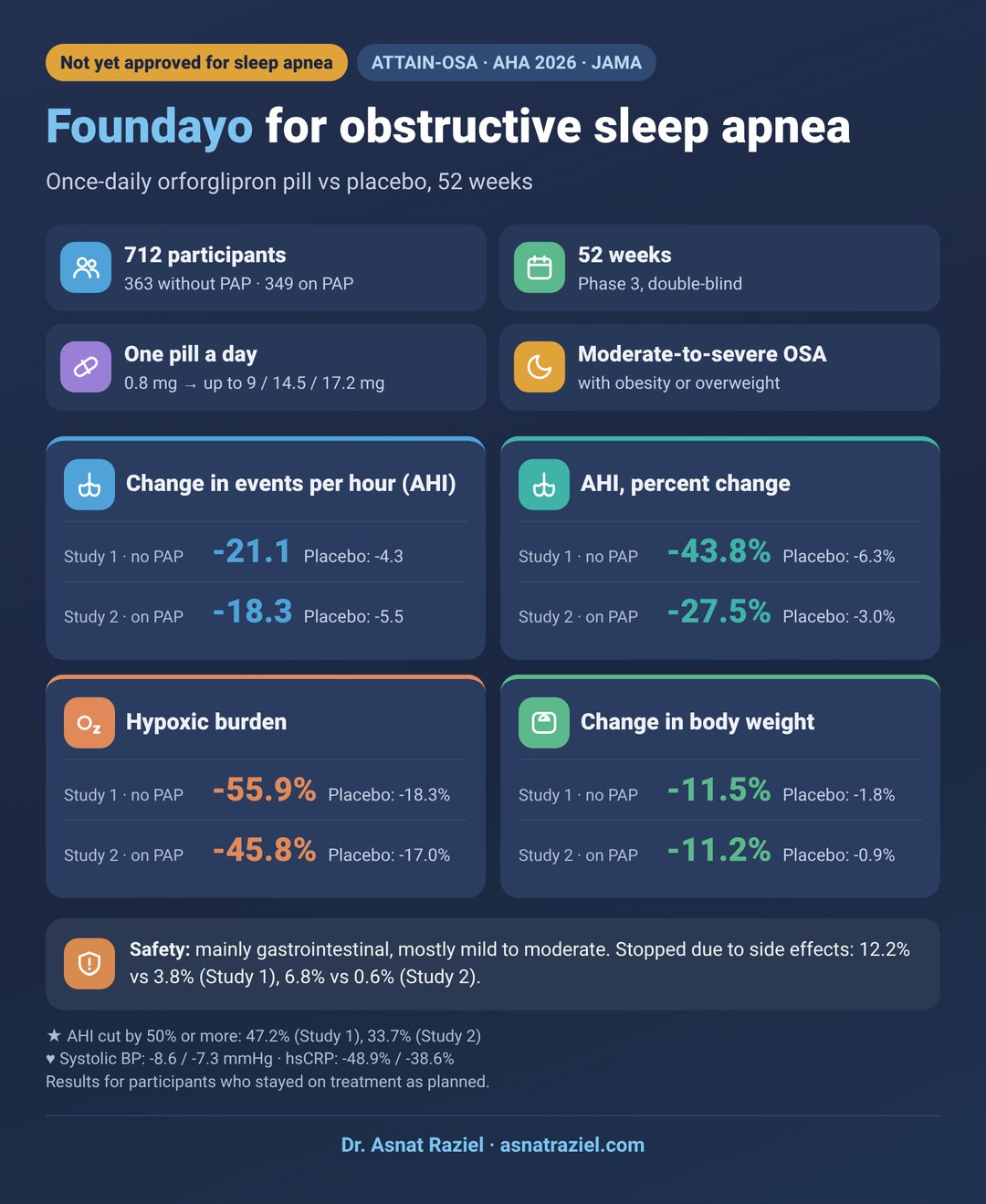
Lilly ran the ATTAIN-OSA trial, a 52-week, double-blind, placebo-controlled phase 3 study. Participants were adults with moderate-to-severe sleep apnea and obesity or overweight. The trial included two parallel studies:
- Study 1: 363 participants who could not or would not use PAP therapy.
- Study 2: 349 participants who had used PAP for at least 3 months before the trial and kept using it throughout.
Participants took orforglipron, the active ingredient in Foundayo, once a day. The dose went up every 4 weeks, from 0.8 mg to the highest tolerated dose: 9 mg, 14.5 mg or 17.2 mg. Foundayo is a GLP-1 pill, and you can read more about it in my complete guide to Foundayo treatment.
The results: fewer breathing events per hour
At the start, participants averaged 50.7 breathing events per hour in Study 1 and 57.6 in Study 2. In other words, this was severe sleep apnea. After a year of treatment, the picture changed:
- Study 1 (no PAP): a drop of 21.1 events per hour with Foundayo, versus only 4.3 with placebo. In percentage terms: 43.8% versus 6.3%.
- Study 2 (on PAP): a drop of 18.3 events per hour, versus 5.5 with placebo. In percentage terms: 27.5% versus 3.0%.
Also, in Study 1, 47.2% of people on Foundayo cut their events by half or more. What’s more, in 31.5% the sleep apnea resolved or became mild. In Study 2, the matching figures were 33.7% and 19.6%.
Foundayo for sleep apnea: less oxygen loss at night
Hypoxic burden also fell markedly. In Study 1, it dropped 55.9% with Foundayo, versus 18.3% with placebo. In Study 2, the drop was 45.8% versus 17.0%. Put simply, the body went through fewer oxygen dips at night.
Weight loss and heart risk factors
At baseline, participants weighed an average of 110.2 kg in Study 1 and 114.6 kg in Study 2. After 52 weeks:
- Study 1: 11.5% of body weight lost (12.7 kg) with Foundayo, versus 1.8% (2.0 kg) with placebo.
- Study 2: 11.2% lost (12.8 kg), versus 0.9% (1.0 kg) with placebo.
Beyond that, hsCRP fell 48.9% without PAP and 38.6% with PAP. hsCRP is a blood marker of inflammation that tracks with heart disease risk. Systolic blood pressure, the top number, dropped by 8.6 and 7.3 mmHg. Finally, note that these figures refer to participants who stayed on treatment as planned.
Side effects
The safety profile matched earlier trials of the drug. The most common side effects were digestive: nausea, diarrhea, constipation, indigestion and vomiting. Most were mild to moderate. Still, 12.2% of people on Foundayo stopped treatment because of side effects in Study 1, versus 3.8% on placebo. In Study 2, the figures were 6.8% versus 0.6%.
What it means for you
First, the trial shows that a daily pill, not just an injection, can ease obstructive sleep apnea. Another drug, tirzepatide, already has US approval for this condition, as I explained in my article on Mounjaro and sleep apnea. Second, the benefit appeared even in people who kept using PAP, so the pill may work alongside the device rather than replace it.
Sleep itself also shapes appetite and weight. Therefore, treating sleep apnea and obesity together may create a positive cycle. The weight loss here is in line with what we saw in earlier orforglipron trials.
What you can do now
- If you snore, wake up tired or doze off during the day, ask about a sleep study.
- If you use CPAP, don’t stop it without talking to your doctor.
- Losing weight, in whatever way suits you, is a key part of treating sleep apnea.
Bottom line: Foundayo for sleep apnea is not yet approved
In the ATTAIN-OSA trial, Foundayo for sleep apnea reduced breathing events, nighttime oxygen dips and weight compared with placebo. Lilly presented the results at the American Heart Association (AHA) Scientific Sessions, and JAMA published them. However, the sleep apnea indication still awaits approval, and Lilly plans to file with the FDA by the end of 2026. In the end, you and your doctor make any treatment decision together.
This article is general information and does not replace personal medical advice.
References
Eli Lilly and Company funded the trial.