By Dr. Asnat Raziel, bariatric surgeon specializing in obesity treatment, metabolic health and healthy longevity; Director of the Multidisciplinary Center for Obesity Treatment, Assia Medical, Assuta Ramat HaChayal, Tel Aviv
Retatrutide side effects: why they matter as much as the results
Retatrutide is an experimental, once-weekly injection for obesity. It has not been approved yet, but we already have results from several large phase 3 trials, in which participants lost, on average, between a fifth and a quarter of their body weight. Yet alongside these impressive numbers, we also need to ask what the price is. In this article, I focus on retatrutide side effects and safety: what the trials measured, how many people stopped treatment, and what we still don’t know. For a broader look at the overall results, see my article on retatrutide for weight loss.
How retatrutide works in the body
Most of today’s weight-loss drugs act on one or two hormones. Wegovy acts on GLP-1, and Mounjaro acts on GLP-1 and GIP. Retatrutide, by contrast, activates three receptors at once. That is why doctors call it a “triple agonist.”
- GLP-1: a gut hormone that increases fullness, slows stomach emptying and quiets “food noise.”
- GIP: another gut hormone that improves insulin release and helps regulate appetite.
- Glucagon: a hormone from the pancreas that raises energy expenditure and encourages fat breakdown, including in the liver.
This combination probably explains the large weight loss. For a detailed explanation, see my article on how the triple-hormone drug works.
The first study: weight loss and a rise in heart rate
The first major study included 338 adults with obesity or overweight. It lasted 48 weeks and was published in the NEJM (New England Journal of Medicine). At the highest dose, 12 mg, participants lost an average of 24.2% of their body weight. In the placebo group, by comparison, weight loss was only 2.1%. In addition, the researchers saw a dose-dependent rise in heart rate. It peaked at week 24 and declined afterward.
TRIUMPH-1: results in people without diabetes
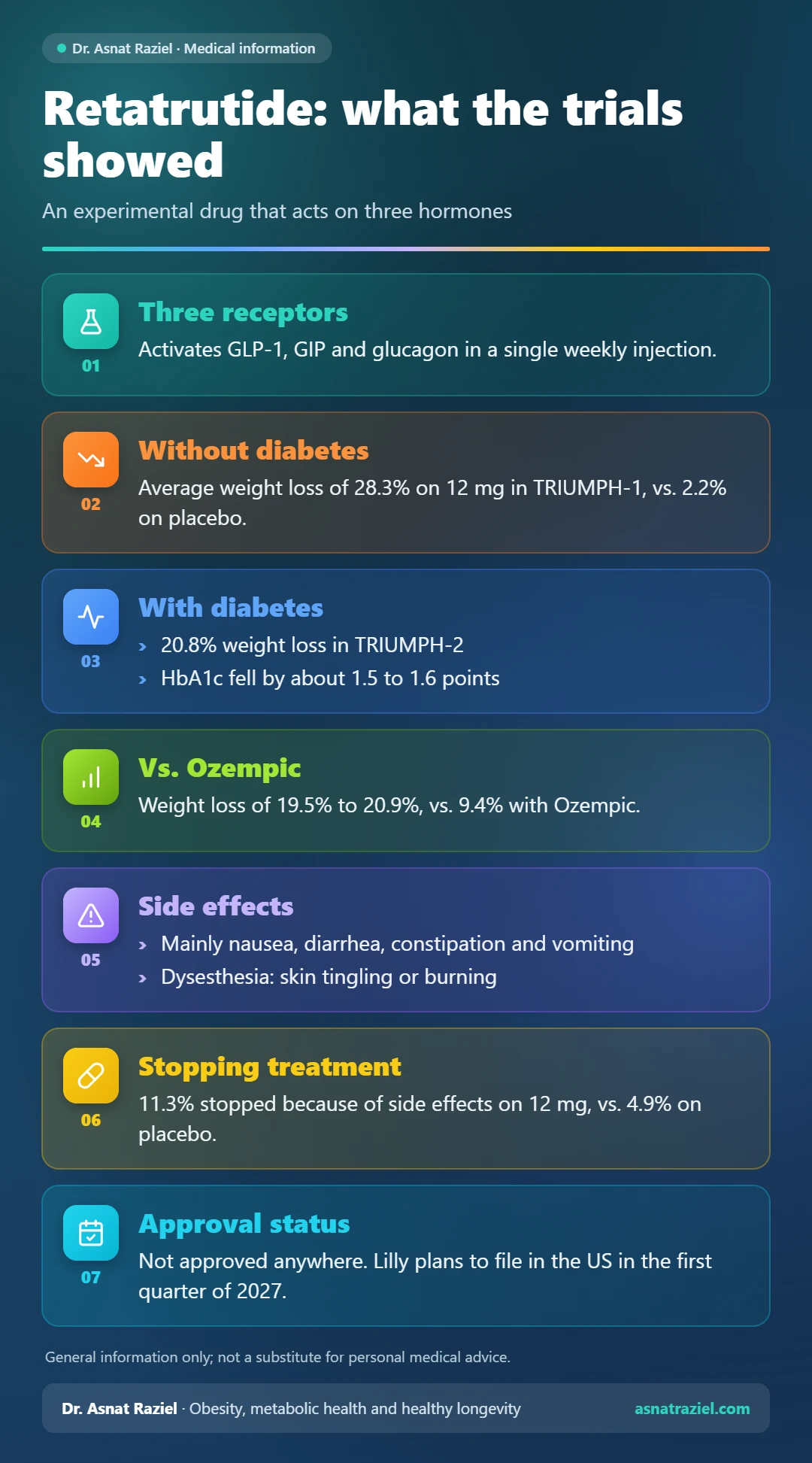
TRIUMPH-1 is the main phase 3 trial. It included 2,339 adults with obesity or overweight, without diabetes, and lasted 80 weeks. According to Lilly’s official announcement, average weight loss among those who stayed on treatment was:
- 12 mg: 28.3% (31.9 kg).
- 9 mg: 25.9% (29.2 kg).
- 4 mg: 19.0% (21.4 kg).
- Placebo: 2.2% (2.5 kg).
It is important to understand the difference between the two ways of calculating the results. The article published in the NEJM also included people who stopped treatment. With that method, average weight loss was 25.0% on 12 mg, 23.7% on 9 mg and 17.6% on 4 mg, compared with 3.9% on placebo. In other words, both numbers are correct, but they answer different questions.
Moreover, the trial looked at subgroups. In participants with sleep apnea, treatment sharply reduced the number of breathing events per hour of sleep. In participants with knee osteoarthritis, pain decreased compared with placebo.
Retatrutide in type 2 diabetes
TRIUMPH-2 included 1,152 adults with type 2 diabetes and obesity or overweight, for 80 weeks. Among those who stayed on treatment, weight fell by 20.8% on 12 mg and by 19.1% on 9 mg, compared with 4.0% on placebo. In addition, HbA1c (average blood sugar over the past three months) fell by about 1.5 to 1.6 percentage points on the 9 and 12 mg doses. In the placebo group, it fell by only 0.2. You can find more details in my article on retatrutide and diabetes.
Later, Lilly published first results from a head-to-head comparison with Ozempic at a dose of 2 mg. The study included 1,298 people with type 2 diabetes and lasted 80 weeks. Participants on retatrutide lost an average of 19.5% to 20.9% of their body weight, compared with 9.4% on Ozempic. However, the HbA1c gap was modest: a drop of 2.2 points versus 1.8.
High-risk groups: heart disease and knee pain
Two more trials focused on high-risk groups. The TRIUMPH-3 trial included 1,949 people with severe obesity (BMI of 35 or higher) and established heart disease. After 80 weeks, they lost an average of 22.6% of their body weight on 12 mg, compared with 3.2% on placebo. Still, this trial did not set out to test whether the drug prevents heart attacks.
TRIUMPH-4 included 445 people with obesity and knee osteoarthritis, for 68 weeks. According to Lilly, average weight loss on 12 mg was 28.7%, compared with 2.1% on placebo. At the same time, knee pain dropped by about three quarters on average.
Retatrutide side effects in the digestive system
As with other GLP-1 drugs, most retatrutide side effects affect the digestive system. They are dose-dependent and appear mainly during the dose-escalation phase. In TRIUMPH-1, at the 12 mg dose, these were the rates compared with placebo:
- Nausea: 42.4% vs. 14.8%.
- Diarrhea: 32.0% vs. 13.5%.
- Constipation: 26.1% vs. 10.9%.
- Vomiting: 25.3% vs. 4.8%.
Overall, 11.3% of participants on 12 mg stopped treatment because of side effects, compared with 4.9% on placebo. In TRIUMPH-2, among people with diabetes, the rate was 7.7% on 12 mg and 11.6% on 9 mg.
Dysesthesia: a newer one among retatrutide side effects
Dysesthesia is an unpleasant or abnormal sensation in the skin, such as tingling, burning or sensitivity to touch. In TRIUMPH-1, it occurred in 12.5% of participants on 12 mg, compared with 0.9% on placebo. In TRIUMPH-4, the rate reached 20.9% at this dose. According to Lilly, most cases were mild to moderate and resolved during treatment. For ways to cope with common symptoms, see my guide to side effects of weight-loss medications.
Muscle mass is another point to watch. With any large weight loss, the body also loses muscle. For this reason, protein and strength training are especially important.
Weighing retatrutide side effects against the benefits
When I explain a new drug to patients, I show them both sides of the scale. On one side is an average loss of about a quarter of body weight, along with better blood sugar control. On the other side are common side effects: nausea in 42.4% of participants on 12 mg, vomiting in 25.3% and dysesthesia in 12.5%. In addition, 11.3% stopped treatment because of side effects, compared with 4.9% on placebo.
Keep in mind that most retatrutide side effects depend on the dose and appear mainly during the dose-escalation phase. So the key question is not only how much weight comes off, but also how the patient feels along the way. Meanwhile, the rise in heart rate seen in the first study and the lack of long-term safety data call for close follow-up.
Long-term retatrutide side effects: what we still don’t know
Despite the impressive results, open questions remain. First, there are no data yet on retatrutide side effects over many years. Second, trials testing the effects on heart events and on the kidneys are still ongoing. In addition, it is unclear what happens to weight after treatment stops. Finally, there is still no head-to-head comparison with Mounjaro.
In the trials, follow-up included weighing, blood pressure and heart rate checks, and blood tests. In people with diabetes, doctors also track HbA1c. Even so, no blood test can predict in advance how much weight a particular person will lose.
Is retatrutide approved and available in Israel?
No. As of the end of October, according to Lilly, retatrutide has not been approved by the FDA or by any other regulator in the world. The company has announced that it plans to file for US approval in the first quarter of 2027. Therefore, in Israel it is currently available only within a clinical trial.
Be careful with products sold online under the drug’s name. Lilly warns that such products may contain the wrong dose, contaminants or a different substance altogether. Meanwhile, effective approved treatments such as Wegovy and Mounjaro are already available. All four of Israel’s health funds (HMOs) offer them through their supplementary insurance plans at a discount of about 50%, and the health funds list prices on their websites. To learn how to choose the right treatment, read my article on weight-loss medications and how to choose.
Our clinic has a dietitian on staff. In addition, when needed, I refer patients to a multidisciplinary mind-body team: dietitians, psychologists, holistic coaches, naturopaths and complementary medicine practitioners, as well as Pilates and yoga instructors and stress-reduction experts.
The bottom line on retatrutide side effects
In the trials, retatrutide led to an average loss of about a quarter of body weight and a significant improvement in blood sugar control. On the other hand, retatrutide side effects in the digestive system are common, and dysesthesia is a relatively new side effect that needs monitoring. The drug is not approved yet, so for now it is better to choose an approved treatment with close professional support. If you are considering medication, consult an obesity treatment specialist.
The information in this article is general and does not replace personal medical advice.
Questions and answers
How much weight did participants lose in the trials?
In TRIUMPH-1, on 12 mg, average weight loss was 28.3% among those who stayed on treatment and 25.0% when all participants were counted. In people with diabetes, weight loss was slightly lower, about 20%.
How does the drug work?
It activates three receptors: GLP-1 and GIP, which increase fullness and improve blood sugar control, and glucagon, which raises energy expenditure and encourages fat breakdown.
Can I get retatrutide in Israel?
No, it is not approved anywhere in the world. Currently, it is available only within a clinical trial.
What is dysesthesia?
It is an abnormal skin sensation, such as tingling or burning. In the trials, it occurred far more often than with placebo, and most cases were mild to moderate.
Sources
Lilly’s triple agonist, retatrutide, delivered powerful weight loss in pivotal Phase 3 obesity trial
Triple-Hormone-Receptor Agonist Retatrutide for Obesity – A Phase 2 Trial
Retatrutide, a Triple Hormone Receptor Agonist, for Treatment of Obesity
Retatrutide in adults with obesity and type 2 diabetes (TRIUMPH-2): a double-blind, parallel-group, randomised, placebo-controlled, phase 3 trial
What to know about retatrutide
The studies were funded by Lilly.




