By Dr. Asnat Raziel, bariatric surgeon specializing in obesity treatment, metabolic health and healthy longevity; Director of the Multidisciplinary Center for Obesity Treatment, Assia Medical, Assuta Ramat HaChayal, Tel Aviv
Amylin-based drugs: my report from ObesityWeek
Amylin-based drugs are one of the most promising directions in obesity treatment. At ObesityWeek in Washington, the organizers devoted a full session to them, titled “The Missing Piece in the Obesity Puzzle”: from the immune system in fat tissue, through amylin physiology, to the drugs in the pipeline. In this article I summarize the talks, and I checked each drug against the original studies. One thing to know up front: as of November 2026, no regulator has approved an amylin-based drug for obesity.
The missing piece in the puzzle: the immune system in fat tissue
The session opened with a question that gets less attention: what happens to immune cells inside fat tissue. According to the speaker, in healthy fat the immune cells calm inflammation and repair the tissue. In contrast, as weight rises, the tissue shifts to an inflammatory state that leads to insulin resistance. With the move to type 2 diabetes, the picture changes again.
The influence runs both ways. Young cells in fat tissue determine which immune cells arrive, and the immune cells affect one another. The fat cells themselves also play a part. For example, leptin, a hormone that fat cells release, impairs immune cells that protect against inflammation. This creates a self-feeding cycle.
What does this mean for patients? According to the speaker, most of these changes happen inside the tissue and do not always show up in a blood test. So there is still no simple test that measures inflammation in fat. I also wrote about the link between obesity and inflammation in my article on obesity as a disease of diseases.
What amylin is and why it matters
The pancreas releases amylin together with insulin, right after a meal. In short, it works in several ways. It slows stomach emptying, suppresses the hormone glucagon after meals, and acts on satiety centers in the brain. As a result, people eat less, and blood sugar after meals stays steadier.
The speakers explained that amylin receptors have two parts: a core receptor and a helper protein called RAMP. These combinations create four receptor families, spread across different tissues. So the drugs fall into two groups. Some target only amylin receptors, while dual drugs also act on the calcitonin receptor. Does this difference change efficacy or side effects? According to the speakers, only future studies will tell.
The session also showed a link between amylin and the immune system in the brain. In laboratory studies, amylin acts on immune cells in the hypothalamus, the control center for hunger and fullness, and switches on a pathway that is also linked to leptin. However, these are lab findings, and their meaning in humans is not yet clear.
Amylin-based drugs: the first generation
Natural amylin tends to clump together and form deposits. So researchers changed its structure slightly and created a version that does not clump: pramlintide. The FDA approved it in 2005 for blood sugar control in type 1 and type 2 diabetes, as an add-on to mealtime insulin. It never received approval for obesity.
The drawback was clear: a short duration of action, so it needed injections two or three times a day. In a study of 411 people with obesity, weight loss after four months was 3.8 to 6.1 kg, compared with 2.8 kg on placebo. The talk quoted about 7%-8%, but according to the study published in Diabetes Care, the advantage over placebo was about 3% at four months, and up to 6.8% after a year. That was not enough to justify three injections a day, so the drug never came into wide use.
The new generation: amylin drugs on their own
The goal of the new generation was simple: longer action, one injection a week, and a stronger effect on the receptor. None of these drugs is on the market yet.
Cagrilintide
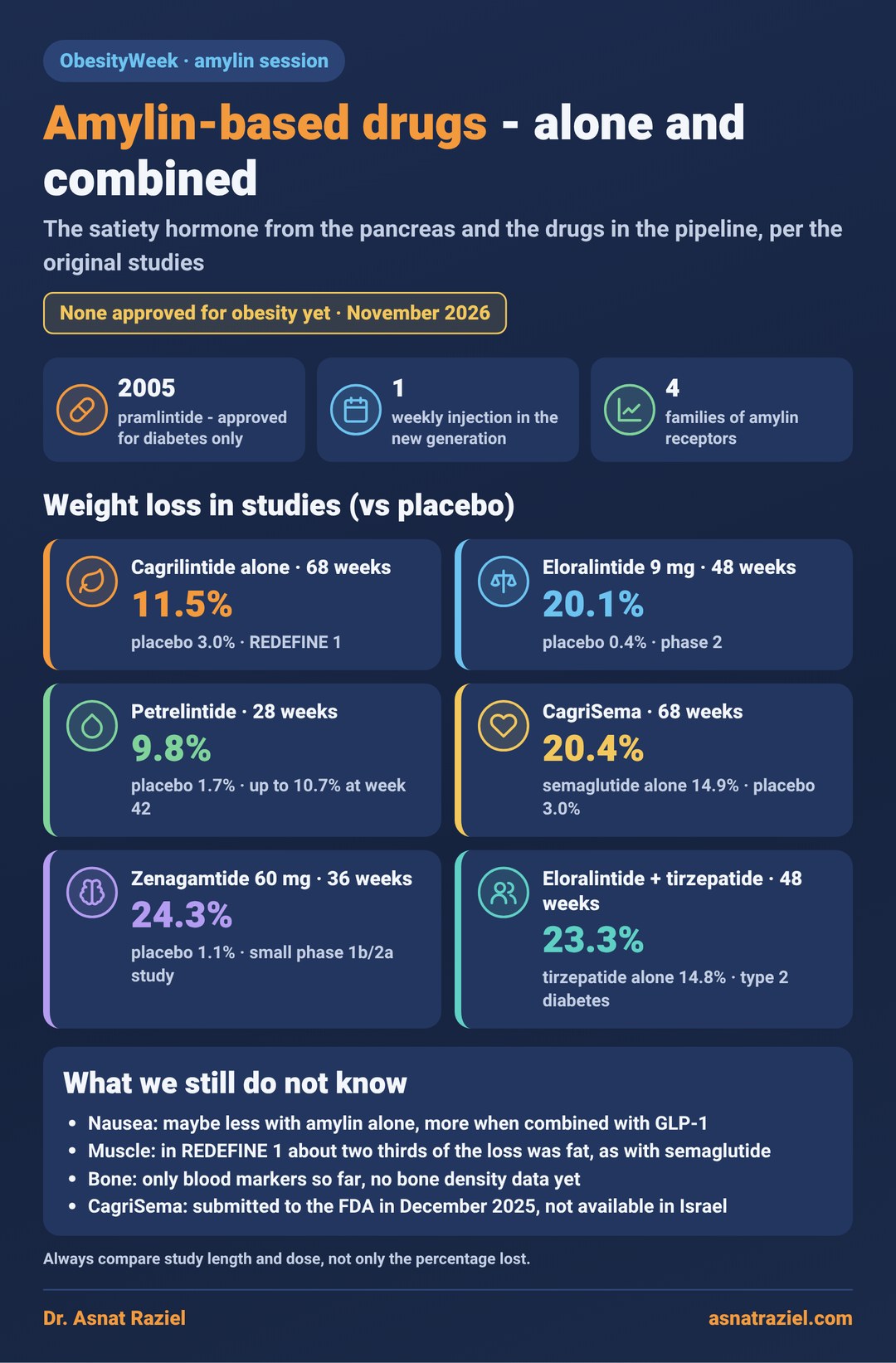
This is the oldest drug in the group, made by Novo Nordisk, and it acts on both amylin and calcitonin receptors. In a phase 2 study in The Lancet, weight loss after 26 weeks was 6.0% to 10.8%, compared with 3.0% on placebo. In the REDEFINE 1 trial, cagrilintide alone led to 11.5% weight loss after 68 weeks. Novo Nordisk is now testing it on its own in a phase 3 program called RENEW.
Eloralintide
This Lilly drug selectively targets amylin receptors. The phase 2 study published in The Lancet included 263 people for 48 weeks. At the highest dose, 9 mg, weight loss was 20.1%, compared with 0.4% on placebo. However, the speaker noted that this study was longer than others, so it is hard to know whether the drug is truly stronger or the researchers simply measured later. Phase 3 trials began in February 2026.
Petrelintide
This drug comes from Zealand Pharma in partnership with Roche. An early 16-week study measured weight loss of up to 8.6%. In the phase 2 ZUPREME-1 trial, weight loss after 28 weeks reached 9.8%, compared with 1.7% on placebo, and up to 10.7% by week 42. Nausea occurred in 20% of participants, compared with 6% on placebo. Phase 3 trials are already under way.
More amylin drugs on the way
Other drugs are at earlier stages. For example, AstraZeneca reports that lenbelintide has moved into phase 3. AbbVie’s ABBV-295 led to up to 9.79% weight loss after 12 weeks in a phase 1 study, including with monthly dosing. Pfizer is also developing a monthly amylin injection, and companies have started testing the first oral amylin pills.
Amylin-based drugs combined with GLP-1
To reach greater weight loss, amylin is combined with a GLP-1 drug. There are two ways to do this: two separate drugs in the same injection, or one molecule that acts on both receptors.
CagriSema
CagriSema combines cagrilintide 2.4 mg with semaglutide 2.4 mg in one weekly dual-chamber injection. The REDEFINE 1 trial, published in NEJM, included 3,417 people for 68 weeks. Here are the results, counting all participants:
- CagriSema: 20.4% weight loss. Among those who stayed on treatment, 22.7%.
- Semaglutide alone: 14.9%.
- Cagrilintide alone: 11.5%.
- Placebo: 3.0%.
On the other hand, nausea occurred in 55% of people on CagriSema, compared with 12.6% on placebo. In the REDEFINE 4 trial against tirzepatide, CagriSema led to 20.2% weight loss versus 23.6%, and did not meet its goal. Novo Nordisk submitted the drug for FDA approval in December 2025, and a decision is expected by the end of 2026. It is not available in Israel.
Zenagamtide, formerly amycretin
This is a single molecule that activates both the GLP-1 receptor and the amylin receptor. It is being tested both as an injection and as a pill, using the same technology that makes oral semaglutide possible. In a phase 1b/2a study in The Lancet, the injection led to 24.3% weight loss after 36 weeks at the 60 mg dose, compared with 1.1% on placebo. However, it was a small study of 125 participants, and many dropped out. Phase 3 trials began in 2026.
Eloralintide plus tirzepatide
Lilly is testing eloralintide combined with tirzepatide, which means action on three receptors. In a phase 2 study in people with type 2 diabetes, the combination led to up to 23.3% weight loss after 48 weeks, compared with 14.8% on tirzepatide alone.
How to read the numbers in these studies
The speaker gave useful advice: do not look only at the percentage of weight lost. Also check how long the study lasted, at what dose, and whether weight was still falling at the end. The stronger the drug, the longer the study needs to be to see where weight loss levels off.
To make sense of it, she offered a simple map. Weight loss of 15%-16% is roughly the semaglutide range. Weight loss of 18%-20% is the tirzepatide range. And 20%-25% is the range of CagriSema and the dual drugs.
Nausea, muscle and bone: what we still do not know
According to the speaker, amylin drugs on their own may cause less nausea, and nausea may increase when they are combined with GLP-1. However, this is an impression, not a proven conclusion. The big open question is what happens to muscle and bone. In a REDEFINE 1 substudy, about two thirds of the weight lost was fat, similar to semaglutide. In other words, there is still no proof that amylin protects muscle better. So strength training and protein matter with any treatment.
What you can do today
Amylin-based drugs are still on the way, but there is no reason to wait for them. Effective treatments are available today:
- GLP-1 and GIP drugs available in Israel, such as Wegovy and Mounjaro, lead to significant weight loss and improve blood sugar, blood pressure and heart health.
- Bariatric surgery is still the most effective treatment for large, lasting weight loss, for those who are suitable candidates.
- A diet rich in protein and vegetables, strength training twice a week, and enough sleep, at every stage of treatment.
- Basic blood tests before treatment: glucose, HbA1c (average blood sugar over the past three months), blood lipids, and liver and kidney function.
At our multidisciplinary center, we build a plan for each patient that brings together a physician, dietitian, psychologist and physical activity, and we choose the right medication or surgical treatment. When amylin drugs are approved, they will join this toolbox. Read also about nutritional deficiencies during weight-loss drug treatment and the physical activity prescription from the same conference.
Bottom line: amylin-based drugs
Amylin-based drugs are a whole family of treatments, on their own and combined with GLP-1. On their own, they lead to about 10% to 20% weight loss in studies, and the combinations reach 20% and more. However, none of them has been approved for obesity yet, and questions about nausea, muscle and bone remain open. In the end, the future looks promising, and in the meantime there are good treatments you can start today.
This article is general information and is not a substitute for personal medical advice.
References
Coadministered Cagrilintide and Semaglutide in Adults with Overweight or Obesity
This article is based on the amylin session at ObesityWeek in Washington, and the figures were checked against the original studies.