By Dr. Asnat Raziel, bariatric surgeon specializing in obesity treatment, metabolic health and healthy longevity; Director of the Multidisciplinary Center for Obesity Treatment, Assia Medical, Assuta Ramat HaChayal, Tel Aviv
Peptide regulation: why everyone is confused
Peptide regulation is one of the most confusing topics in medicine today. In the very same week, the United States eased the rules on compounding some peptides, while Israel issued a sharp warning against them. Meanwhile, athletes risk a ban for using the very same substances.
In this article, I explain what each place allows and what it forbids. I also review which peptides Americans use most and who uses them. Finally, I explain the risks that remain even when a supervised pharmacy prepares them.
Peptide regulation in Israel
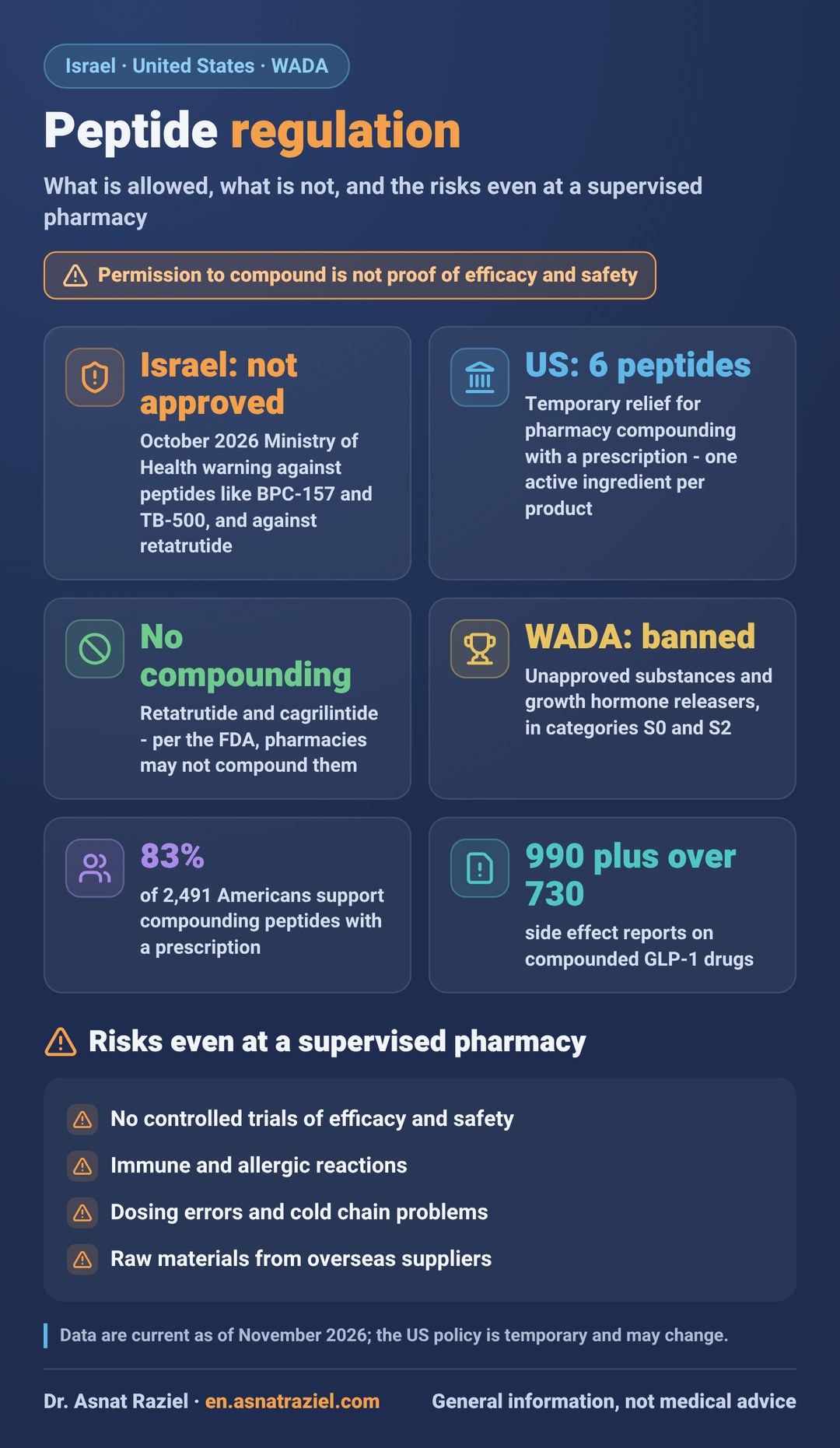
In late October 2026, Israel’s Ministry of Health issued a public warning about illegal peptides. The warning names BPC-157, TB-500, CJC-1295 and GHK-Cu, along with the experimental drug retatrutide. According to a report on mako, a ministry official confirmed that these substances had already been seized in Israel.
The message is clear: Israel has not approved these compounds for use. By contrast, pharmacies sell approved peptide drugs with a doctor’s prescription. Examples include Wegovy, Mounjaro and Foundayo for obesity treatment.
Peptide regulation in the United States: a timeline
In the United States, by contrast, the situation is far more complex. Pharmacies may compound drugs from raw ingredients only under certain conditions. To do this, the FDA sorts these ingredients into categories by level of risk.
- 2023 – the FDA moved many peptides into Category 2, meaning substances with a significant safety risk. Pharmacies could not compound them.
- April 2026 – the agency took 12 peptides out of Category 2 and scheduled an advisory committee meeting.
- July 2026 – the Pharmacy Compounding Advisory Committee backed six peptides: BPC-157, KPV, TB-500, MOTS-c, Epitalon and Semax.
- Late October 2026 – the US Department of Health and Human Services (HHS) announced a new policy. Under it, the agency will not enforce the law against pharmacies that compound the six peptides with a prescription.
What the US policy does not do
It is important to stress, however, that none of these peptides has won approval as a drug. Also, the policy is temporary, and it limits each peptide to a specific route of administration. In addition, it requires each product to contain only one active ingredient. In other words, “stacks” of several peptides are not part of the relief.
On the other hand, the FDA states explicitly that pharmacies may not compound retatrutide or cagrilintide. According to the FDA’s warning page, these substances have not been shown to be safe and effective for any condition. Note that retatrutide and CagriSema are still not approved.
Which peptides are most used in the United States?
Overall, the picture comes from two kinds of data. First, consumer surveys. Second, medical records and lab tests.
- BPC-157 – the number of new users rose 33-fold between 2020 and 2026, according to medical records.
- TB-500 – usually combined with BPC-157 for injury recovery.
- Growth hormone releasers – CJC-1295, ipamorelin and tesamorelin, for muscle and fat loss.
- GHK-Cu – for skin and hair, as a cream or an injection.
- MOTS-c – marketed as a “mitochondrial peptide” for energy and longevity.
- GLP-1 drugs – pharmacy-compounded semaglutide and tirzepatide, and gray market retatrutide.
Lab testing of 6,441 gray market samples covered fourteen substances. The list includes all the peptides above, plus cagrilintide, survodutide and PT-141.
Who actually uses peptides?
According to nference data on BPC-157, the typical user is a man of about 49. The share of men rose to 70%, and 96% of users whose race was recorded were white. Most often, the main reason for use was pain, followed by digestive problems and injuries.
In addition, a Hone Health survey of 2,491 Americans found that 83% support pharmacy compounding of peptides with a prescription. What’s more, 39% said a regulatory change would lead them to try peptides or use more. In the LGBTQ community, the PRIDE study showed that using substances to enhance appearance is common. Moreover, this use goes along with symptoms of eating disorders and muscle dysmorphia.
Peptide regulation is no guarantee: risks even at a supervised pharmacy
Suppose a US pharmacy compounded the peptide by every rule. Is it safe? Not necessarily. These are the risks that remain even then:
No proof of efficacy or safety
A compounded product does not go through FDA review before it reaches the market. Most of these peptides have no controlled human trials. For example, for BPC-157, the FDA noted limits in the safety data and problems in characterizing the active ingredient.
Immune reactions (immunogenicity)
First of all, the immune system may see peptides as foreign molecules. Small impurities from manufacturing, or proteins that clump together, raise this risk. As a result, there can be an allergic reaction, and sometimes antibodies that neutralize the compound. In the state of Victoria, Australia, health officials reported 13 cases of severe allergic reaction to unapproved peptides.
Dosing errors and the cold chain
Experience with compounded GLP-1 drugs teaches a lot. By May 2026, the FDA had received 990 reports on compounded semaglutide and more than 730 on compounded tirzepatide. In fact, some of these events came from dosing errors.
Raw materials from abroad
Similarly, even a supervised pharmacy buys its raw material from a supplier. The FDA set up an import alert to stop GLP-1 raw materials with quality problems. In other words, quality depends on every link in the chain.
Peptide regulation in sport: WADA
Finally, the World Anti-Doping Agency (WADA) is especially strict. Category S0 bans any substance not approved for medical use anywhere in the world. So WADA bans substances like BPC-157 and retatrutide at all times, even out of competition.
In addition, Category S2 bans peptide hormones and growth hormone releasers, such as CJC-1295, ipamorelin and tesamorelin. Notably, the 2027 list takes effect in January 2027. An athlete who needs medical treatment with one of these substances must apply for a therapeutic use exemption in advance.
Further reading: peptides in bodybuilding and their risks.
The bottom line
Peptide regulation differs from country to country, but one principle applies everywhere: permission to compound a substance is not proof that it is effective and safe. Israel has not approved these compounds. In the United States, the relief is temporary and partial. Meanwhile, competitive sport bans most of them outright. So anyone considering a peptide should first ask what the evidence is, who made the product and what the approved alternative is.
If you are looking for proven obesity treatment, there are many options today. I wrote about the Wegovy pill in Israel, about Wegovy at 7.2 mg and about retatrutide in clinical practice.
This article is general information only and is not a substitute for personal medical or legal advice.
References
Health Ministry warns against illegal peptides marketed for weight loss
משרד הבריאות מזהיר: חומרים מסוכנים להרזיה ולפיתוח גוף נתפסו בישראל
Tiny Chains, Big Changes? What FDA’s Latest Actions Mean for Peptide Compounding
FDA Announces Removal of 12 Peptides from Category 2 and Schedules PCAC Meetings
FDA’s Concerns with Unapproved GLP-1 Drugs Used for Weight Loss
BPC-157 ‘Wolverine Peptide’ Use Rose 33-Fold Despite Scant Evidence
83% of peptide-aware Americans want the FDA to make peptides more accessible
FDA Peptide Compounding Policy: What a Temporary Enforcement Reprieve Could Mean for Pharmacies
Increase in anaphylaxis notifications related to unapproved peptides in Victoria
FDA warns clinicians on compounded GLP-1s amid 1,700+ safety reports