By Dr. Asnat Raziel, bariatric surgeon specializing in obesity treatment, metabolic health and healthy longevity; Director of the Multidisciplinary Center for Obesity Treatment, Assia Medical, Assuta Ramat HaChayal, Tel Aviv
Sarcopenia: not only a problem of old age
Sarcopenia is the gradual loss of muscle mass, strength and function. Many people think it is simply the fate of old age. However, at the LM2026 Lifestyle Medicine Conference in Orlando, two experts painted a different picture. Dr. Aruna Nathan, an internist and lifestyle medicine specialist, and Dr. Shirish Sachdeva, a physical therapist and muscle ultrasound expert, showed that sarcopenia also appears at younger ages. It is especially common in people with chronic disease, obesity and diabetes.
What is sarcopenia, and how is it different from frailty?
According to the updated European definition (EWGSOP2), sarcopenia is a progressive disease of the skeletal muscles. The previous definition rested on muscle mass. The new one puts muscle strength and function at the center.
It helps to tell three terms apart. Sarcopenia affects the muscle itself. Frailty is a general decline across many body systems, so the body copes less well with any blow. Cachexia is muscle loss caused by a serious illness, such as cancer, with inflammation and poor appetite.
How many people have sarcopenia?
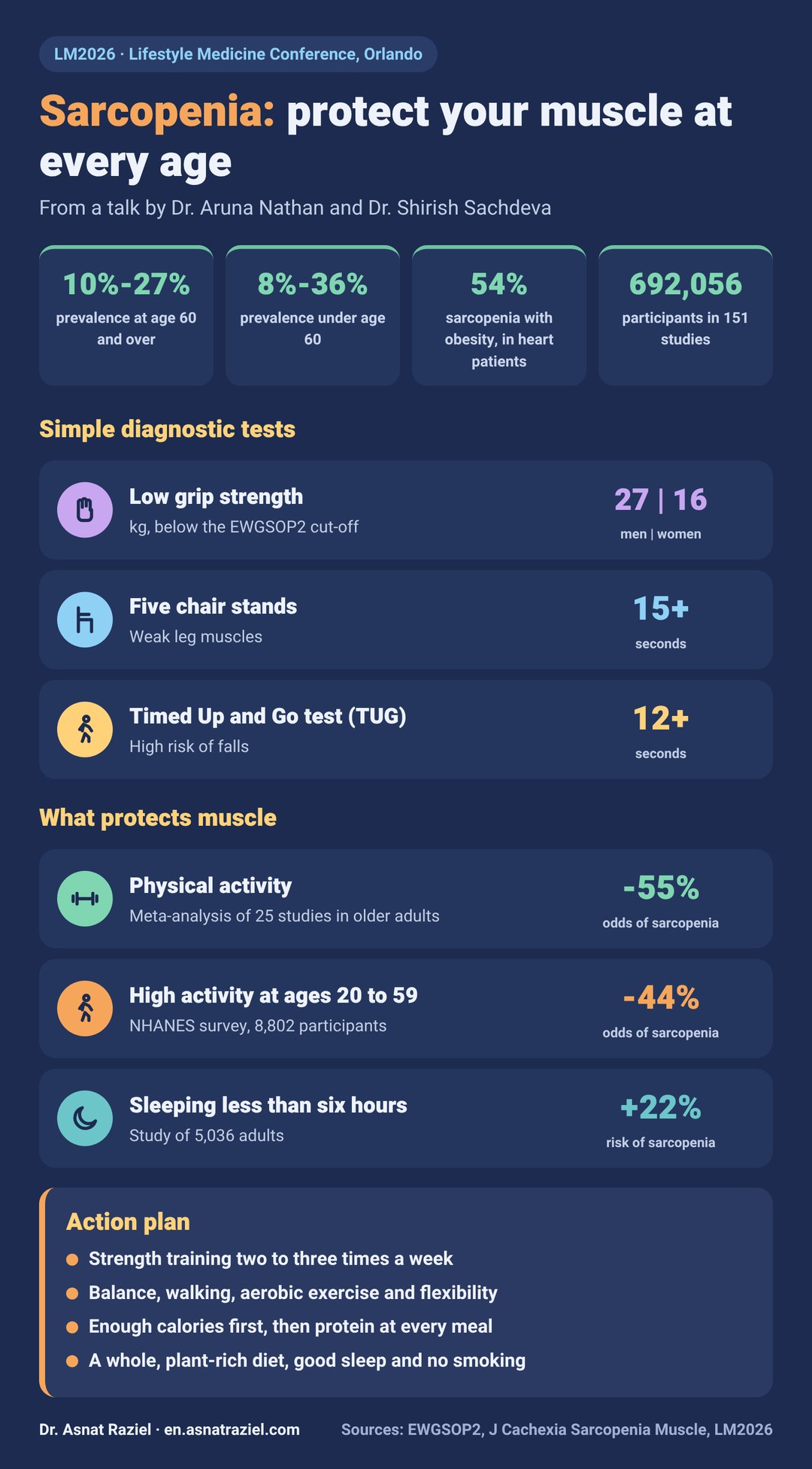
In a global meta-analysis of 151 studies with 692,056 participants, prevalence ranged from 10% to 27% at age 60 and over. Under 60, it ranged from 8% to 36%. The wide gap comes from different definitions and measurement tools. Prevalence is much higher among patients: from 18% in diabetes to 66% in advanced esophageal cancer, according to the data presented.
Obesity and sarcopenia: a cycle that feeds itself
Here the topic touches my own work with my patients directly. Obesity and belly fat often go together with low muscle mass. In a study presented at the talk, which followed 337 men with heart disease for about 20 years, sarcopenia appeared in 54% of those with obesity. By contrast, it appeared in 37% of those with overweight and in 25% of those with normal weight.
The mechanism works both ways. Less muscle leads to less movement and less energy burned, and so to more fat. At the same time, visceral fat drives inflammation, and the inflammation harms the muscle. In addition, BMI can mislead, because it does not tell fat from muscle. So waist circumference says a lot about risk.
Muscle is also the body’s biggest consumer of glucose. Less muscle means more difficulty clearing glucose from the blood, and insulin resistance gets worse. That is why protecting muscle during weight loss is part of treatment, not an extra. I also wrote about the link between obesity and muscle loss.
How do you diagnose sarcopenia in the clinic?
The speakers pointed out a familiar gap: we all know sarcopenia matters, but few of us test for it. In fact, most tests take only a few minutes:
The SARC-F questionnaire: five questions on strength, walking, rising from a chair, climbing stairs and falls. A score of 4 or more suggests possible sarcopenia. The questionnaire is accurate when positive, but misses about half of cases.
Grip strength: measured with a dedicated device (dynamometer). Below 27 kg in men and below 16 kg in women indicates low strength.
Five chair stands: more than 15 seconds points to weak leg muscles.
The Timed Up and Go test (TUG): stand up from a chair, walk three meters and come back. 12 seconds or more points to a high risk of falls.
Body composition: DXA is the clinical reference method. I wrote separately about bioelectrical impedance (BIA). In addition, BIA devices, ultrasound of the thigh muscle and AI analysis of existing CT scans can detect muscle loss early.
Treating sarcopenia: strength training at the center
Physical activity is the strongest tool. In a meta-analysis of 25 studies in older adults, physical activity lowered the odds of sarcopenia by about 55%. The picture is similar in younger people. In the NHANES survey of 8,802 Americans aged 20 to 59, people with low activity had 27% lower odds of sarcopenia. Moderate activity brought 36% lower odds, and high activity 44% lower odds.
Interestingly, in the same study, leisure activity protected better than physical work. In other words, people with physically demanding jobs still need planned training, with rest and recovery.
A meta-analysis of 12 controlled trials in people with secondary sarcopenia, for example in obesity and diabetes, showed that strength training improved grip strength and muscle mass. However, walking speed did not improve significantly. So the speakers recommended combining strength training with balance training, walking, aerobic exercise and flexibility.
Nutrition and sarcopenia: calories first, then protein
The first message was surprising: before protein supplements, make sure you eat enough. Malnutrition and sarcopenia often appear together. Among older hospital patients, the odds of malnutrition were 4.06 times higher in those with sarcopenia.
Protein alone has an inconsistent effect, because older muscle responds to it weakly. Protein combined with strength training gives the best results. Overall diet quality matters too. In the US Nurses’ Health Study, with 54,762 women, women with a high-quality diet had a lower risk of physical impairment. The MIND diet was also linked to better grip strength and function. The advice is a whole-food, plant-rich diet, similar to the Mediterranean diet.
Sleep, smoking and alcohol
Sleep: in a Chinese study of 5,036 adults, sleeping less than six hours a night raised the risk of possible sarcopenia by 22%. It also raised the risk of low grip strength by 27%. So healthy sleep protects your muscles too.
Smoking: across 29 studies, smokers had a higher risk of sarcopenia and to poorer strength, walking and balance.
Alcohol: the data are mixed. However, older women who drank heavily or binged had a higher risk.
Preventing sarcopenia: what can you do this week?
Test your strength: try to stand up from a chair five times without using your hands, and time it. Over 15 seconds is worth checking with a doctor.
Train for strength: two to three times a week, with weights, bands or body weight, gradually and with guidance. See also building muscle after 60.
Add balance and movement: daily walks and balance exercises reduce falls. See also the article on how many steps a day you really need.
Eat enough: protein at every meal, as part of a complete and varied diet.
During weight loss: especially with medication, combine strength training and protein to protect your muscle.
Bottom line
Sarcopenia is not only a matter of age. It goes hand in hand with obesity, diabetes, inactivity, poor sleep and poor nutrition. Diagnosis is simple and cheap, but still not done enough. In the end, the main treatment for sarcopenia is strength training with good nutrition. So start protecting your muscle now, and do not wait for the first fall.
This article provides general information and is not personal medical advice. Before starting a training program or changing your diet, consult your physician.
References
Sarcopenia: revised European consensus on definition and diagnosis
Global prevalence of sarcopenia and severe sarcopenia: a systematic review and meta-analysis
Longitudinal association of sleep duration with possible sarcopenia: evidence from CHARLS
Managing & Treating Sarcopenia with Therapeutic Lifestyle Medicine & Emerging Technologies – Aruna Nathan, Shirish Sachdeva, LM2026