By Dr. Asnat Raziel, bariatric surgeon specializing in obesity treatment, metabolic health and healthy longevity; Director of the Multidisciplinary Center for Obesity Treatment, Assia Medical, Assuta Ramat HaChayal, Tel Aviv
Sarcopenic obesity: when excess fat meets a shortage of muscle
Sarcopenic obesity is a dangerous combination that hardly anyone talks about. In the public conversation about obesity, the focus is almost entirely on excess fat. Yet modern medicine makes it clear that one of the most dangerous situations is not excess fat alone. Rather, it is the combination of excess fat and a shortage of muscle mass.
This condition is called sarcopenic obesity. It is becoming more common, especially in an era of rapid weight loss and treatment without proper guidance. It raises the risk of falls, disease and death, even in people who “look thinner” than before.
What is sarcopenia?
Sarcopenia is a loss of muscle mass, strength and muscle function. It develops with age, but also because of inactivity, a low-protein diet, chronic disease and rapid weight loss.
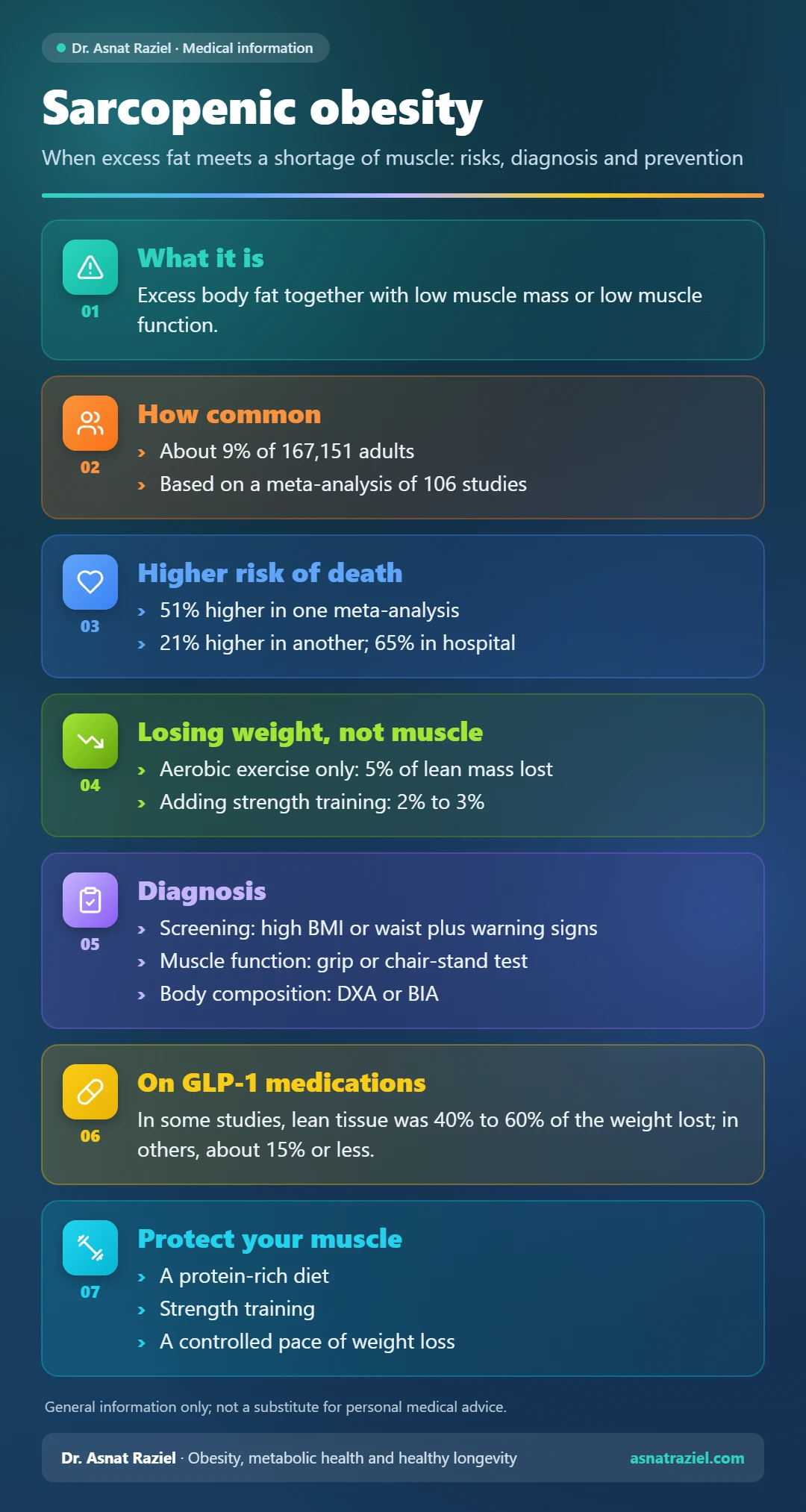
When sarcopenia appears alongside obesity, the result is a particularly complex condition. The body carries excess fat but lacks the muscle it needs for function, stability and metabolic health. In 2022, the ESPEN and EASO consensus statement, from the European societies for clinical nutrition and for the study of obesity, defined the condition as the coexistence of excess body fat with low muscle mass or low muscle function.
Why is sarcopenic obesity so dangerous?
Sarcopenic obesity isn’t just a problem of function. It is a medical condition with wide-ranging consequences. A meta-analysis of 106 studies with 167,151 adults estimated that about 9% of them had the condition. In addition, their risk of death from any cause was 51% higher than that of healthy people. Studies also link the condition to:
- Cardiovascular disease
- Metabolic disorders and insulin resistance
- Functional limitation and loss of independence
- Cognitive decline and joint disease
- Falls and fractures, because of muscle weakness
Another meta-analysis, with 50,866 participants, also found a 21% higher risk of death. Among hospitalized patients, the risk was 65% higher. Paradoxically, these are sometimes people who have lost weight and are receiving compliments, while their health is actually getting worse.
How do people get there?
The most common path to sarcopenic obesity is rapid, uncontrolled weight loss. Crash diets, prolonged fasting, medication without nutritional guidance and unsuitable exercise can all lead to significant muscle loss. When the body is in a deep calorie deficit, with no stimulus for the muscles and not enough protein, muscle becomes the first “casualty.”
The data show this isn’t just theory. In an NEJM study of older adults with obesity, those who lost about 9% of their weight with aerobic exercise alone lost 5% of their lean body mass. In contrast, those who added strength training lost only 2% to 3%.
Sarcopenic obesity: why the scale is misleading
BMI (body mass index) and body weight do not detect sarcopenia. A person can be at a “normal” or even low weight and still have a severe shortage of muscle. That’s why measuring body composition, strength and function is just as important as measuring weight, and sometimes even more so. I’ve written before about why body composition matters more than weight.
How is sarcopenic obesity diagnosed?
According to the European consensus, diagnosis begins with screening. First, doctors look for a high BMI or waist circumference, together with signs of muscle weakness. Examples include older age, chronic disease, difficulty getting up or falls. Second, they test muscle function, using handgrip strength or a chair-stand test. Finally, they measure body composition with a DXA scan, a low-radiation scan, or with BIA, which uses a weak electrical current.
The consensus divides the condition into two stages. The first stage has no complications. In the second stage, there are already complications related to body composition or muscle function. In other words, the earlier the diagnosis, the easier it is to stop the decline.
The right treatment: changing the goal
The goal of obesity treatment isn’t only to reduce fat, but to improve body composition. That means reducing excess fat, preserving and even building muscle, and improving strength, posture and function. This requires a combined approach: a protein-rich diet, physical activity with an emphasis on strength training, managing the pace of weight loss and close medical follow-up. The practical steps are detailed in my guide to preserving muscle mass during weight loss.
The role of medication
Obesity medications can be an important tool, but only within the right framework. Without a tailored diet and physical activity, even an effective treatment can lead to a body that is “thin but weak.” A review of GLP-1-based medications found that in some studies, lean tissue made up 40% to 60% of the weight lost. In other studies, it made up about 15% or less. The researchers emphasize that older age and more severe disease increase the risk of sarcopenia.
Therefore, managing treatment correctly makes it possible to reduce fat while protecting muscle, not at its expense. I have written separately about weight-loss injections and muscle loss and about new medications designed to preserve muscle.
Who is at especially high risk?
- Adults over 60
- Women after menopause
- People with repeated cycles of weight loss and regain
- Patients with chronic diseases
- People who are physically inactive
In women, the drop in estrogen levels during menopause speeds up muscle loss and the buildup of abdominal fat. That’s why this is exactly the stage at which it’s important to combine strength training with protein at every meal. I expanded on this in my guide to obesity during menopause.
In these groups, any weight-loss process must be carried out with special care. For people over 60 in particular, see my article on weight loss in older adults.
The bottom line on sarcopenic obesity
Sarcopenic obesity is a reminder that not every weight loss is a success. A body that is light but weak is not a healthy body. Responsible medicine isn’t satisfied with the number on the scale; instead, it looks at strength, function and the ability to live independently. Ultimately, muscle is a health asset. When you protect it throughout weight loss, you also protect your health, your independence and your long-term quality of life. That’s why sarcopenia and obesity should be assessed together.
The information in this article is general and does not replace personal medical advice.
References
Definition and diagnostic criteria for sarcopenic obesity: ESPEN and EASO consensus statement
Aerobic or Resistance Exercise, or Both, in Dieting Obese Older Adults
Changes in lean body mass with glucagon-like peptide-1-based therapies and mitigation strategies




