By Dr. Asnat Raziel, bariatric surgeon specializing in obesity treatment, metabolic health and healthy longevity; Director of the Multidisciplinary Center for Obesity Treatment, Assia Medical, Assuta Ramat HaChayal, Tel Aviv
How many steps a day do you really need? The message from LM2026
How many steps a day do you really need for good health? Many people are sure the answer is 10,000, and so they give up before they start. At the LM2026 Lifestyle Medicine Conference in Orlando, Michael Stack offered a far more encouraging answer. Stack is an exercise physiologist and president of the Physical Activity Alliance, the largest US coalition in the field. His message is simple: the biggest gain comes from going from nothing to a little.
Where did the number 10,000 come from?
According to Stack, few studies support a target of 10,000 steps a day. More steps are clearly better than fewer. Still, the curve is not a straight line. Risk falls sharply at the low end, and after that the drop levels off.
The graph Stack showed comes from a meta-analysis of 17 cohort studies with 226,889 participants. Each extra 1,000 steps a day was linked to a 15% lower risk of death from any cause. In addition, each extra 500 steps was linked to a 7% drop in cardiovascular death.
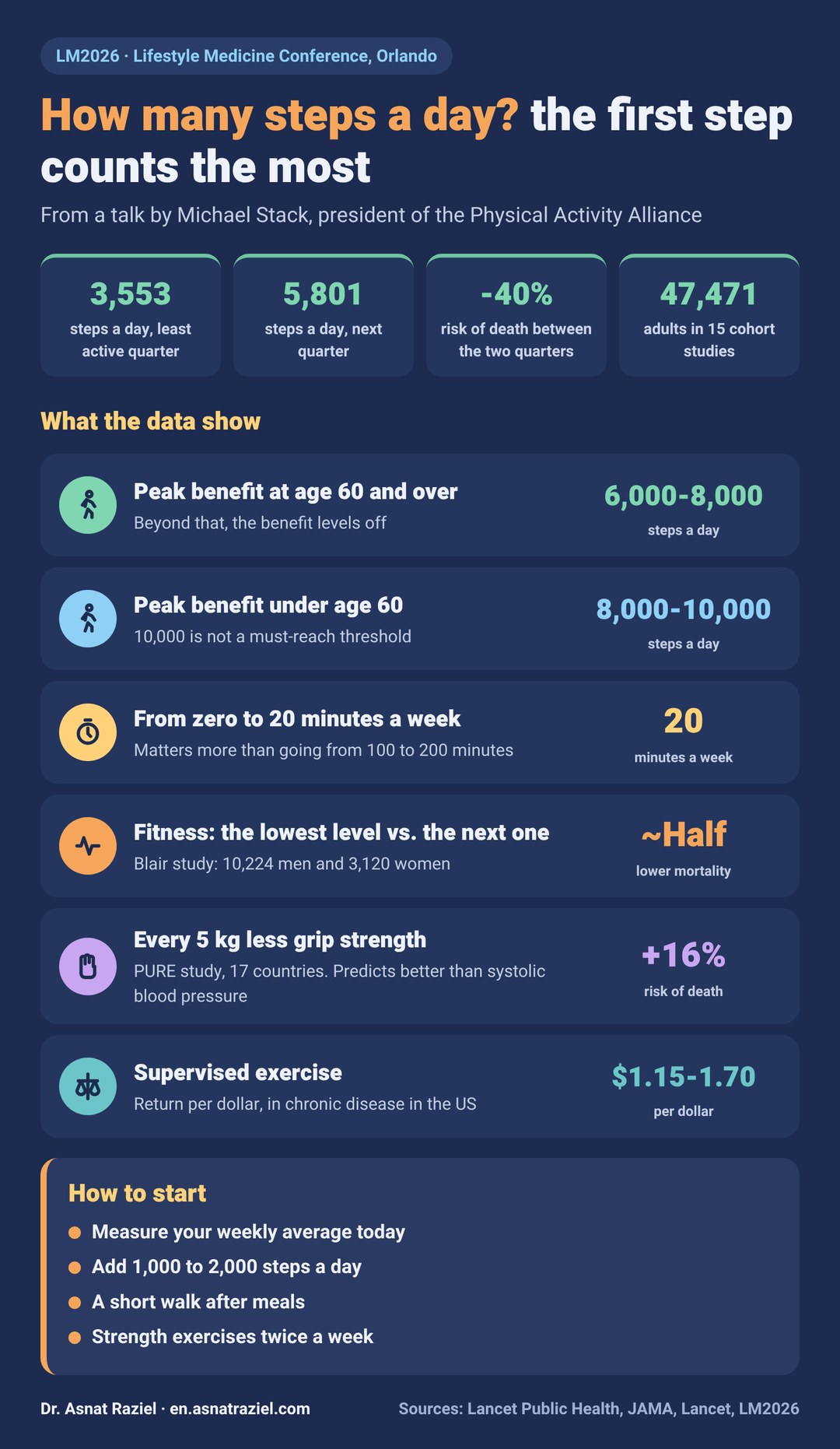
Another meta-analysis of 15 cohorts with 47,471 adults shows this well. For example, the least active quarter walked 3,553 steps a day on average. In the next quarter, at 5,801 steps, the risk of death was 40% lower. Beyond that, the benefit gradually leveled off. In people aged 60 and over, it peaked at about 6,000 to 8,000 steps. In younger adults, by contrast, it peaked at about 8,000 to 10,000 steps.
How many steps a day and how many minutes a week? Not a pass or fail test
The official US recommendation is 150 minutes a week of moderate to vigorous activity. According to Stack, the problem is not the recommendation itself. The problem is that people treat it as a test: 150 minutes is good, and 149 minutes is failure. In practice, going from zero to 20 minutes a week does more for health than going from 100 to 200 minutes.
So the question of how many steps a day you need has a personal answer. Someone who walks 2,000 steps today will gain a lot from 4,000. Therefore, there is no need to jump straight to 10,000.
An older study that still matters
Stack presented the study by Steven Blair, one of the best-known exercise physiologists in the world. It followed 10,224 men and 3,120 women who completed a treadmill test. In men, mortality fell from 64.0 per 10,000 person-years in the least fit group to 18.6 in the fittest. In women, it fell from 39.5 to 8.5.
According to Stack, the most surprising figure is at the bottom of the scale. Moving from the lowest fitness level to the one above it cut mortality by about half. In other words, going from “not fit at all” to “a little less unfit” brings the biggest gain. This runs against social media, which usually shows fitness as a hard gym workout.
Muscle strength: just as important
That said, walking is not everything. The PURE study examined about 140,000 people in 17 countries. Each 5 kg drop in grip strength was linked to a 16% higher risk of death from any cause. Moreover, grip strength predicted death from any cause and cardiovascular death better than systolic blood pressure.
Still, Stack stressed that a strong handshake does not guarantee a long life. Grip strength reflects the strength of the whole body. That is why strength training matters at every age, and especially during weight loss.
In addition, he showed a well-known set of thigh MRI scans. The thigh muscle of a 70-year-old triathlete looks almost like that of a 40-year-old triathlete. By contrast, in an inactive 74-year-old man the muscle is shrunken and surrounded by fat. The study of masters athletes aged 40 to 81 found no age-related loss of thigh muscle mass. The researchers concluded that much of muscle loss comes from disuse, not from age itself.
Beyond how many steps a day: what gets people moving?
We doctors usually talk about distant benefits: preventing a heart attack, losing weight and living longer. Stack suggested focusing on the near benefits instead. Physical activity improves sleep, reduces anxiety, lowers blood pressure and sharpens thinking. After all, our brain prefers an immediate reward to a distant one.
He also preferred the words “movement” and “activity” to the word “exercise”. “I’m not an exercise person” is a common phrase. Nobody, he said, says “movement is not for me”.
Exercise as a treatment that pays off
A large part of the talk dealt with US health policy. Stack said that government bodies there are starting to talk about prevention and paying for outcomes. According to him, policymakers do not only ask whether physical activity helps. Instead, they ask how much money it saves.
A 2025 review examined the cost-effectiveness of supervised exercise for adults with chronic conditions in the US. Overall, the researchers found a return of $1.15 to $1.70 for every dollar invested. Direct savings ranged from $121 to $2,834 per person, thanks to less use of health services. However, the review included only eight studies, and more research is needed.
How many steps a day should you aim for? Practical steps
Measure your starting point: check on your phone or watch how many steps you take today, as a weekly average.
Add a little: 1,000 to 2,000 extra steps a day is an excellent first goal.
Spread your movement: a short walk after meals also lowers glucose, as I wrote in the article on glucose sensors. Activity snacks during the day help too.
Add strength: resistance exercises twice a week, with weights, bands or body weight.
Protect your results: after weight loss, about 8,500 steps a day may help prevent regain.
Bottom line
How many steps a day you need matters less than how many you take today. The biggest jump in health comes from going from nothing to a little. In the end, a ten-minute walk counts, and 20 minutes a week beats zero. So start with the next step, and add strength training gradually.
This article provides general information and is not personal medical advice. Before starting a new exercise program, especially with heart disease or another chronic illness, consult your physician.
References
The association between daily step count and all-cause and cardiovascular mortality: a meta-analysis
Daily steps and all-cause mortality: a meta-analysis of 15 international cohorts
Physical fitness and all-cause mortality. A prospective study of healthy men and women
Chronic exercise preserves lean muscle mass in masters athletes
Exercise Into Value-Based Care – Michael Stack, LM2026, American College of Lifestyle Medicine