By Dr. Asnat Raziel, bariatric surgeon specializing in obesity treatment, metabolic health and healthy longevity; Director of the Multidisciplinary Center for Obesity Treatment, Assia Medical, Assuta Ramat HaChayal, Tel Aviv
Walking for weight maintenance: what the new research suggests
Walking for weight maintenance may be one of the simplest and cheapest tools against weight regain. For years, obesity medicine focused mainly on how to lose weight. Today, however, it’s clear that the real challenge begins after the weight comes off. Most patients succeed in losing weight at first. Even so, many of them regain it within a few years.
A study presented at the European Congress on Obesity, ECO 2026, in Istanbul offers an accessible solution. According to the researchers, walking about 8,500 steps a day may help people keep their new weight. The study was published in the journal IJERPH, and its data are especially interesting for anyone who has already lost weight.
The real challenge: not losing weight, but keeping it off
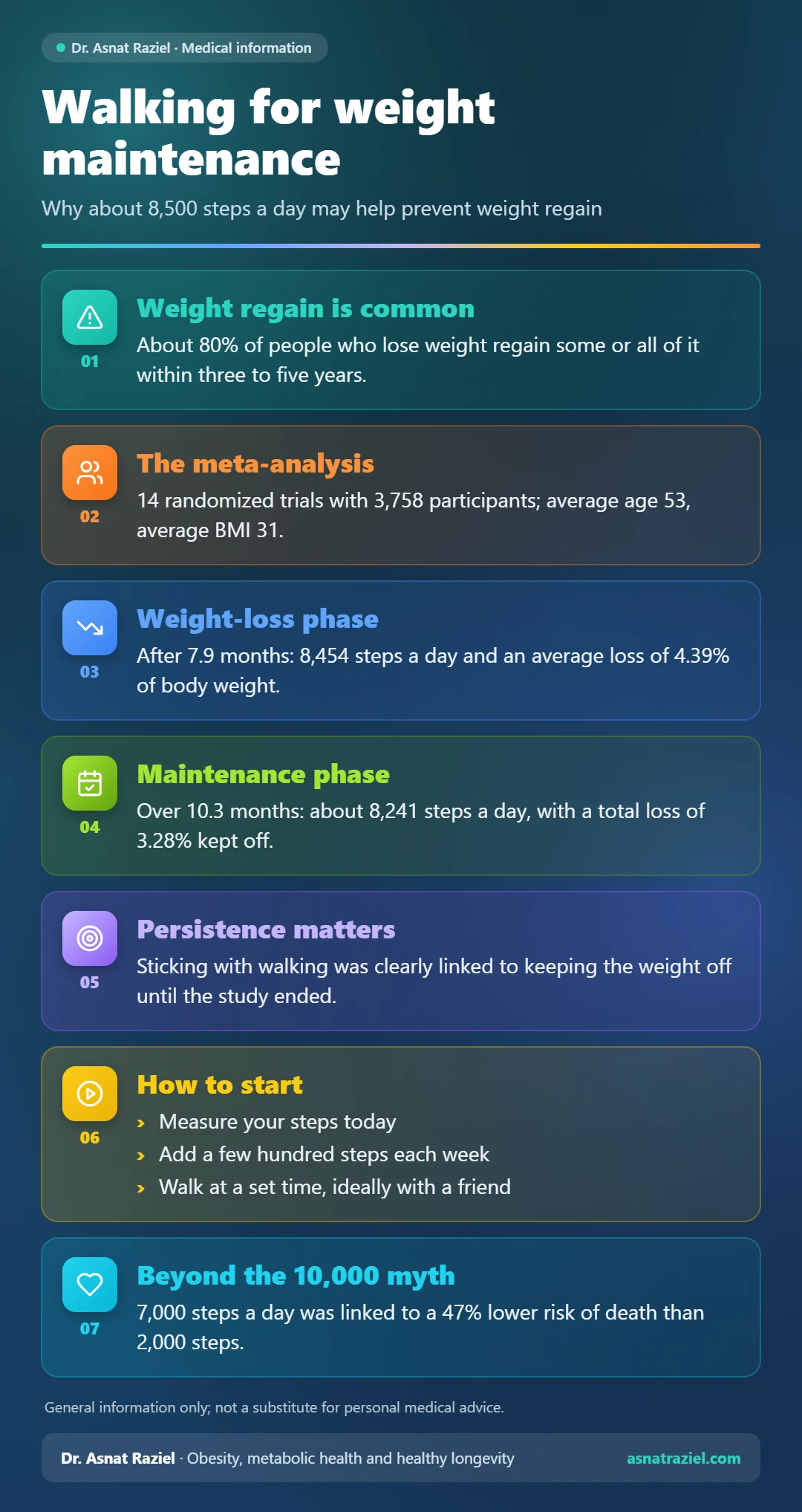
Prof. Marwan El Ghoch of the University of Modena and Reggio Emilia in Italy led the study, together with researchers from Italy and Lebanon. According to him, about 80% of people who lose weight regain some or all of it within three to five years. A well-known review found a similar picture: only about 20% manage to maintain a loss of at least 10% for a year.
It’s important to understand that this is a biological process, not a “lack of willpower.” The body protects its energy stores. It lowers energy expenditure, increases hunger and changes hormone levels. In fact, a study in NEJM showed that these hormonal changes persist for at least a year after weight loss. That is why any strategy that helps maintain weight loss has great clinical value.
A meta-analysis of thousands of participants
The researchers conducted a systematic review of 18 randomized controlled trials. Of these, 14 trials with 3,758 participants were included in the statistical analysis. The average age was 53, and the average BMI was 31. The trials took place in countries such as the UK, the United States, Australia and Japan.
The trials compared two groups. One group took part in lifestyle change programs: dietary advice, encouragement to be physically active and step-count tracking. The other group, by contrast, received diet alone or no intervention at all. In addition, the programs had two phases: a weight-loss phase and a maintenance phase.
8,500 steps a day: a small number with big meaning
At the start of the trials, both groups walked a similar amount: 7,280 steps a day in the intervention group and 7,180 in the control group. During the programs, however, things changed. By the end of the weight-loss phase, which lasted an average of 7.9 months, the intervention group reached 8,454 steps a day. At the same time, participants lost an average of 4.39% of their body weight, or about 4 kg.
The more important part came later. Even during the maintenance phase, which lasted an average of 10.3 months, participants kept up about 8,241 steps a day. Moreover, they kept off most of the weight, with a total loss of 3.28% of body weight. In the control group, on the other hand, the researchers saw no significant change in steps or weight throughout the study.
Walking for weight maintenance requires persistence
One of the most interesting findings concerned timing. In the initial weight-loss phase, step count did not necessarily predict greater weight loss. The researchers believe that diet is the main factor at this stage. In the weight maintenance phase, however, the picture is reversed.
The researchers found a clear link between sticking with walking and keeping the weight off until the end of the study. In other words, people who stayed highly active over time were much better at maintaining their weight. This finding reinforces the understanding that physical activity is not just about “burning calories.” Rather, it supports metabolism, insulin sensitivity and the preservation of muscle mass. I have also written about the importance of persistence in my article on maintaining weight after major weight loss.
Why walking is a real therapeutic tool
The great advantage of walking is its simplicity. You don’t need a gym, special equipment or money. For many patients, especially those with joint pain or low fitness, walking is the most accessible activity. In addition, it’s easy to build into your routine: walk to work, take the stairs or go for a stroll after dinner. If you want to add strength training, you’ll find an explanation in my article on aerobic vs. strength training.
So how do you get started? First, measure how many steps you walk today, using your phone or a smartwatch. Next, gradually add a few hundred steps each week. It also helps to set a regular time for walking, for example after a meal. Walking with a friend or in a group makes it easier to stick with it. Finally, if you have pain or heart disease, talk to your doctor before increasing your activity.
The 10,000-step myth
The study also helps debunk a common myth. For years, many people treated the 10,000-step goal almost as a law of nature. In reality, as Harvard researchers point out, the number came from the name of a Japanese pedometer from the 1960s, not from medical research.
What’s more, a 2025 meta-analysis in Lancet Public Health found that 7,000 steps a day was linked to a 47% lower risk of death compared with 2,000 steps. Therefore, a goal of about 8,500 steps is moderate, realistic and useful for many people.
Walking for weight maintenance in the era of obesity drugs
Obesity treatment today is multidisciplinary. Medications such as semaglutide and tirzepatide have revolutionized our ability to lose weight. Yet even with these treatments, the question of maintenance comes up again and again. For example, many people regain weight after stopping the medication, as I describe in my article on maintaining weight after stopping GLP-1 drugs.
This is why this study is so important. It reminds us that even in the era of medications, lifestyle remains part of treatment. The combination of medication, tailored nutrition, emotional support and daily activity is what makes long-term success possible. I explain how to put these together in practice in my article on combining nutrition and exercise.
The bottom line on walking for weight maintenance
The health world is busy searching for advanced technologies and breakthrough treatments. However, this study reminds us of a simple truth: sometimes small habits make the biggest difference. Walking 8,500 steps a day is not a magic solution. Even so, walking for weight maintenance is one of the most accessible strategies against weight regain. And if the fear of regaining weight weighs on you, I recommend reading about coping with the fear of weight regain.
The information in this article is general information only and is not a substitute for personal medical advice.
References
Walking 8,500 steps daily may help prevent weight regain
Long-term weight loss maintenance
Long-term persistence of hormonal adaptations to weight loss
Association of Step Volume and Intensity With All-Cause Mortality in Older Women
Daily steps and health outcomes in adults: a systematic review and dose-response meta-analysis




