By Dr. Asnat Raziel, bariatric surgeon specializing in obesity treatment, metabolic health and healthy longevity; Director of the Multidisciplinary Center for Obesity Treatment, Assia Medical, Assuta Ramat HaChayal, Tel Aviv
A continuous glucose monitor on your arm: what I learned at LM2026
A continuous glucose monitor is no longer only for people with diabetes. Today you can buy one without a prescription and watch your glucose in real time on your phone. At the LM2026 Lifestyle Medicine Conference in Orlando, I heard an excellent talk on the subject. Dr. Ayush Visaria and Prof. Souko Stogucci of Rutgers University reviewed the latest studies. Their conclusion was clear: the sensor is a great tool for learning and for changing habits, but it is not a diagnostic tool.
What is a continuous glucose monitor and how does it work?
A CGM (continuous glucose monitor) is a small device you stick on your upper arm. The needle is only used for insertion, and a thin filament stays under the skin. The filament measures glucose in the fluid between the cells, not in the blood itself. So the reading lags about 15 minutes behind the blood, mainly when glucose rises or falls quickly.
In addition, each company turns the signal into a glucose value with its own algorithm. So you should not compare numbers between devices from different companies. One sensor usually lasts 10 to 15 days. In March 2024, the US Food and Drug Administration (FDA) cleared the first over-the-counter sensor for adults who do not use insulin. Since then, healthy people have been buying it too.
How accurate is a continuous glucose monitor?
The average error of current sensors is about 8%. However, according to the talk, the FDA allows overestimation of up to 15%. On the other hand, the sensor may underestimate during a fast rise. How you use it matters as well. In the first 12 to 24 hours, local inflammation disturbs the readings. Sleeping on the arm with the sensor creates false “lows”. Vitamin C at 500 to 1,000 mg may also raise the reading falsely.
The speakers stressed three principles. First, a single spike is not a diagnosis. Second, normal glucose is not a flat line: healthy people also pass 140 mg/dL at times. Finally, there is no reason to give up fruit and whole grains just because they raise glucose a little.
Who benefits from a continuous glucose monitor? What the studies show
The picture is simple: the closer glucose is to normal, the weaker the evidence for benefit. In type 1 diabetes and in type 2 diabetes treated with insulin, the benefit is consistent. For example, the MOBILE trial in people on basal insulin showed a 0.4% drop in HbA1c (average glucose over the last three months). Time in range reached 59%, compared with 43% with a regular glucose meter.
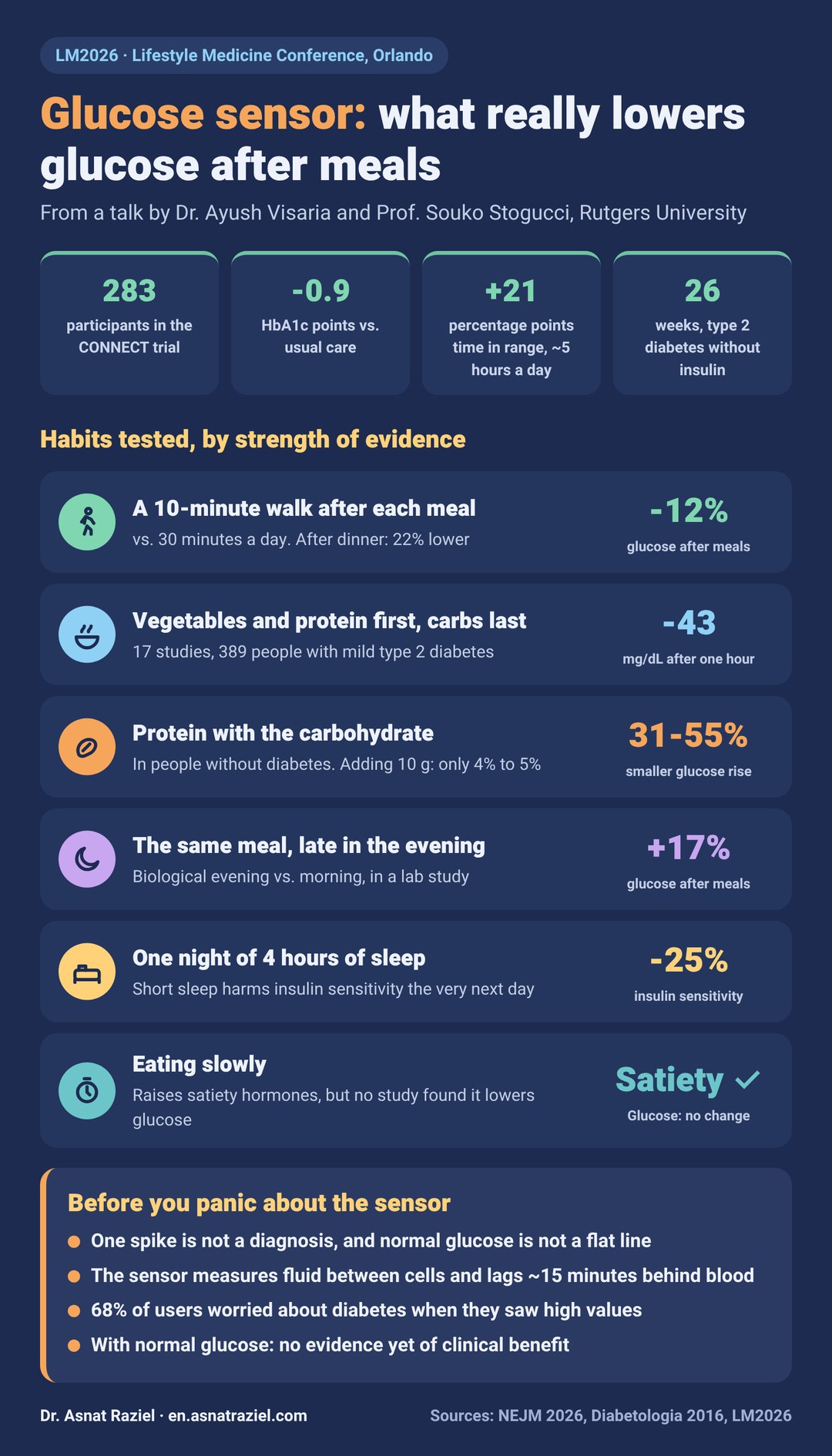
In October 2026, the CONNECT trial appeared in NEJM. The researchers studied 283 adults with type 2 diabetes who do not use insulin, in 22 primary care clinics in the US, for 26 weeks. In the sensor group, HbA1c fell from 8.8% to 7.2%. In the usual care group, it fell from 8.7% to 8.0%. That is a 0.9 percentage point difference in favor of the sensor. Time in the 70 to 180 mg/dL range rose by 21 percentage points, about five more hours a day. No severe lows occurred.
However, Dexcom, the sensor’s maker, funded the trial. We still do not know how long the effect lasts. Moreover, much of the benefit fades when people stop using the sensor. In the MOBILE extension, time in range dropped from 62% to 50% within six months of stopping.
And in prediabetes or in healthy people?
In prediabetes the picture is modest. In a 12-week study, an app with a sensor added 31.5 minutes a day in the 70 to 140 mg/dL range. But HbA1c did not change. No study has yet shown that the sensor prevents diabetes. In people with normal glucose, there is currently no evidence of clinical benefit.
Does the sensor change behavior? Studies show small, short-term changes: 20 grams less carbohydrate a day, 71 fewer calories a day and 16 more minutes of activity. The certainty of the evidence is low, and most studies are short.
Five ways to lower glucose after meals
The practical part of the talk asked what really works, with or without a continuous glucose monitor. These are the habits studied, by strength of evidence.
1. A short walk after the meal
This has the strongest evidence. In a study from New Zealand, people with type 2 diabetes walked ten minutes after each meal. Glucose after meals fell by 12%, compared with one 30-minute walk at any time of day. After dinner, the drop reached 22%. In contrast, activity before the meal had no effect. Short breaks from sitting, every 15 to 20 minutes, also lowered glucose. Still, long-term benefit has not been proven.
2. Meal order: vegetables and protein before carbs
In a meta-analysis of 17 studies with 389 people with mild type 2 diabetes, eating the carbohydrate last lowered glucose by 43 mg/dL after one hour. After two hours the difference was 13 mg/dL, and HbA1c fell by 0.16%. In people without diabetes, the effect is much smaller. Most studies used rice meals in Japan, Singapore and Korea.
3. Adding protein, fiber and vinegar
Protein with the carbohydrate cut the glucose rise by 31% to 55% in people without diabetes. But a realistic 10 grams of added protein cut it by only 4% to 5%. Beta-glucan from oats reduced the glucose rise by 23%. Vinegar has a modest effect, and the certainty of the evidence is very low.
4. An earlier dinner
The exact same meal raises glucose more in the evening, and a continuous glucose monitor shows this well. In a lab study, glucose was 17% higher in the biological evening than in the morning. So it is worth paying attention to meal timing too.
5. Good sleep and stress management
One night of four hours of sleep lowered insulin sensitivity by about 25%. Women who slept 1.3 hours less for six weeks developed more insulin resistance. Acute stress raised glucose after a meal by 27 mg/dL in people with type 2 diabetes. Mindfulness programs lowered HbA1c by 0.35% up to a month after the program, but not after six months. Still, good sleep and less stress matter for health in any case.
What about eating slowly? Eating slowly raises satiety hormones. However, no study found that it lowers glucose after meals. Sometimes glucose even rose slightly.
How to read a continuous glucose monitor: the SIGNAL method
The speakers compared reading a sensor to reading an ECG. To avoid missing a finding, go through the same steps every time:
S – Signal: Is the reading reliable? Look for gaps, compression lows and errors.
I – Safety: First, look for significant lows.
G – The big picture: Mean glucose, GMI (an estimate of HbA1c) and time in range, based on at least two weeks of data.
N – Variability: How much glucose swings. High variability may appear before the mean rises.
A – The shape of the day: Night, morning and each meal separately. Here you ask what caused a rise.
L – Link and learn: Connect the pattern to its context, and test one change at a time.
A case from the talk: a spike in a healthy woman
Rebecca is 33, healthy, with an HbA1c of 5.0%. She bought a sensor and was alarmed by a spike to about 190 mg/dL after dinner. The speakers listed 10 to 15 possible explanations: the evening hour, meal order, sauces and fats, alcohol and more. In the end, it turned out that Rebecca had eaten low-carb for almost a year, and then ate a high-carb meal. In that situation the fast insulin response weakens, and glucose spikes. It is not necessarily a sign of disease.
A second case showed an important principle: glucose is the result, and insulin is the engine. Two patients can have exactly the same curve. In the scenario presented, one had a fasting insulin of 26 and the other 3. The first is already compensating for insulin resistance. In other words, the curve alone does not tell the whole story.
A personal experiment with a continuous glucose monitor: three days, one meal
In the speakers’ view, the sensor is most useful as a measure of habit change. They suggested a simple personal experiment. Eat the same meal on three different days:
Day one: your usual meal, with no walk.
The next day: the same meal, followed by a 10 to 15 minute walk.
Day three: the same meal, but vegetables and protein first and carbs last.
Repeat each change a few times before drawing a conclusion. This way you find out what works for you.
The other side of a continuous glucose monitor: worry and gaps
In people with diabetes, controlled studies found no psychological harm. Skin irritation, however, is common. In people without diabetes, the picture is less clear. In a survey of 56 users, 68% worried about diabetes when they saw high values. Distress stood out among young people and people with obesity. On the other hand, 89% reported a positive change in diet or activity.
Reviews also describe anxiety, compulsive phone checking, needless food restriction and sleep disturbed by alerts. No study has yet tested whether the sensor triggers new eating disorders. As the speakers put it, the absence of measurement is not proof of safety. In addition, access to sensors is not equal, and most studies were done in specific populations.
Should you use a continuous glucose monitor?
If you have diabetes, and especially if you use insulin, the sensor helps, and it is worth discussing with your doctor. In diabetes without insulin, the new evidence strengthens the case for benefit. Benefits have also been studied in diabetes during pregnancy. If your glucose is normal, the sensor can teach you about your body. But use it for a short period, with guidance, and look for patterns rather than single numbers.
In the end, the habits themselves are what matter. A walk after meals, vegetables before carbs, an earlier dinner and good sleep help even without a sensor. They are also the basis of type 2 diabetes remission through lifestyle.
Bottom line
A continuous glucose monitor is a learning tool, not a diagnostic tool. One spike is not a disease, and normal glucose is not a flat line. Use it to test habits, not to fear food. Before changing your diet based on the readings, consult a doctor or a dietitian.
This article provides general information and is not personal medical advice. Consult your physician before any change in treatment.
References
Continuous Glucose Monitoring in Non-Insulin-Treated Type 2 Diabetes
FDA Clears First Over-the-Counter Continuous Glucose Monitor
How to Use Continuous Glucose Monitoring to Improve Personalized Lifestyle and Nutrition Counseling – LM2026, American College of Lifestyle Medicine
The CONNECT trial was funded by Dexcom, the sensor’s maker.