By Dr. Asnat Raziel, bariatric surgeon specializing in obesity treatment, metabolic health and healthy longevity; Director of the Multidisciplinary Center for Obesity Treatment, Assia Medical, Assuta Ramat HaChayal, Tel Aviv
Fasting-mimicking diet cycles: what Prof. Longo presented at LM2026
Fasting-mimicking diet cycles are moving from the lab into the clinic. At the LM2026 lifestyle medicine conference, Prof. Valter Longo presented the latest data. He directs the Longevity Institute at the University of Southern California (USC), and he developed the method. Beyond biological age, he showed controlled trials in type 2 diabetes, Crohn’s disease and kidney disease. He also reviewed early data from cancer treatment, and a new study on what to eat for the rest of the month.
I have already written an overview of the method and longevity, covering the first studies. Here I focus on what is new: specific diseases, the actual numbers, and what it means for you. I checked the original studies he presented and linked to them throughout.
What is a fasting-mimicking diet, and why in cycles?
The Fasting Mimicking Diet, or FMD, is a five-day eating plan done once a month. Yigal Kotin, a naturopath and fasting expert, wrote a detailed review of it on Mako (in Hebrew), and you can find more on his website. The plan is low in calories, sugar and protein, and rich in unsaturated fats. For the rest of the month you eat normally. The goal is to make the body respond as it does to a water-only fast, while still eating.
Longo first developed a diet for mice that matched water fasting on key markers. For example, it lowered IGF-1, insulin-like growth factor 1, a hormone linked to aging. It also lowered blood sugar and raised ketone bodies. So this is a precise menu, not simply eating less.
He opened the lecture with a sobering point. Smoking and obesity are important risk factors for cancer, heart disease and Alzheimer’s. Yet the effect of thirty years of aging, from age 35 to 65, is far larger. In other words, slowing the aging process may affect several diseases at once. That is the idea behind longevity medicine.
Fasting-mimicking diet cycles and biological age
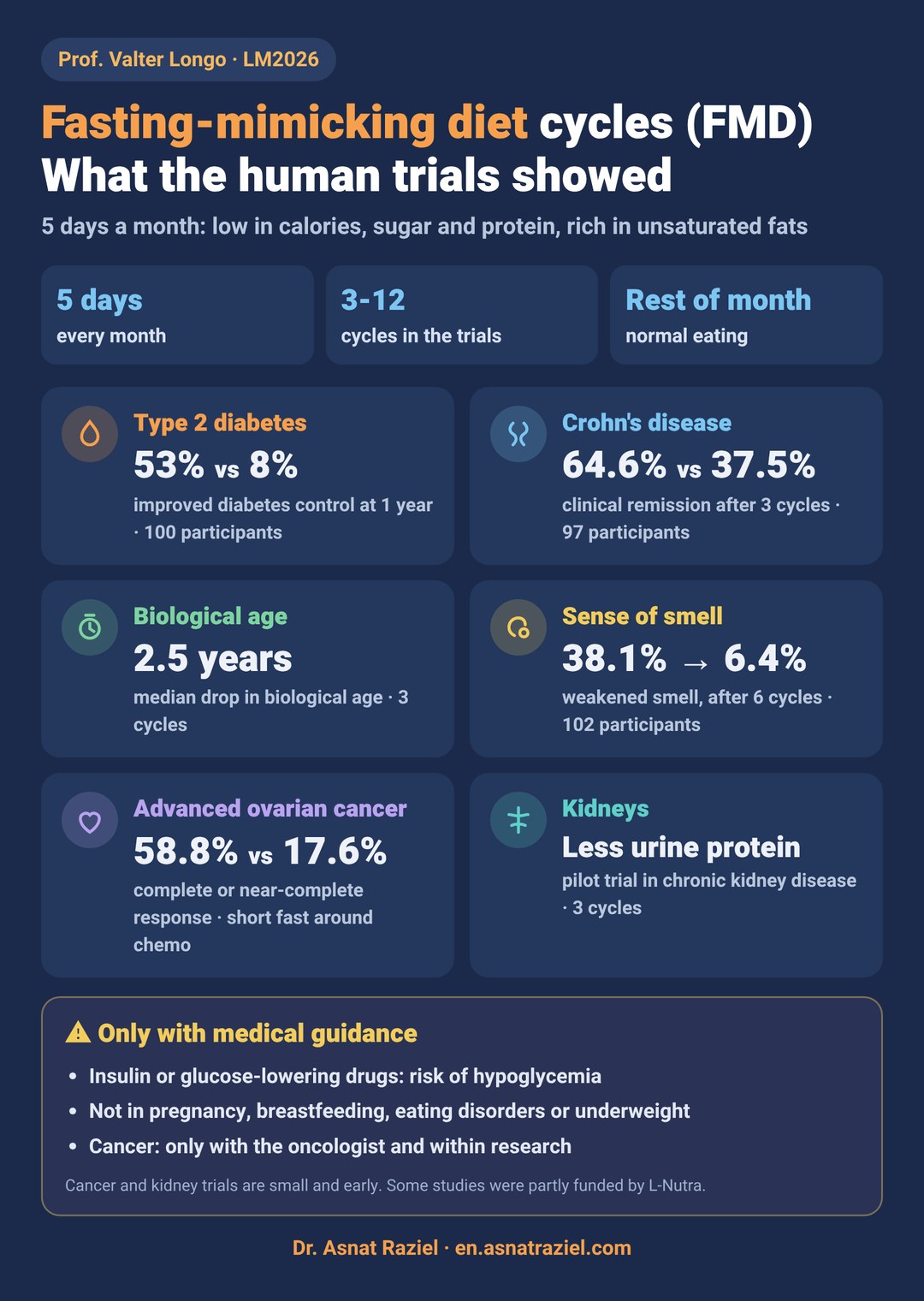
The first randomized trial included 100 healthy participants in the United States. They followed the diet for five days a month, for three months. Three cycles reduced body weight, abdominal and total body fat, blood pressure and IGF-1. The researchers reported no serious adverse effects.
Moreover, the improvement was clearest in people at risk. For example, in participants with high blood sugar, high CRP (a blood marker of inflammation) or high cholesterol. In healthy participants the changes were much smaller.
According to an analysis of two trials, three cycles came with a 2.5-year drop in median biological age. Weight loss alone did not explain this drop. In another trial he showed, which compared the diet with a Mediterranean diet, the Mediterranean group lost lean mass. By contrast, after four fasting-mimicking cycles, participants kept their lean mass.
Fasting-mimicking diet cycles in type 2 diabetes
The most practical result in the lecture came from a controlled trial in the Netherlands, at Leiden University. The researchers enrolled 100 people with type 2 diabetes and a BMI of 27 or more. All of them took metformin alone, or managed with diet alone. Half of them did a five-day cycle every month, alongside usual care from their family doctor, for a year.
After one year, diabetes control improved in 53% of the diet group, compared with 8% of the control group. On the other hand, control worsened in only 23% of the diet group, compared with 59% of controls. In addition, HbA1c (average blood sugar over the past three months) fell by 0.3% compared with controls. Weight fell by 3.6 kg compared with controls, and the need for glucose-lowering drugs went down.
It is worth knowing that the study was partly funded by L-Nutra, the company that makes the meal kit. Even so, the people who assessed the results did not know which group each participant was in.
Smell and taste improve too
An Italian crossover trial included 102 participants with overweight or obesity. They completed six monthly cycles. The share of people with a weakened sense of smell fell from 38.1% at the start to 6.4% after six cycles. Cardiometabolic and inflammatory markers also fell, and people with diabetes used fewer drugs.
Crohn’s disease: a controlled trial in Nature Medicine
This year a randomized controlled trial was published in mild to moderate Crohn’s disease, with 97 participants. Participants followed the diet for five days a month, for three months, and ate their usual diet the rest of the time. The control group kept eating as usual.
After three fasting-mimicking diet cycles, clinical response was much better: 69.2%, compared with 43.8% in controls. In addition, 64.6% reached clinical remission, compared with 37.5%. Fecal calprotectin, a marker of gut inflammation, fell by 22.0%, while in controls it rose by 8.0%. These findings fit with what we are learning about gut bacteria and inflammation. However, this was an open-label trial, meaning participants knew which group they were in.
Kidneys: from rats to a first trial in patients
In a study published in Science Translational Medicine, the researchers developed a low-salt version of the diet. In rats with kidney damage, the cycles brought protein in the urine back to normal and restored kidney structure. The researchers also saw genes from kidney development switch back on.
Next, in a small pilot trial in patients with chronic kidney disease, participants completed three cycles. The cycles reduced protein loss in the urine and improved the function of blood vessel walls. In earlier mouse studies Longo presented, the cycles even promoted regeneration of insulin-producing cells. Still, animal findings are not proof of a cure in humans.
Fasting-mimicking diet cycles alongside cancer treatment
This is the most sensitive part of the lecture, so I will be especially precise. An Italian study tested the method in 101 cancer patients, alongside their usual oncology treatment. The diet was safe and feasible. It lowered blood sugar and growth factors, and changed how the immune system acted against the tumor. Longo noted that five patients with advanced tumors achieved a complete and lasting response.
In triple-negative breast cancer, the BREAKFAST trial included 30 patients with early-stage disease. They did a five-day cycle every three weeks, alongside chemotherapy before surgery. Rates of complete tumor disappearance at surgery were high. According to the figure he presented, event-free survival at three years was 86.7%, compared with 65.8% with chemotherapy alone at the same center. This comparison is not randomized, so it should be read with caution.
At the ASCO meeting, a randomized trial in advanced ovarian cancer tested short-term fasting rather than the full meal plan. Thirty-six women fasted from 36 hours before each chemotherapy session until 24 hours after it, with up to 350 calories a day. Of these, 58.8% had a complete or near-complete response, compared with 17.6% on a free diet. The researchers found no meaningful difference in chemotherapy toxicity.
The practical conclusion is clear: with cancer, any kind of fasting is done only in full coordination with the oncologist. The researchers themselves stress that large trials are needed before recommendations change.
The longevity diet: what to eat for the rest of the month
At the end of the lecture, Longo presented a new study in Cell Metabolism. In mice, the researchers compared several eating patterns: Western, ketogenic, and a low-protein longevity diet. The Western and ketogenic diets increased fat mass and frailty. By contrast, a mostly plant-based diet with fish reduced fat and frailty and improved heart and metabolic markers.
The key condition was a moderate supplement of methionine, an essential amino acid. Without it, a low-protein diet may increase frailty. In addition, the diet raised growth hormone, GLP-1 and FGF21, while keeping IGF-1 low. In other words, in the mice the body itself boosted the hormone on which the new weight-loss drugs are based.
Alongside this, an analysis of data from about 200,000 men and women in the United States showed a striking link. Among those who ate the most animal protein, type 2 diabetes was roughly twice as common. This is an observational study, which shows a link, not cause and effect. If you want to get started, read about plant protein sources.
Who are fasting-mimicking diet cycles for, and who should avoid them?
Longo himself advises against improvising, and recommends doing the diet with a doctor’s guidance. In addition, patients on insulin or drugs that sharply lower blood sugar are at risk of hypoglycemia. Note that the Dutch trial included only patients on metformin or diet alone.
In my view, the method is not suitable during pregnancy or breastfeeding, or for people with eating disorders. People who are underweight, frail older adults, and cancer patients without oncology guidance should also avoid it. The common side effects are fatigue, weakness and headache, usually mild.
Finally, keep in mind that Prof. Longo has a financial interest in L-Nutra, the company that markets the program. Some of the trials were small or open-label. So the data are promising, but they do not yet replace proven drug treatment.
What you can do today
First, if you have type 2 diabetes, fatty liver or high blood pressure, ask your doctor whether fasting-mimicking diet cycles suit you. In my clinic I combine tools like this within a plan for diabetes remission, together with medication adjustment.
Second, the rest of the month matters just as much. Choose a mostly plant-based diet, with fish, legumes, nuts and olive oil. Third, add strength training to preserve muscle mass while losing weight. If daily fasting suits you better, read also about intermittent fasting and the biological clock.
Bottom line
Fasting-mimicking diet cycles are no longer just an experimental idea. In type 2 diabetes and Crohn’s disease there are controlled trials with real clinical results. In kidney disease and cancer the picture is promising, but early. The method fits well within lifestyle medicine, which aims to prevent chronic disease and not only to treat it.
This article is general information and is not a substitute for personal medical advice.
Questions and answers
How often do you do the diet?
In the trials, a five-day cycle was done once a month, for three to twelve months. It is best to set the right frequency with your doctor.
Can the method be combined with obesity medications?
The trials presented did not test this combination. So if you take medication for obesity or diabetes, do it only with close medical supervision.
Do you need to buy a ready-made kit?
Most trials used a precise, packaged menu. A home-made menu has not been tested to the same standard, so it is best built with a dietitian.
References
Short-Term Fasting Around Chemotherapy May Improve Treatment Response in Ovarian Cancer
הצום שמאריך חיים: הכל על תזונת ה־FMD
Disclosure: the Dutch trial was partly funded by L-Nutra. Prof. Longo and the University of Southern California have a financial interest in the company.