By Dr. Asnat Raziel, bariatric surgeon specializing in obesity treatment, metabolic health and healthy longevity; Director of the Multidisciplinary Center for Obesity Treatment, Assia Medical, Assuta Ramat HaChayal, Tel Aviv
Exercise and the brain: far more than medicine
Exercise and the brain are linked in ways that go far beyond burning calories. This week, at the LM2026 conference of the American College of Lifestyle Medicine (ACLM), I listened to a fascinating keynote. Dr. John J. Ratey, a psychiatrist at Harvard Medical School, presented “the next chapter” in the science of movement and the brain. His message is simple: movement builds the brain, not just the body.
Ratey opened with a quick exercise. The whole audience stood up, stretched their arms forward, pulled them back with a shout of “boom,” and bent down to touch the floor. “Now we’ve turned our brains on,” he said. The title of his talk summed it up: exercise is good for your body, but it is even better for your brain.
In his view, movement shapes mood, attention, learning, stress regulation and social connection. That is why he proposes a broad idea of Mental Fitness. It means more than coping with pressure. Rather, it is the capacity to think, learn, adapt, connect with others and live fully.
It all started with one patient
Ratey shared how he came to the field. A well-known professor at Harvard and MIT, a lifelong marathon runner, came to see him after a knee injury. Since he had stopped running, he struggled to start and finish tasks, got angry and forgot things. In effect, he had developed symptoms of attention deficit disorder that he had never had before. Ratey treated him with medication, and his symptoms improved. After rehab, the professor went back to running about seven miles a day, and later he was able to stop the medication.
What we learned from SPARK
In 2008, Ratey published the book SPARK. It explained how movement changes the brain. First, exercise boosts the activity of neurotransmitters. It also improves blood flow to the brain and triggers the release of growth factors, which Ratey calls “Miracle-Gro for the brain.”
One study that shaped his thinking came from the lab of Prof. Carl Cotman at the University of California, Irvine. Mice with a running wheel ran an average of 4.5 km per night. Within about ten days, their scores on maze learning tests rose by 50%. In addition, their cortex grew thicker, the hippocampus grew, and BDNF levels rose by about 200%.
BDNF (brain-derived neurotrophic factor) is a protein that supports brain plasticity, learning and memory. Thanks to it, nerve cells form new and stronger connections more easily. According to Ratey, no other factor we know of today does this as well as movement.
Eight areas where movement helps the brain
Ratey summarized the chapters of his book in eight main areas:
Learning: movement strengthens attention, memory and the brain’s capacity to adapt.
Stress: it helps regulate the stress response and build resilience.
Anxiety: regular activity can reduce anxiety symptoms and ease physical tension.
Depression: training improves mood and can reduce symptoms.
Attention deficit: movement supports focus, self-regulation and executive function.
Addiction: physical effort can help manage cravings and support recovery.
Hormonal changes: movement may ease mood symptoms during hormonal transitions.
Aging: finally, it helps preserve thinking, function and independence.
Exercise and the brain in ADHD
According to Ratey, the thinking brain evolved as an “internalization” of movement. The planning and inhibition areas at the front of the brain grew to control skilled movement. That is why active nerve cells grow and connect, while inactive ones erode. In this sense, the brain is like a muscle, and the link between exercise and the brain runs deep in our evolution.
Ratey described ADHD as “a Ferrari brain with bicycle brakes.” Exercise strengthens the prefrontal cortex, in other words the brakes. As a result, it supports working memory, attention, self-control, decision-making and cognitive flexibility. In a study from the University of Illinois, sixth graders walked for 20 minutes between two EEG tests. After the walk, the test showed more active brain activity. Ratey’s takeaway: even a short walk gets the brain ready to learn.
The largest review yet on exercise and the brain
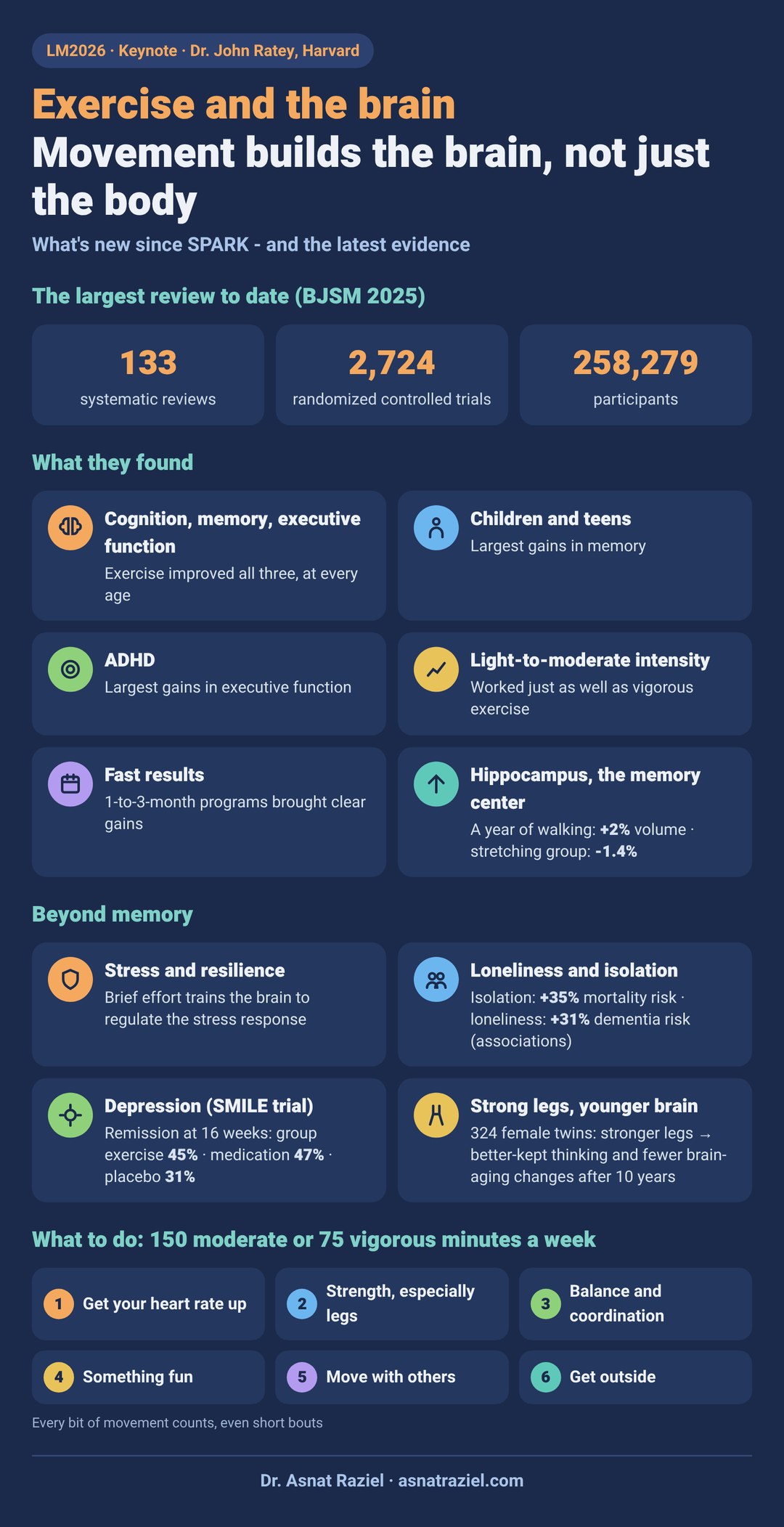
Since SPARK, the number of studies in this field has soared. Ratey presented an umbrella review published in 2025 in the British Journal of Sports Medicine. The researchers pooled 133 systematic reviews, covering 2,724 randomized controlled trials and 258,279 participants. It is the largest synthesis to date on physical activity and thinking skills.
The result is clear: exercise improved general cognition, memory and executive function. Executive functions are the abilities to plan, organize, control impulses and stay focused. Children and teens saw the largest gains in memory. In contrast, people with ADHD saw the largest gains in executive function.
Moreover, light-to-moderate intensity worked just as well as vigorous exercise. Short programs, lasting one to three months, also delivered especially good results. According to the researchers’ announcement from the University of South Australia, yoga and tai chi had a particularly strong effect on memory. Exergames (video games that require you to move) especially improved general cognition. In addition, the findings held up even without the lower-quality reviews. In other words, this is not a fluke of weak studies.
Exercise and the aging brain
Ratey described a study of mostly sedentary people in their sixties and seventies. They began walking briskly three times a week. After six months, MRI scans showed increases in both gray and white matter. Today, a review of 59 randomized trials with more than 5,000 participants strengthens that finding.
A well-known trial by researchers in Pittsburgh and Illinois showed this too. In the trial, 120 older adults walked for up to 40 minutes, three times a week, for a year. Their hippocampus, the brain’s memory center, grew by about 2%, and their spatial memory improved. In contrast, in the stretching group the hippocampus shrank by about 1.4%.
Ratey’s message is clear: the goal is not to make everyone’s brain bigger. The goal is to resist the erosion that comes with age. I wrote more about daily steps and dementia risk in my article on walking and Alzheimer’s.
Walking speed: a vital sign
Ratey presented walking speed as a true vital sign. How fast we walk reveals a lot about our brain and our future health. In his words, walking improves thinking, and the faster the pace, the better. It also supports brain volume, protects against metabolic syndrome and predicts future health.
He relied, among other sources, on a review by Mayo Clinic researchers. According to the review, aerobic exercise may reduce the risk of dementia and may even slow its progression. Ratey also mentioned walking as a tool in Parkinson’s disease.
Exercise and the brain in depression
Hippocrates already recommended walking for people who were depressed. Ratey presented the Duke University studies that tested this. In the SMILE trial, 202 adults with major depression received group aerobic exercise, home exercise, an antidepressant (sertraline) or a placebo pill. After 16 weeks, 45% of those in the group exercise arm reached remission. In the medication group, 47% reached remission, and in the placebo group, 31%.
In other words, regular exercise achieved a result similar to medication. This is one of the clearest examples of the link between exercise and the brain. Ratey explained that movement acts on the same systems that psychiatric medications target: serotonin, dopamine and norepinephrine. Beyond that, it releases endorphins, endocannabinoids (the body’s own cannabis-like compounds) and myokines (proteins released by working muscle that reach the brain). Ratey called it “a biochemical symphony.”
Exercise and the brain: muscles talk
Strength training is not just about muscle. During effort, muscles send signals to the brain. They include IGF-1, an insulin-like growth factor, and VEGF, a factor that promotes the growth of blood vessels. These signals support brain health and adaptation. At the same time, BDNF supports the plasticity of connections between nerve cells, learning and memory.
Striking evidence came from a twin study at King’s College London. The researchers followed 324 female twins aged 43 to 73. The twin with stronger legs at the start kept her thinking skills better, and ten years later her brain showed fewer signs of aging. That is why Ratey recommends strength training, especially for the legs. He demonstrated a “wall sit,” holding it from 10 seconds up to a minute. At 78, he said, he himself had recently done 460-pound leg presses, ten repetitions. For how to train safely, see my article on strength training and muscle mass.
The cerebellum: far more than movement
About 80% of the brain’s nerve cells live in the cerebellum. Over the course of evolution, the cerebellum and the cerebral cortex developed together. Complex movement, behavior and thinking demanded prediction, timing and coordination. The cerebellum predicts, times, coordinates and corrects our actions. However, it also helps regulate thinking and emotion.
Hence the value of dance. According to Ratey, dancing combines a high heart rate, muscle work, precision, rhythm, music, balance and responding to a partner. He himself dances Zumba three times a week in Hawaii. He also praised martial arts, ping pong and tennis, which demand quick reactions and constant change. For beginners, he recommends walking, especially in nature. In Japan, 28 SPARK centers offer rhythmic, vigorous movement to children with disabilities, depression, ADHD or autism.
Balance and coordination exercises also matter. A lovely example he showed was Conductorcise by conductor David Dworkin, a workout that combines music, movement, coordination and mental engagement.
Variety in training: each type adds something
Ratey stressed that variety is the spice of life. An Italian trial in 80 older adults compared different types of training over 12 weeks. Cardio training improved attention and abstract reasoning. In contrast, strength training improved praxis, meaning the ability to plan and carry out complex movements. The conclusion: combining several types of activity gives the brain a variety of stimuli.
The stress paradox
Exercise briefly activates the stress system. Yet over time, it strengthens our ability to regulate it. First, it calms the HPA axis, the system that regulates stress hormones. Second, it supports prefrontal control and emotional regulation. Finally, over time the stress response weakens, and sleep and mood improve. For more on rest, see my guide to healthy sleep.
Movement and the immune system
During exercise, immune cells such as NK (natural killer) cells circulate more actively. In addition, regular activity reduces the chronic low-grade inflammation linked to aging. Fitness is also associated with healthier immune profiles as we grow older.
An open and exciting question is whether movement helps the body clear senescent cells (cells that have stopped dividing and release inflammatory substances). Early evidence is promising. However, direct proof of this in humans is still limited.
Connection is a treatment
Ratey presented data from meta-analyses from the past two years. Social isolation is linked to a 35% higher risk of death. Likewise, loneliness is linked to a 31% higher risk of dementia. He stressed that these are associations, not proof of cause and effect.
The link between exercise and the brain also runs through other people. According to Ratey, shared activity improves emotional regulation, empathy, closeness and trust, partly through the hormone oxytocin. He mentioned The Wider Circle, an organization that has used movement for about 20 years to bring people together, especially older adults. He also cited the Harvard Study of Adult Development, which highlights the importance of close people and of commitment to something beyond ourselves.
A surprising example came from US prisons. At Cook County Jail in Chicago, a pickleball program began in 2017. Staff reported fewer disciplinary problems, and members of rival gangs played together. At a prison in Connecticut, staff described more positive interactions, less isolation and renewed hope. These are program observations, not controlled trials. Still, they show the power of movement, cooperation and connection.
It’s never too late to start
Ratey told the story of Ernestine Shepherd, who barely exercised until age 56. By 74 she was teaching fitness, running marathons and winning bodybuilding competitions. Fauja Singh started running at 80. In 2011, he set eight world records for his age group in under five hours. That same year, at 100, he finished the Toronto marathon.
Ratey also presented Prof. Rudolph Tanzi’s recommendations for brain health. They include at least 10,000 steps a day, social connection, a Mediterranean diet, learning new things, eight hours of sleep and reducing stress with meditation.
Exercise and the brain: what to do in practice
The basic recommendation: 150 minutes a week of moderate activity, such as brisk walking, cycling or swimming. Alternatively, 75 minutes a week of vigorous activity, or a mix of both. Every bit of movement counts, even short bouts.
Ratey’s six recommendations for a well-rounded routine:
1. Get your heart rate up – aerobic exercise, such as brisk walking, running or swimming.
2. Build strength – especially in your legs.
3. Don’t forget balance and coordination – for example, stand on one foot for five, ten and twenty seconds, and build up gradually.
4. Choose something fun – enjoyment is the key to sticking with it.
5. Move with others – ball games, a walking group or a shared class.
6. Get outside – a walk in the park, a hike in nature or a workout on the beach.
How do you stay with it? Ratey quoted Dr. Michelle Segar of the University of Michigan. Instead of focusing only on distant goals, such as weight loss or blood pressure, notice how you feel on the day you exercise. That immediate feeling helps sustain the habit. Ratey closed with a call to move, so that our brains are ready for an uncertain future in the age of artificial intelligence.
Bottom line: exercise and the brain
The link between exercise and the brain now rests on thousands of studies. Movement improves learning, memory and mood, builds resilience to stress and slows the erosion of the brain with age. Moreover, you do not need extreme training: even light-to-moderate activity, over one to three months, brings improvement. So choose an activity you love, do it with people you love, and notice how much better you feel today.
The information in this article is general and does not replace personal medical advice. Before a major change in your exercise routine, especially if you have a medical condition, consult your doctor.
References
Exercise of any kind boosts brainpower at any age
Exercise training increases size of hippocampus and improves memory
Physical exercise as a preventive or disease-modifying treatment of dementia and brain aging
Exercise and pharmacotherapy in the treatment of major depressive disorder
SPARK: The Next Chapter – Exercise, Mental Fitness, and Human Flourishing (John J. Ratey, MD, LM2026 keynote)