By Dr. Asnat Raziel, bariatric surgeon specializing in obesity treatment, metabolic health and healthy longevity; Director of the Multidisciplinary Center for Obesity Treatment, Assia Medical, Assuta Ramat HaChayal, Tel Aviv
Strength training and muscle mass: a link worth knowing
Strength training and muscle mass are directly connected: a muscle that never works against resistance gets weaker over time. Muscle isn’t just about looks. It uses up blood sugar, supports your joints and helps you stay independent as you age. In this article, I’ll explain how much to train, how to build a program and how to do a deadlift safely.
Why muscle matters for your health
With age, muscle gradually weakens, even in healthy people. Moreover, it’s not only the amount of muscle that matters, but also its quality. For example, fat inside the muscle impairs both function and metabolism.
Muscle is also a central part of what’s called intrinsic capacity: the physical and mental abilities that allow you to function at any age. You’ll find more in my article on intrinsic capacity.
What the guidelines say about strength training
In March, the American College of Sports Medicine (ACSM) published an updated position stand on resistance training. It is based on 137 systematic reviews covering more than 30,000 participants. These are the main conclusions:
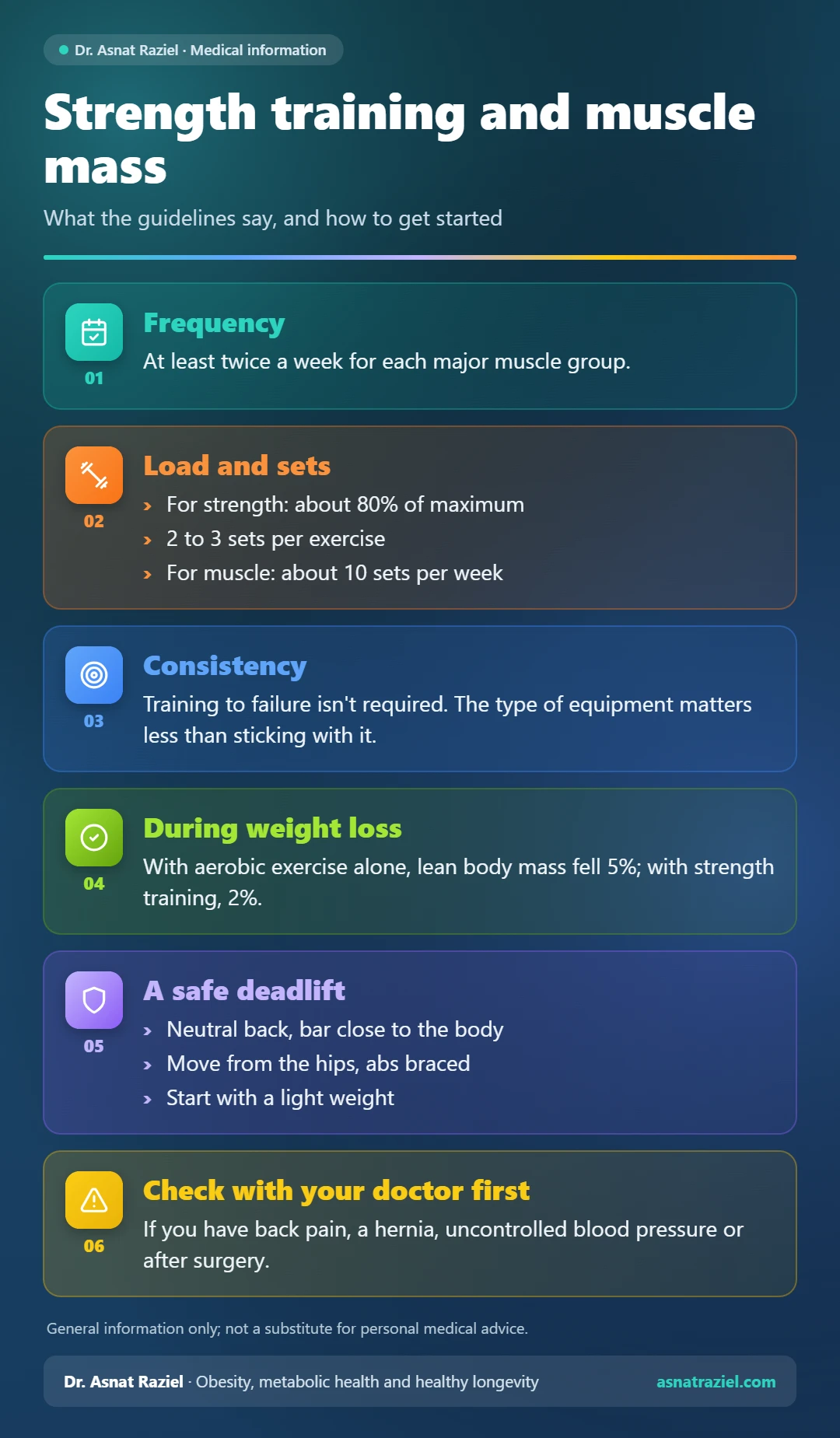
- Frequency: at least twice a week for each major muscle group.
- For strength: heavy loads, about 80% of your one-repetition maximum, for two to three sets.
- For muscle growth: about ten sets per week for each muscle group.
- Full range of motion: improves strength.
- Training to failure: not required. According to the review, training to failure did not consistently change the results.
- Equipment: free weights, machines, resistance bands and body weight can all work.
According to Prof. Stuart Phillips, one of the authors of the position stand, the most important message is consistency. In other words, the best program is the one you’ll stick with.
Strength training during weight loss
When you lose weight, your body also loses muscle. That’s why strength training is especially important here. In a study published in NEJM, 160 older adults (aged 65 and over) with obesity lost about 9% of their body weight with different types of exercise. With aerobic exercise alone, lean body mass dropped by 5%. In contrast, with strength training it dropped by only 2%, and with a combination of both by 3%.
In short, combining the two is the way to go. I wrote about the differences between the approaches in my article on aerobic vs. strength training. You’ll find a practical list of steps in my guide to preventing muscle loss during weight loss.
Strength training after 60
It’s never too late to start. In the ACSM position stand, resistance training improved not only strength and muscle mass, but also walking speed, balance and everyday function. These are exactly the abilities that keep you independent as you get older.
At this age, it’s best to start slowly, with body weight, resistance bands or machines. In addition, exercises that combine strength and balance, such as standing up from a chair and stepping up onto a stair, are especially suitable. Ideally, start with guidance from a trainer or physical therapist, and increase the load only once the movement feels safe.
Nutrition matters here, too. Older muscle responds less to stimulation, so protein at every meal helps it rebuild after a workout.
The deadlift: why this exercise
The deadlift means lifting a weight from the floor until you are standing upright. The exercise works the glutes, hamstrings, back and grip together. It also mimics an everyday task: lifting a bag, a box or a child off the floor. That’s why it’s so useful for daily function.
That said, the deadlift isn’t mandatory. You can build an excellent program without it, for example with squats, lunges and machines.
How to deadlift safely
- Stance: feet hip-width apart, with the bar over the middle of your feet.
- Move from the hips: push your hips back and bend your knees slightly.
- Neutral back: keep your back straight, without rounding or arching excessively.
- Bar close to the body: the bar stays close to your legs throughout the movement.
- Bracing: tighten your abdominal muscles before you lift.
- Lifting: push the floor away with your legs until you are standing upright, without leaning back.
- Lowering: return slowly and with control, along the same path.
Start with a very light weight, or even a stick or a kettlebell. A hex (trap) bar, which you stand inside, is also convenient for beginners. It’s a good idea to learn the movement with a certified trainer, and only then increase the load.
There are also easier variations. For example, the Romanian deadlift starts from a standing position and goes down only to mid-shin. You can also do the exercise with one dumbbell in each hand. This way, you learn to move from the hips before lifting from the floor.
When to check with your doctor first
If you have back pain, a hernia, uncontrolled blood pressure, heart disease or recent surgery, talk to your doctor first. The same applies after bariatric surgery. In addition, people with high blood pressure should avoid holding their breath for long during exertion.
A simple strength training plan for beginners
First, schedule two workouts a week, on non-consecutive days. In each workout, choose five or six exercises: a push, a pull, a leg exercise, a hip exercise such as the deadlift, and a core exercise. Do two to three sets of each exercise.
Next, gradually increase the load when an exercise becomes easy. To track your progress, you can also measure grip strength. Finally, eat enough protein, because muscle needs building blocks.
The bottom line
Strength training and muscle mass go hand in hand: twice a week for each muscle group, with a gradually increasing load, is enough to improve strength and function. During weight loss, combining strength and aerobic training preserves muscle compared with aerobic exercise alone. The deadlift is an effective exercise, provided you learn the correct technique and start light.
The information in this article is general and does not replace personal medical advice.
Questions and answers
How many times a week should I train?
At least twice a week for each major muscle group, according to the latest recommendations.
Do I have to lift heavy weights?
No. Heavy weights are especially good for building strength, but resistance bands and body weight also build muscle and improve function.
Is the deadlift dangerous for my back?
With correct technique and an appropriate load, it is safe for most people. If you have back pain, consult a doctor or physical therapist first.
How does strength training affect weight loss?
It limits muscle loss while you lose weight, so a larger share of the weight you lose is fat.
References
Aerobic or Resistance Exercise, or Both, in Dieting Obese Older Adults




