By Dr. Asnat Raziel, bariatric surgeon specializing in obesity treatment, metabolic health and healthy longevity; Director of the Multidisciplinary Center for Obesity Treatment, Assia Medical, Assuta Ramat HaChayal, Tel Aviv
Functional fitness: not how many diseases we have, but what we can still do
Functional fitness is the name I use for a concept scientists call intrinsic capacity. It describes the sum of all the physical and mental abilities available to us at any given moment. Instead of counting diagnoses, the measure asks a simple question: what can our body and mind still do? In a new conversation on the Longevity.Technology channel, Prof. John Beard, one of the fathers of the concept, explores a big question. Will this measure become the yardstick researchers use to test the first longevity drugs?
Why diseases alone don’t tell the whole story
Beard previously led the Department of Ageing and Life Course at the World Health Organization. Today he directs the International Longevity Center USA at Columbia University. His message is sharp: diagnoses on their own give only a partial picture of aging.
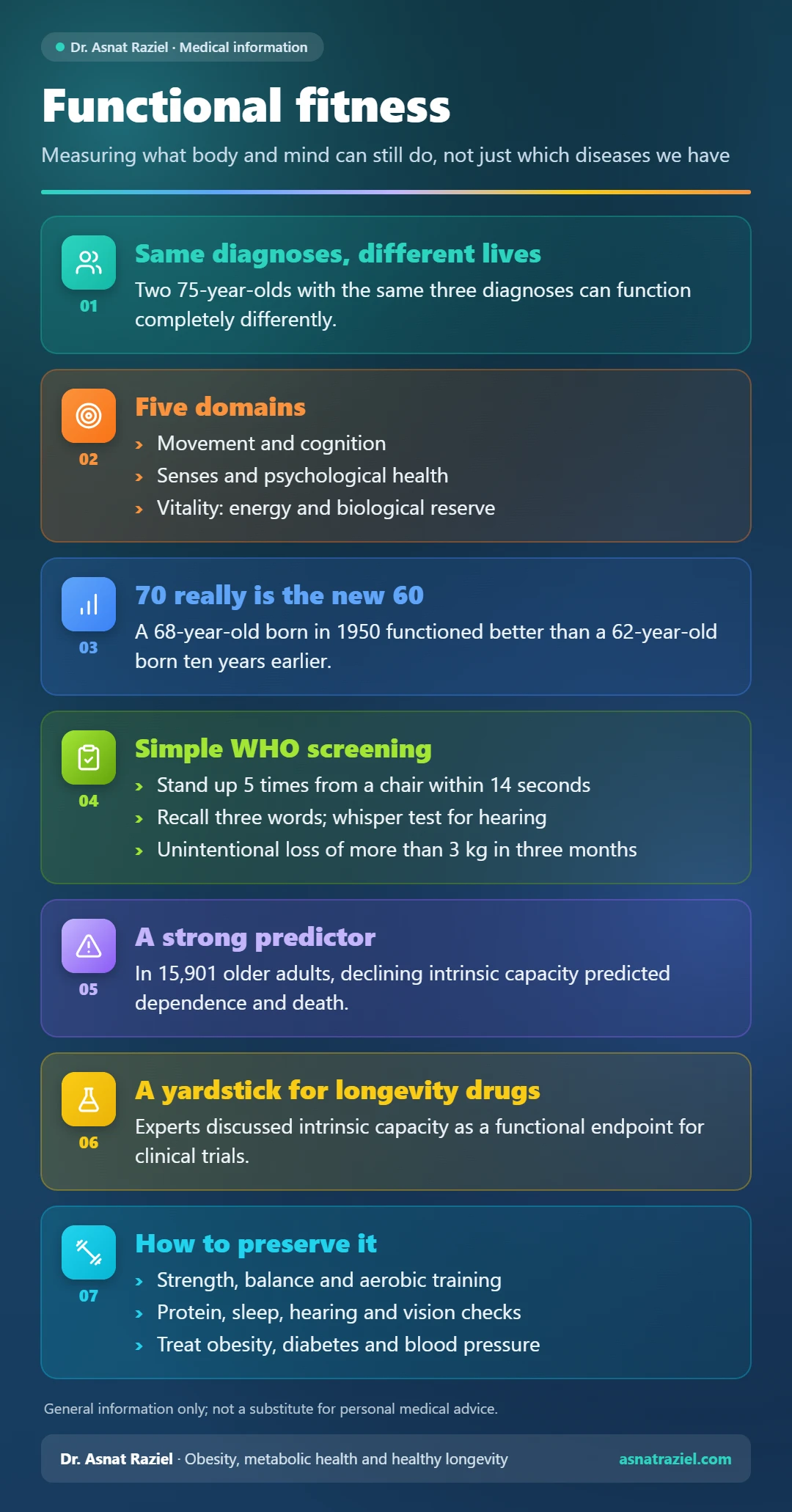
Take two 75-year-olds with the same three diagnoses. One travels, works out and lives independently. The other struggles to get up from an armchair. Their lists of diseases are identical, but their function is completely different.
Moreover, a study of 2,560 participants over age 60 in England found something important. Intrinsic capacity predicted loss of independence in daily activities. It did so even after the researchers accounted for the number of chronic diseases. In other words, function is a piece of data in its own right, not just a reflection of disease.
Where does the name come from?
Beard himself admits the English term is not especially catchy. In an interview with The New York Times, he explained that “intrinsic” refers to everything “from the skin inward.” “Capacity,” on the other hand, describes function.
In Hebrew, I call it kosher ha-chaim, which literally means “fitness for life.” The Hebrew word for fitness does both jobs at once. We know it from physical fitness, but also from fitness for work, powers of concentration and judgment. The word “life,” in turn, reminds us what all of this is for. So functional fitness is what allows us to be and to do what matters to us, from the skin inward.
The five building blocks of functional fitness
The World Health Organization and Beard’s research divide the measure into five domains:
- Movement: strength, walking, balance and mobility.
- Cognition: memory, attention, orientation and thinking.
- Senses: mainly vision and hearing.
- Psychological: mood, resilience and coping.
- Vitality: the body’s energy and biological reserve.
I have written in detail elsewhere about the definition, the link to mortality and the American research program. Here, I will focus on what the conversation with Beard adds.
Is 70 really the new 60?
One of the topics in the conversation is the popular saying that 70 is the new 60. As it turns out, it has scientific backing. A study he published with colleagues in Nature Aging compared different generations in England and China.
The researchers found that younger generations reached older age with much higher intrinsic capacity. In addition, their decline with age was more gradual. For example, a 68-year-old participant born in 1950 functioned better than a 62-year-old born ten years earlier. The improvement stood out especially in cognition, movement and vitality. The trend looked similar in men and women, and in both countries.
According to Beard, improvements in education, nutrition and sanitation in the twentieth century probably played a central role. However, the researchers warn that new challenges, including the obesity epidemic, could reverse the trend. For me, this is a reminder that treating obesity is also an investment in the functional fitness of the next generation.
Functional fitness is built at a young age
In the conversation, Beard stresses that health in the early stages of life affects our capacity decades later. He also distinguishes between prevention and health promotion.
Prevention asks how to steer clear of a specific disease. Health promotion, by contrast, asks how to build the widest possible physical and mental reserve. In other words, you can be free of disease and still gradually lose strength, hearing or energy. The new approach aims to spot this decline early and act before it turns into disability.
How do we actually measure functional fitness?
The good news is that some of the tests are very simple. The WHO ICOPE guide offers a short screening for family doctors and community teams:
- Chair rise: can you stand up five times in a row, without using your hands, within 14 seconds?
- Memory: recalling three words, plus questions on orientation in time and place.
- Hearing: a simple whisper test.
- Vision: difficulty seeing, even with glasses.
- Nutrition: unintentional weight loss of more than 3 kg in three months, or loss of appetite.
- Mood: feeling down or losing interest over the past two weeks.
It is important to remember that this is a screening, not a diagnosis. An abnormal finding is a reason for a comprehensive assessment, not a reason to panic. There are also other simple tests, such as grip strength and the ability to stand on one leg.
Does a screening like this actually mean anything? A study that followed 15,901 older adults in Latin America, India and China found a clear answer. A decline in intrinsic capacity strongly and independently predicted dependence on others and death.
Functional fitness as a yardstick for longevity drugs
This is the question in the title of the conversation. To prove that a drug extends life, you need to follow people for decades. That is why researchers are looking for a measure that changes quickly, yet still reflects what truly matters.
In May 2026, a public meeting of the Reagan-Udall Foundation, which works alongside the FDA, took place in Washington together with ARPA-H and XPRIZE. Participants discussed using intrinsic capacity as a functional endpoint in clinical trials. They also proposed a fascinating idea: a “health curve for adults,” similar to the growth charts pediatricians know so well. Beard was among the speakers.
First, the idea already rests on an official foundation. The international classification of diseases, ICD-11, includes a code for aging-related decline in intrinsic capacity. Second, the conversation also mentions GLP-1 drugs and vaccines as examples of interventions that may affect aging broadly. Still, this remains an open question, not proof.
What is still missing
Beard is not selling illusions. As he puts it, there is still no uniform, agreed-upon way to measure intrinsic capacity, and without one it is hard to compare studies. His team is working on precise measures, including biomarkers and wearable clocks.
In addition, he warns that some longevity clinics are running ahead of the evidence. That is, a “score” offered today for a fee is not necessarily a validated measure. On the other hand, the logic behind the measure is already useful for each of us.
How do you preserve functional fitness?
There is no magic pill, but there are habits that affect all five domains:
- Strength and balance training: it protects movement, the domain that wears down early in many people.
- Aerobic activity: it improves vitality and blood flow to the brain.
- A protein-rich diet: it supports muscle, especially during weight loss.
- Hearing and vision checks: a hearing aid in time is also an investment in cognition and social connections.
- Sleep, mood and relationships: they are part of the reserve, not a nice extra.
- Metabolic balance: treating obesity, diabetes and high blood pressure protects every system.
I wrote about the practical basics of training over the years in my guide to complete fitness. It is also worth checking yourself once a year. Is it easy for you to get up from a chair? Can you hear well in a noisy room? Is the energy still there?
Bottom line
For years we asked how long we would live, and then what our biological age is. The next question is simple and human: what can we still do? Functional fitness gives this question a name, a measure and perhaps, soon, official standing in drug research. Ultimately, the goal is not just to add years, but to keep the ability to live them to the fullest.
The information in this article is general and does not replace personal medical advice.
References
Could Intrinsic Capacity Become the Endpoint for Longevity Drugs?
Cohort trends in intrinsic capacity in England and China
The structure and predictive value of intrinsic capacity in a longitudinal study of ageing
The Most Important Longevity Term You’ve Probably Never Heard Of
Study finds slowing of age-related declines in older adults
70 Is the New 60: Age Related Declines Slowing in Older People




