By Dr. Asnat Raziel, bariatric surgeon specializing in obesity treatment, metabolic health and healthy longevity; Director of the Multidisciplinary Center for Obesity Treatment, Assia Medical, Assuta Ramat HaChayal, Tel Aviv
The CX11 pill: another GLP-1 pill on the way
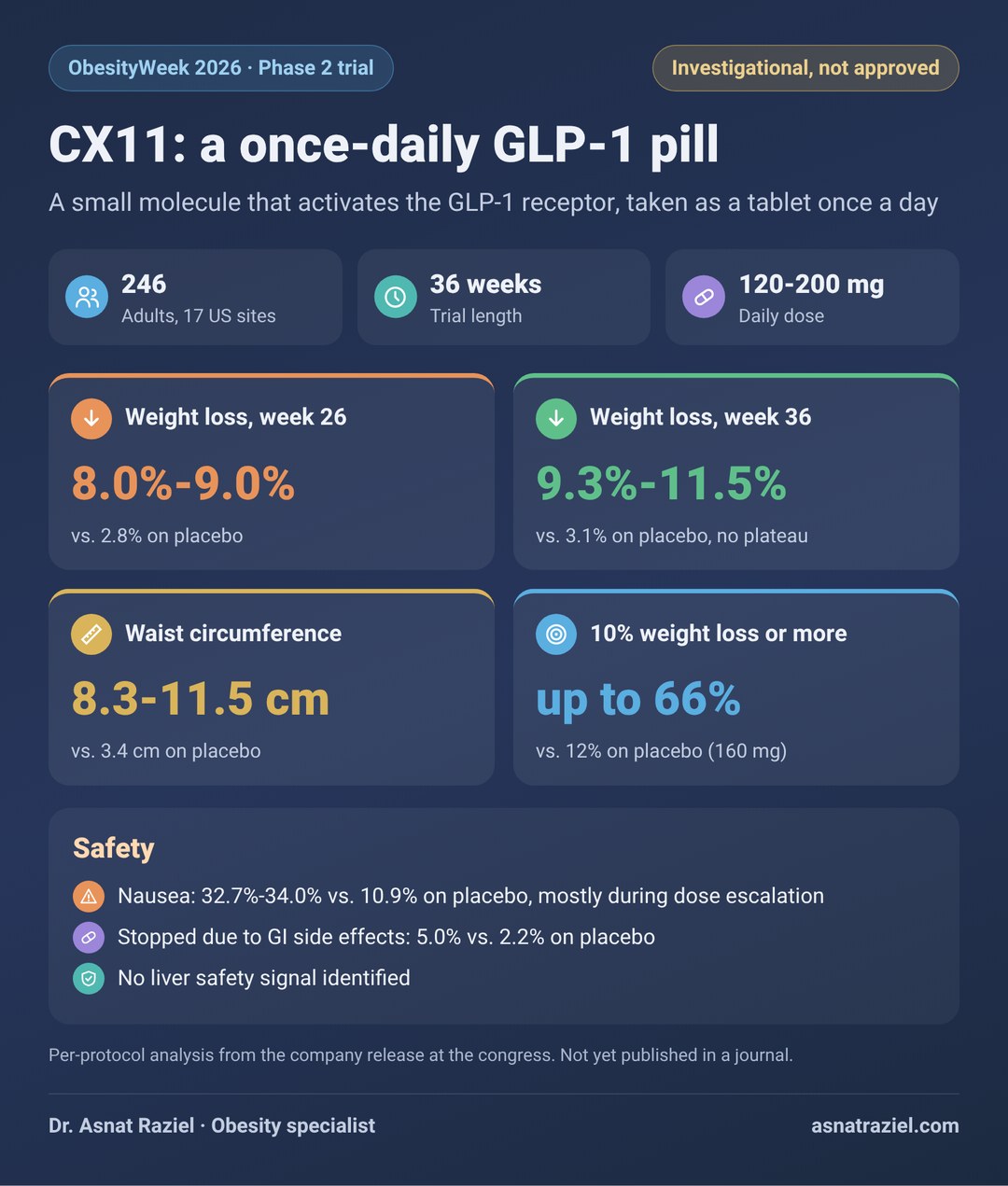
The CX11 pill is an investigational once-daily obesity pill that works like the GLP-1 injections. At ObesityWeek, the American obesity congress held this week in Washington, Corxel presented the full results of its phase 2 trial. After 36 weeks, participants lost 9.3% to 11.5% of their body weight, versus 3.1% on placebo. To be clear: the drug is still investigational and not approved for use.
What is the CX11 pill and how does it work?
Chemically, CX11 is a small molecule that activates the receptor for GLP-1, the gut’s fullness hormone. In other words, it uses the same mechanism as the familiar injections, but in a tablet taken once a day.
The Chinese company Vincentage originally developed the drug, and it is running a phase 3 trial in China. In December 2024, Corxel acquired the rights outside China. A pill with a similar approach is Foundayo (orforglipron), which is already approved in some countries.
The trial: who took part and what it measured
The trial enrolled 246 adults at 17 US sites. All had obesity (BMI of 30 or more), or overweight (BMI of 27 or more) with at least one related condition. Researchers randomly split them into five equal groups.
Four groups took CX11 at 120, 160 or 200 mg. At the highest dose, they tested two dose-escalation speeds, fast and slow. The fifth group took placebo. The trial lasted 36 weeks, and the main measure was the change in body weight at week 26. Trial details are listed in the US clinical trials registry.
The CX11 pill: results at weeks 26 and 36
At week 26, participants lost 8.0% to 9.0% of their weight, versus 2.8% on placebo. So the trial met its main goal. By week 36, weight loss reached 9.3% to 11.5%, versus 3.1% on placebo. Moreover, according to the company, weight loss had not leveled off by the end of the trial.
Waist size and BMI
In addition, waist circumference shrank by 8.3 to 11.5 cm, versus 3.4 cm on placebo. BMI fell by 3.3 to 4.3 units, versus 1.1 units on placebo.
How many reached their goal?
At 160 mg, 89% lost at least 5% of their weight, and 66% lost at least 10%. For comparison, the placebo figures were 44% and 12%. Losing 15% or more was relatively rare: 14% to 20% in the treatment groups, and 0% on placebo.
Side effects of the CX11 pill
As with other GLP-1 drugs, the main side effects involved the digestive system. Nausea affected 32.7% to 34.0% of those on the drug, versus 10.9% on placebo. On average, vomiting occurred in 13.5% versus 4.3%, and constipation and diarrhea in 8.0% each. Most effects were mild to moderate and showed up mainly during dose escalation.
Only 5.0% of those on the drug stopped it because of digestive side effects, versus 2.2% on placebo. The liver matters too: the company found no sign of liver injury. That’s important, because another company once halted a similar pill over liver safety concerns.
The CX11 pill versus current drugs
Losing about 10% in nine months is a good result, but modest compared with the strongest injections. On the other hand, a pill offers convenience, relatively cheap production and the chance to reach many people. Either way, comparing different trials directly is not precise.
The company now plans global phase 3 trials and reports alignment with the FDA. It is also developing an amylin pill called CX12, which is still in the lab stage. I’ve written about the amylin drug family in my article on amylin-based drugs.
What this means for you
Today, there is no need to wait for CX11. So anyone who needs treatment can start now with one of the approved drugs, tailored with their doctor. Also, remember that any weight-loss pill works best alongside good nutrition, sleep and movement.
Still, the direction is clear: more GLP-1 pills are coming, and the choice will widen. Read about other investigational pills from the congress in my articles on the aleniglipron pill and the CRB-913 pill.
The bottom line
In its phase 2 trial, the CX11 pill led to up to 11.5% weight loss within 36 weeks, with no sign of liver injury. However, these are company data not yet published in a journal. The next step, large phase 3 trials, will decide whether the pill ever reaches pharmacies.
This article is general information and does not replace personal medical advice.
References
A Study to Evaluate the Efficacy and Safety of CX11 Tablets in Overweight/Obese Participants
Corxel, the company developing the drug, released the data.