By Dr. Asnat Raziel, bariatric surgeon specializing in obesity treatment, metabolic health and healthy longevity; Director of the Multidisciplinary Center for Obesity Treatment, Assia Medical, Assuta Ramat HaChayal, Tel Aviv
NAC supplement: why everyone is talking about it
The NAC supplement has become one of the stars of the longevity world in recent years. It shows up in podcasts, in “biohacker” supplement stacks and in detox products. Behind the name is a long-established medicine: N-acetylcysteine. Here I explain what it does, what research shows, and who it might harm.
What is acetylcysteine, and how is it linked to glutathione?
Acetylcysteine is a stable form of the amino acid cysteine. Your body uses cysteine to build glutathione, the main antioxidant inside cells. Glutathione production depends mostly on cysteine supply. So NAC serves as a raw material. NAC also thins mucus in the airways. That explains its long use as a mucus medicine.
Here is the key difference from the glutathione supplement itself: instead of the finished molecule, you give the body the building block. Your body then makes what it needs.
The drug that saves livers: acetaminophen overdose
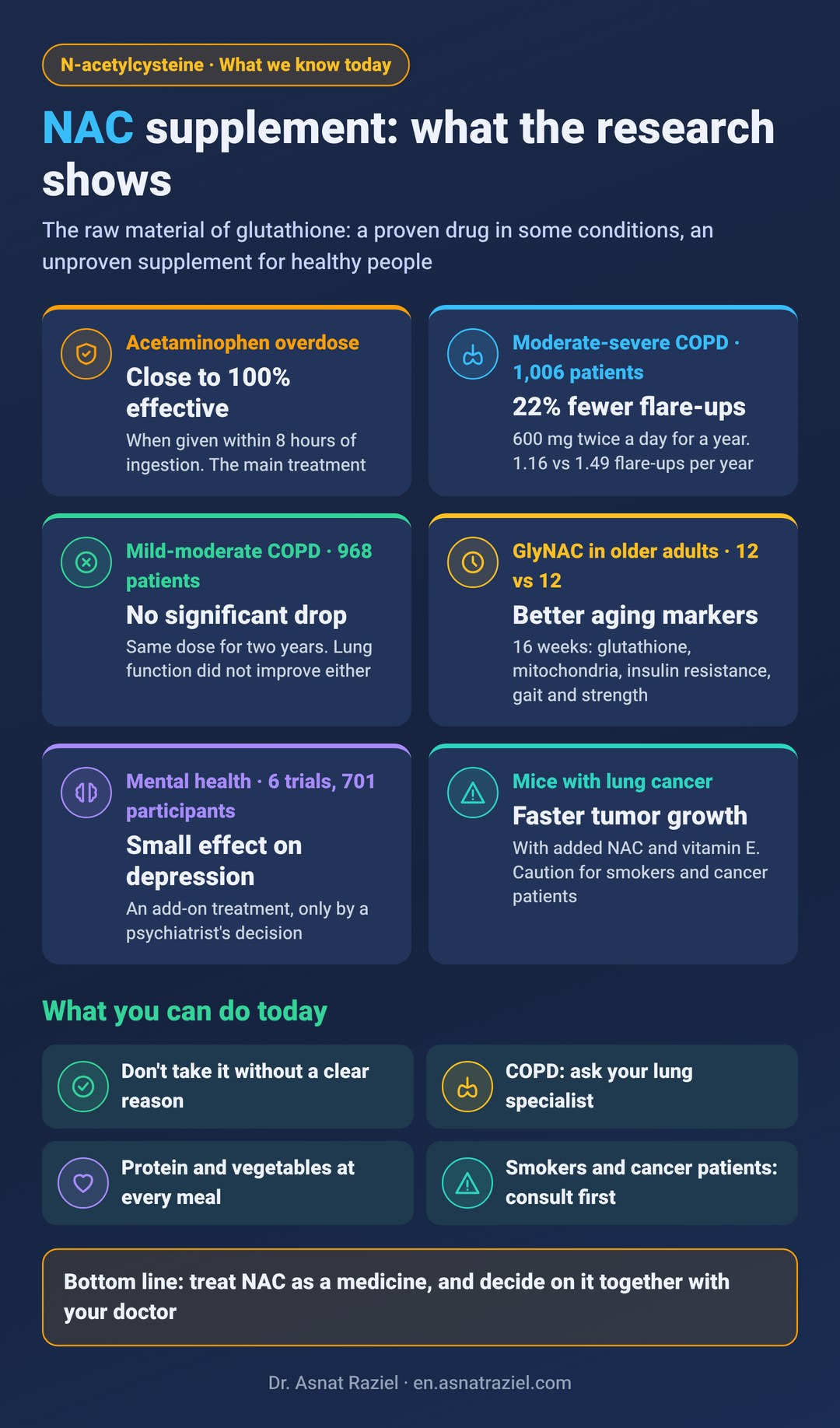
The best-proven use of NAC is not as a supplement at all. It is an emergency drug. An overdose of acetaminophen (paracetamol), the active ingredient in Tylenol, drains liver glutathione. It can cause liver failure. According to the StatPearls medical review, NAC is the main treatment for this condition. When given within 8 hours of ingestion, it is close to 100% effective.
In other words, NAC’s ability to restore liver glutathione is well established. But that is an extreme state of severe depletion. The big question is what happens in a healthy person whose stores are normal.
NAC supplement and chronic obstructive lung disease
Another area with large trials is chronic obstructive pulmonary disease (COPD). In COPD, the airways are damaged over time, mostly by smoking. In the PANTHEON trial in China, 1,006 patients had moderate to severe disease. They took 600 mg twice a day or a placebo for a year.
The NAC group had 1.16 flare-ups per patient per year. The placebo group had 1.49. That is a 22% drop in flare-ups. Side effects were also similar in both groups: 29% with NAC versus 26% with placebo.
However, the picture is not uniform. In a newer Chinese trial, 968 patients with milder disease took the same dose. They took it for two years. This time, NAC did not significantly reduce flare-ups or improve lung function. So this decision belongs to your lung specialist, based on disease severity.
NAC supplement and aging: the GlyNAC study
The longevity world is excited about combining NAC with the amino acid glycine. This mix is called GlyNAC. Researchers at Baylor College of Medicine propose that the body makes less glutathione with age. Giving both raw materials, they suggest, corrects the shortfall.
In a randomized double-blind trial, they split 24 older adults into two groups: 12 took GlyNAC and 12 took a placebo, for 16 weeks. A further 12 young adults took GlyNAC for two weeks for comparison. Older adults on GlyNAC, but not on placebo, improved in several areas. These included glutathione deficiency, oxidative stress and mitochondrial function. Inflammation and insulin resistance also improved. Gait speed, muscle strength, waist size and blood pressure also improved.
These are encouraging results, but they need perspective. Each group had only 12 people, over four months. The doses were set by body weight. They are much higher than in a typical capsule. We still need large, long trials before GlyNAC can be recommended for everyone.
NAC supplement and mental health
NAC also affects the nerve messenger glutamate. So researchers have tested it as an add-on for psychiatric disorders. A meta-analysis of six trials with 701 participants looked at schizophrenia, bipolar disorder and depression. Side effects and dropout rates were similar to control groups. But the effect on depression was small. The researchers called for more high-quality trials. This is a treatment only a psychiatrist should consider, not a supplement for self-care.
The other side: antioxidants and cancer
Here, too, it helps to know the less familiar side. In a study of mice with lung cancer, NAC and vitamin E sped up tumor growth. They also shortened survival. The antioxidants reduced oxidative damage in tumor cells too. That helped the tumors grow.
It is important to stress that this was a mouse study, not a human one. Still, the researchers themselves warned that the finding may matter for high-risk groups, such as smokers. So anyone with cancer, or at high risk, should ask their oncologist first.
Safety and regulatory status
In capsules, NAC is generally well tolerated. Common side effects are nausea and stomach upset, and it has a sulfur-like smell and taste. As a hospital IV infusion, it can cause allergy-like reactions. So it is given under supervision.
In the US, NAC was approved as a drug before it was sold as a supplement. For that reason, the FDA ruled that it does not meet the definition of a dietary supplement. But in 2022, the agency issued a policy that in practice lets sales continue. Certain conditions apply.
What you can do today
Don’t start without a clear reason. For a healthy person, there is no proof today of long-term benefit from regular use.
With lung disease, ask your lung specialist. In moderate to severe disease, high-dose NAC reduced flare-ups in a large trial.
If you smoke or have cancer, be careful. Talk to your doctor before taking any antioxidant.
Get the raw materials from your plate. Enough protein, legumes, eggs, fish, vegetables and a Mediterranean diet supply the building blocks for glutathione. I wrote about supplements in general in my guide to choosing longevity supplements.
Remember what really slows aging. Exercise, sleep and diet still lead the way, as a large study comparing 51 interventions showed. And when it comes to drips, read about detox and vitamin IV drips before you book one.
The bottom line on the NAC supplement
The NAC supplement is a compound with a respected medical history. It saves lives in acetaminophen overdose, and it reduced flare-ups in some COPD patients. The small GlyNAC study also opens an intriguing path for healthy aging. However, healthy people still have no proof of benefit from regular use. Mouse studies also raised concerns about tumors. So it is best treated as a medicine, and decided on together with your doctor.
This article is general information and does not replace personal medical advice. Before taking any supplement, talk to your doctor.