By Dr. Asnat Raziel, bariatric surgeon specializing in obesity treatment, metabolic health and healthy longevity; Director of the Multidisciplinary Center for Obesity Treatment, Assia Medical, Assuta Ramat HaChayal, Tel Aviv
Longevity supplements: the new goal is more healthy years
Longevity supplements are sold today with big promises: to slow aging, boost the mitochondria and extend life. But how do you know whether a supplement really works? In this article, I focus on the practical question: how to evaluate a supplement before you take it, why an impressive mechanism in the lab is still not proof, and what matters more than any capsule.
Longevity nutrition has been going through an interesting shift in recent years. Instead of asking only “which supplement slows aging?”, researchers are asking a broader and more precise question. Which biological processes make us gradually lose strength, metabolic function, cognitive ability and resilience? And can nutrition influence them?
This is the shift from lifespan, meaning how many years we live, to healthspan, meaning how many of those years we live with good function, independence and health. The World Health Organization also defines healthy aging by functional ability, not just by the absence of disease. So the new approach does not look for a single “magic ingredient.” Instead, it builds nutrition around defined health goals, known biological mechanisms and measures that can be tracked over time.
The 12 hallmarks of aging
One of the key scientific foundations of the field is the Hallmarks of Aging model. The original model was published in 2013 in the journal Cell. In 2023, researchers updated and expanded it, and today it includes 12 core processes:
- Genomic instability and DNA damage.
- Shortening of the telomeres, the ends of the chromosomes.
- Epigenetic changes in gene regulation.
- Loss of protein quality and protein control.
- Reduced autophagy, the cell’s cleanup mechanism.
- Disrupted nutrient sensing.
- Impaired function of the mitochondria, the cell’s power plants.
- Cellular senescence: cells that have stopped dividing and release inflammatory substances.
- Stem cell exhaustion.
- Changes in communication between cells.
- Chronic inflammation.
- Changes in the microbiome, the community of bacteria in the gut.
The key point is that these processes work together. For example, poorly functioning mitochondria may affect energy production, oxidative stress and inflammation. Chronic inflammation, in turn, affects metabolism and tissue function. That is why aging is now seen as a network of processes that influence one another. You can read more about the role of the mitochondria in my article on mitochondria and aging.
Don’t start with the supplement, start with the person
This may be the most interesting insight of the new approach. Instead of asking “which supplement should I take?”, it is better to ask first: what do we want to preserve?
For one person, the main goal is muscle mass, strength and mobility. For another, it is metabolic health. A third person may focus on cognitive function, vision or physical resilience. Only after defining the goal can we ask which mechanisms are relevant to it. Then we ask which interventions have been proven in humans, and which measures will show whether the intervention works. This is the difference between “anti-aging” marketing and science-based medicine and nutrition.
Longevity supplements: two tests for every ingredient
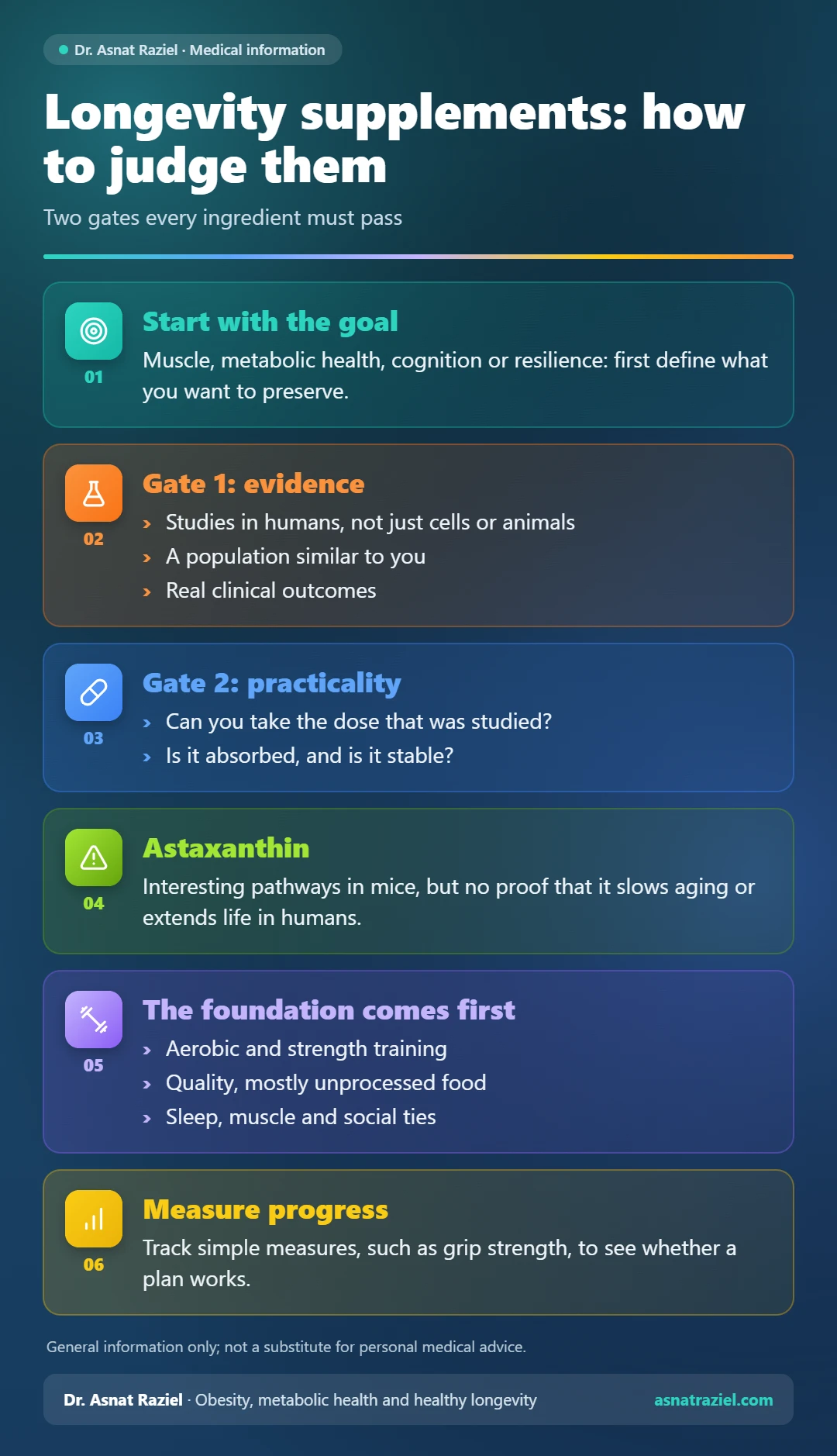
Think of two “gates” that every ingredient must pass before it is recommended for a longer healthspan. The first is the evidence gate. It is not enough for a cell or animal study to show an effect on AMPK, mTOR, autophagy or the mitochondria. AMPK and mTOR are key control pathways that sense the energy state of the cell. We need to ask whether there are studies in humans, whether the population studied resembles the patient, and what the clinical outcomes were.
The second gate is practical. Can you actually consume the dose that was studied? In addition, we need to check whether the substance is absorbed and whether it is stable. The form in which it is taken also affects its bioavailability. A critical review of supplements for healthy aging highlights exactly this gap. In other words, an impressive biological mechanism does not equal proven clinical benefit.
Longevity supplements put to the test: what about astaxanthin?
New papers in the field focus on astaxanthin. It is a red carotenoid, a natural pigment found in algae and in the sea creatures that feed on them. Experimental studies point to several interesting mechanisms. For example, a study in mice fed a high-fat diet looked at insulin-resistant muscle. There, astaxanthin activated the AMPK pathway and raised PGC-1α and SIRT1. These pathways are linked to the formation of new mitochondria and to energy metabolism.
In addition, a study in fast-aging mice pointed to a possible effect on autophagy in the brain, through the IGF-1/Akt/FoxO3a and mTOR pathways. But caution is needed here. Most of the mechanistic evidence comes from animals and lab studies. Even where there are human studies in areas such as fitness, skin, vision, metabolism and cognition, they do not prove that astaxanthin slows aging or extends life. That is exactly the difference between an effect on a biological pathway and clinical proof.
Longevity supplements: the future may lie in combinations
Another interesting approach is to think less about a single supplement and more about the physiological goal. For example, when the goal is to preserve muscle and function in older age, the plan will include enough protein and strength training. Sometimes it will also include vitamin D in case of deficiency, or omega-3, depending on the person’s condition. I discussed this in more detail in my article on protein and longevity.
When the goal is metabolic health, on the other hand, the intervention will look different. It will focus first and foremost on diet quality, physical activity, a healthy weight and sleep. In other words, there is no reason to expect a single capsule to address all 12 hallmarks. That is why good longevity nutrition is built from several components that complement one another.
The foundation still doesn’t come in a bottle
Despite the excitement about longevity supplements, the tools with the strongest evidence are less exotic. First, physical activity, especially a combination of aerobic exercise and strength training. Second, high-quality nutrition based mainly on unprocessed food. In addition, maintaining muscle mass, preventing obesity and metabolic disease, not smoking, good sleep and social connections. All of these still form the foundation of healthspan. For a recent study on changing what you eat later in life, see my article on a four-week diet change in older adults.
A review of longevity supplements and medications in public health also describes the challenges in the field. Supplements can be an additional layer when there is a personal reason and suitable evidence. But they do not replace the foundation. For a broader view, see my article on the longevity diet, which focuses on eating patterns rather than supplements.
From anti-aging to precision longevity nutrition
This may be the direction of the entire field: precision longevity, meaning longevity tailored to the individual. Instead of the same list of supplements for everyone, we will define each person’s weak points. For example: muscle mass, cardiorespiratory fitness, insulin resistance, blood fats, bone health or cognitive function. Then we will build a plan that preserves function and resilience over the years, and measure whether it succeeds. One simple measure of this kind is grip strength.
In my view, this is the most interesting part of the longevity revolution. The goal is not to find a substance that will make us young again. The goal is to spot, in time, the processes that lead to loss of function, and to influence them long before disease appears. In the end, longevity nutrition is a way of life, not a capsule.
A checklist before you buy longevity supplements
Before buying a supplement, I suggest going through five simple questions. First, what is the goal: muscle, metabolic health, cognitive function or resilience? Second, are there studies in humans, not just in cells or animals? Third, does the population studied resemble you? Fourth, can you consume the dose that was studied, and is the substance absorbed and stable? Finally, do you have a proven deficiency, such as vitamin D, or underlying conditions and medications that affect the decision? If the answers are unclear, it is better to start with the basics: movement, high-quality nutrition and sleep.
Questions and answers
Has astaxanthin been proven to extend life in humans?
No. There are studies on biological mechanisms and on several measures of health and function. However, there is currently no clinical proof that it extends life expectancy in humans.
Does affecting one of the hallmarks of aging mean slowing aging?
Not necessarily. These pathways are very important for understanding the biology of aging. Even so, a change in a biological marker or pathway does not, on its own, prove a longer life or a longer healthspan.
Should I take longevity supplements?
The decision should be personal. It depends on your age, diet, deficiencies, underlying conditions, medications and health goals. It is better to choose ingredients with evidence in humans, and not to rely only on cell or animal studies.
What is the most important thing I can do today?
Preserve muscle mass and physical fitness, eat high-quality food and maintain metabolic health. In addition, it is important to sleep well and to treat medical risk factors. These are still the cornerstones of a long, healthy life.
The information in this article is general and does not replace personal medical advice.
Further reading: glutathione supplements and the NAC supplement.
Sources
Hallmarks of aging: An expanding universe
Healthy ageing and functional ability
Nutritional Supplements for Healthy Aging: A Critical Analysis Review