By Dr. Asnat Raziel, bariatric surgeon specializing in obesity treatment, metabolic health and healthy longevity; Director of the Multidisciplinary Center for Obesity Treatment, Assia Medical, Assuta Ramat HaChayal, Tel Aviv
What is a glutathione supplement, and why is everyone talking about it?
A glutathione supplement is now sold as capsules, powders, sprays and IV drips. Makers promise detox, protection from oxidative damage, glowing skin and even cancer prevention. Indeed, the glutathione your body makes on its own is vital for healthy cells. However, a new review on Medscape concludes that a health benefit is not yet proven. Here I explain what we know, what is still open, and what to do today.
The antioxidant your body makes on its own
Glutathione is built from three amino acids: glutamate, cysteine and glycine. It is found in most cells, and it is one of the main antioxidants inside them. Levels are especially high in the liver. This organ breaks down foreign substances for removal.
Your body makes glutathione itself, and production depends mainly on how much cysteine is available. Fruit, vegetables and meat also contain glutathione. Still, no one knows how much of it reaches the cells after digestion. Beyond neutralizing free radicals, glutathione affects many signaling pathways, regulates proteins and helps cells divide.
Detox: a real mechanism, an unproven promise
Glutathione has a genuine role in clearing toxins. Liver enzymes attach it to foreign compounds, which makes them easier to remove. A familiar example is acetaminophen (paracetamol), the active ingredient in Tylenol. Normally, glutathione neutralizes a toxic by-product of the drug. After an overdose, though, the liver’s glutathione stores run out.
But that does not mean a supplement improves this job in a healthy person. In fact, there is no convincing evidence that the supplement removes “environmental toxins” or cleanses the body. A critical review also found no evidence that detox diets remove toxins from the body. Your real cleansing system is the liver. Keeping it healthy, free of fatty liver disease, matters far more than any capsule.
Does a glutathione supplement even reach the cells?
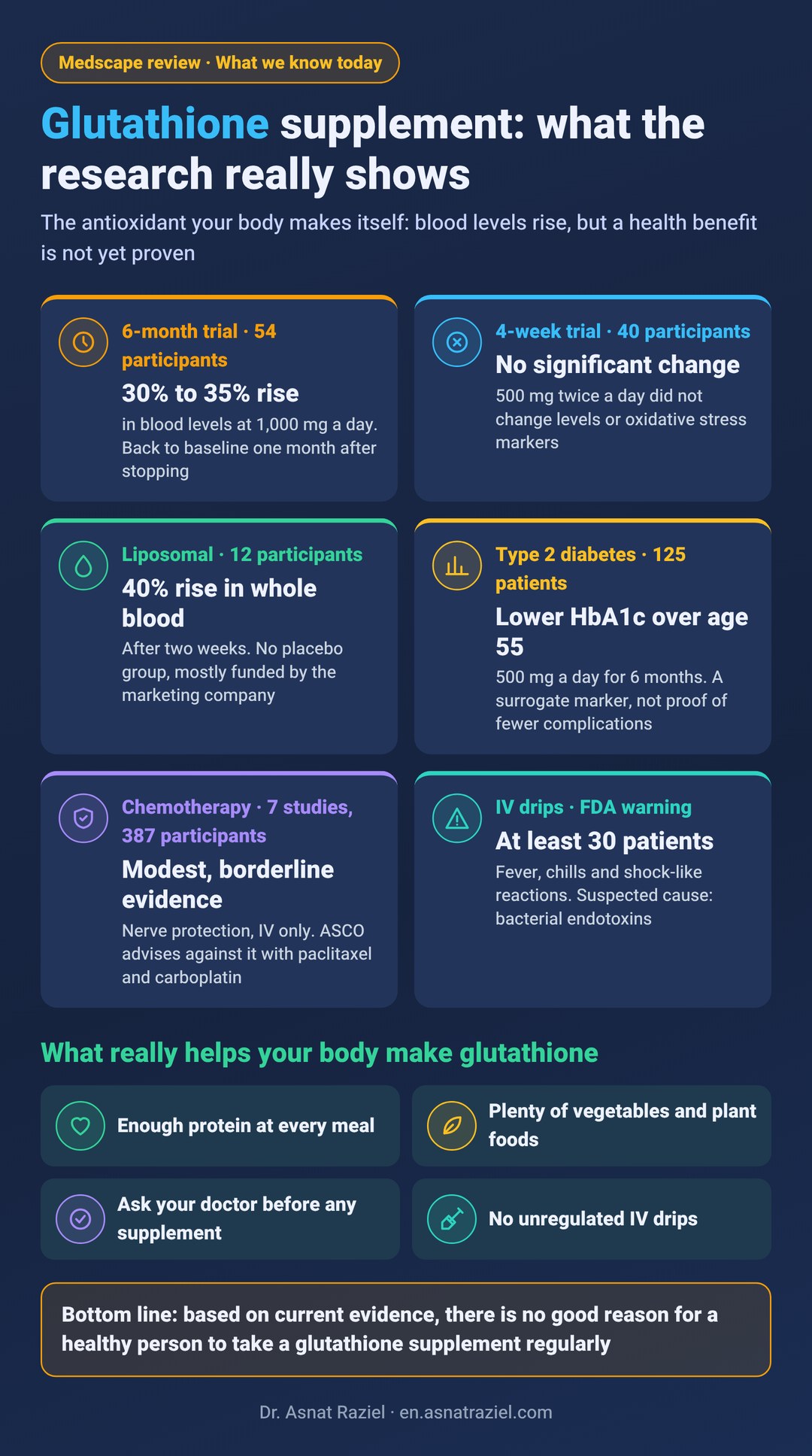
For years, doctors and researchers believed glutathione breaks down in the gut before it is absorbed. Studies on this question have produced mixed results. In one controlled trial, 40 healthy adults took 500 mg twice a day for 4 weeks. At the end, oxidative stress markers had not changed significantly. Neither had red blood cell glutathione.
In contrast, a longer six-month trial told a different story. It enrolled 54 healthy non-smoking adults. Each participant received 250 mg a day, 1,000 mg a day or a placebo.
At the high dose, levels rose by an average of 30% to 35%. This held in red blood cells, plasma and lymphocytes. In cheek cells, levels rose by 260%. The low dose also raised levels in blood and red blood cells, but more modestly. One month after stopping, levels returned to baseline.
Keep in mind that a rise from baseline is not proof of an effect versus placebo. Also, the study measured blood levels, not health. In other words, we do not know whether the rise improved toxin clearance or prevented disease.
Liposomal glutathione: better absorption, but any benefit?
Manufacturers now offer liposomal glutathione, wrapped in tiny fat bubbles meant to improve absorption. A pilot study tested 12 healthy adults aged 51 to 72, 11 of them women. Participants took 500 or 1,000 mg a day for 4 weeks.
Glutathione levels rose after one week and peaked after two. Compared with baseline, they rose by 40% in whole blood and 25% in red blood cells. They also rose by 28% in plasma and 100% in mononuclear blood cells. At the same time, the oxidative stress marker 8-isoprostane in plasma fell by up to 35%. In addition, natural killer (NK) cell activity rose at some time points. NK cells are immune cells that attack infected and cancerous cells.
However, the study has major limits. First, the peak values came from different dose groups and time points. Overall, the two doses did not differ. Second, it included only 12 people, with no placebo group and no comparison with regular glutathione. Moreover, the company that supplied and marketed the product funded most of the study. So we cannot say the liposomal form is absorbed better than regular glutathione or helps health.
A new crossover study tested a micellar form, made of tiny particles that wrap the compound. It reached higher blood levels than regular glutathione, despite a lower dose. But here too, the researchers themselves call for larger and longer studies.
Glutathione supplement and diabetes: better markers, not necessarily better health
Some studies tested people with chronic conditions. In a randomized trial in India, 125 people with type 2 diabetes took 500 mg daily for six months. They also kept their usual care. In older patients, over age 55, glutathione stores rose and oxidative damage fell. HbA1c, a measure of average blood sugar over the past three months, also dropped.
But HbA1c is only a surrogate marker. Therefore, larger studies are needed to know whether these changes lead to fewer complications. Beyond that, each study measured different markers, tissues and periods. So they are hard to compare. Above all, a high blood glutathione level is not the same as proven protection from disease.
Cancer and glutathione: a double-edged sword
The claim that glutathione prevents cancer calls for great caution. On one hand, it protects healthy cells from oxidative damage and neutralizes carcinogens. On the other hand, cancer cells use it too. Many tumors rewire glutathione metabolism to survive harsh conditions and escape programmed cell death.
Moreover, high tumor glutathione has been linked to weaker treatment response in several cancers. Some glutathione-dependent enzymes even neutralize certain chemotherapy drugs. Also, some treatments damage the tumor through oxidative stress, and antioxidants may protect tumor cells as well.
What about protecting nerves during chemotherapy? A Cochrane review, from a group that summarizes medical research, examined seven studies. Together they had 387 participants. It found only modest, borderline evidence of nerve protection, and most studies were small. Notably, patients in these studies received glutathione by IV, not as a pharmacy capsule. The American Society of Clinical Oncology (ASCO) even advises against it. This applies to nerve protection with paclitaxel and carboplatin.
Glutathione IV drips: the risk nobody mentions
Glutathione IV drips are popular in wellness clinics and beauty salons, mostly for skin lightening. Yet a drip carries different risks from a capsule. In 2019, the FDA issued a warning about contaminated injectable glutathione after patients fell ill.
In August 2026, the agency repeated the warning. At least 30 patients developed fever, chills and shock-like reactions after infusions. Some needed hospital care. The main suspect: bacterial endotoxins in glutathione made for dietary supplements only, not for injection.
Side effects of a glutathione supplement in capsules
In the small studies in healthy people, a glutathione supplement in capsules was generally well tolerated. Researchers did not report a rise in serious side effects. But most studies had only a few dozen participants. They lasted from weeks to six months.
So we do not know what happens with long-term use, high doses, or in people with chronic illness. In addition, there are almost no good studies on glutathione and drug interactions. And remember: a lack of evidence of harm is not proof of safety.
What you can do today
The good news: your body makes glutathione, and you can help it in simple ways:
Eat enough protein. Your body builds glutathione from amino acids, and it especially needs cysteine. Fish, chicken, eggs, dairy, legumes and nuts supply these building blocks. I wrote separately about acetylcysteine, the form of cysteine sold as a supplement.
Fill your plate with vegetables and plant foods. A plant-rich diet, like the healthy eating patterns that slow biological aging, provides key raw materials for your metabolism.
Ask what the supplement is supposed to do. Before any purchase, check what evidence exists, and for whom. I wrote about this in my guide to choosing longevity supplements. I also covered similar trends in the world of biohacking, the attempt to upgrade the body with technology.
During cancer treatment, talk to your doctor first. Do not start any antioxidant without your oncologist’s approval.
Avoid unregulated wellness drips. An IV drip is a medical treatment, and it belongs only in a medical setting. I covered this in detail in my article on detox and vitamin IV drips.
The bottom line on a glutathione supplement
The glutathione your body makes is a vital molecule for protecting cells and clearing toxins. A few human studies showed that a glutathione supplement raises blood levels under some conditions. However, research has not yet shown that this rise improves health, prevents disease or removes toxins. So, based on current evidence, there is no good reason for a healthy person to take it regularly. A balanced diet, with enough protein and plenty of vegetables, is the sensible path.
This article is general information and does not replace personal medical advice. Before taking any supplement, talk to your doctor.
References
Glutathione Supplements: Health Benefits or Just Hype?
Randomized controlled trial of oral glutathione supplementation on body stores of glutathione
Interventions for preventing neuropathy caused by cisplatin and related compounds
FDA highlights concerns with using dietary ingredient glutathione to compound sterile injectables
FDA reminds compounders not to use dietary supplement grade glutathione for injectables
Most of the liposomal glutathione study was funded by the company that supplied and marketed the product.