By Dr. Asnat Raziel, bariatric surgeon specializing in obesity treatment, metabolic health and healthy longevity; Director of the Multidisciplinary Center for Obesity Treatment, Assia Medical, Assuta Ramat HaChayal, Tel Aviv
Fatty liver risk factors: why the silent disease deserves attention
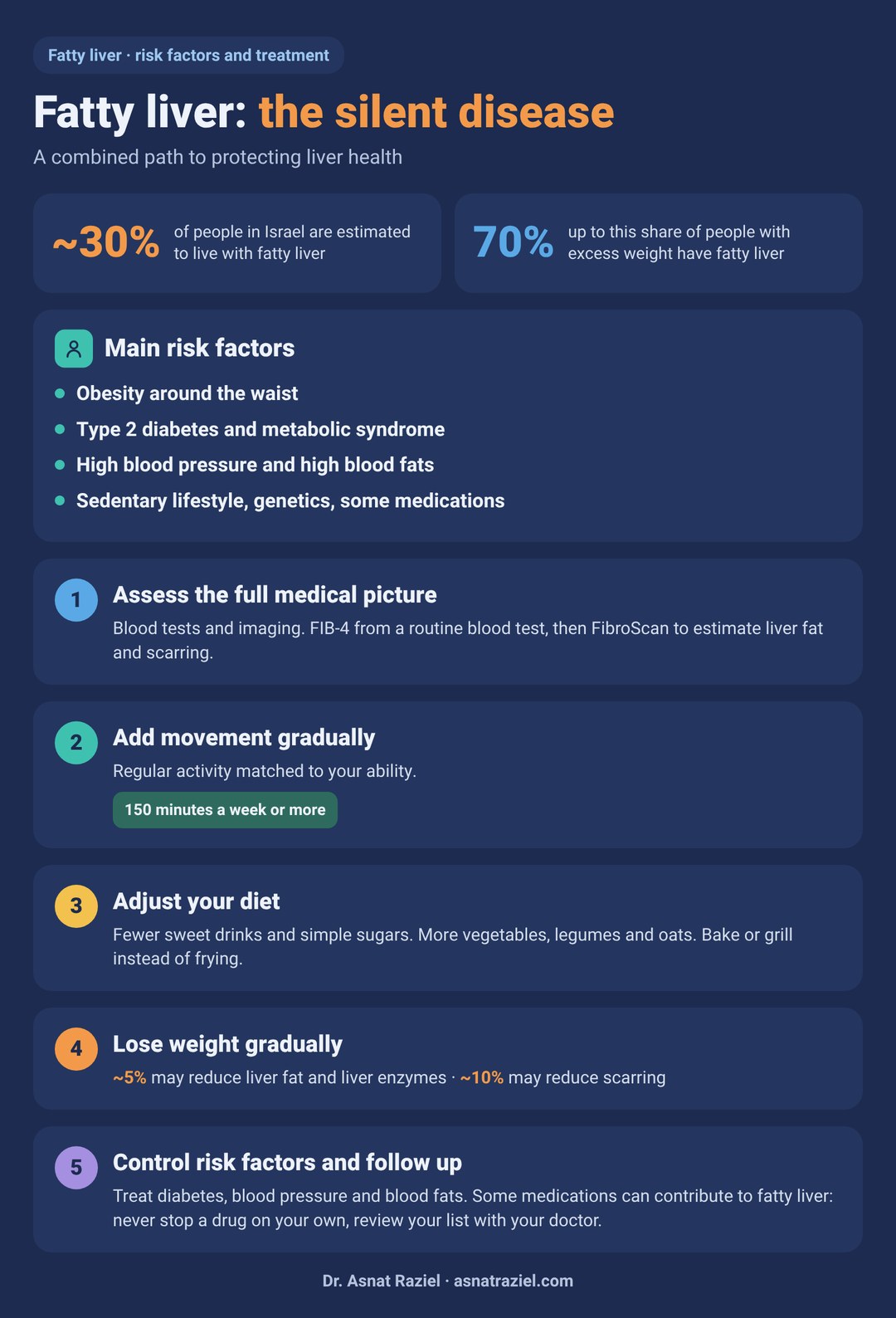
Knowing the fatty liver risk factors matters, because experts estimate that about 30% of people in Israel live with fatty liver. There are usually no early signs, so the finding turns up in blood tests or imaging. The main treatment combines physical activity, dietary changes and gradual weight loss, along with control of diabetes, blood pressure and blood fats.
It is understandable that such a finding can be worrying. Fat buildup in the liver does not always progress, but in some people it can cause inflammation and scarring, and later even cirrhosis. Medical follow-up helps assess the state of the liver and the related risk factors.
Here you will learn how fatty liver develops, which metabolic factors are linked to it and what you can do to reduce the risks. We will review how doctors evaluate the condition, the principles of lifestyle change and the place of new treatment options. This way, you can understand what the finding means and which next steps to consider.
Further reading: glutathione supplements.
Key takeaways
- Learn which metabolic conditions can raise the risk, and how they relate to liver health.
- Get to know lifestyle steps that may support treatment, along with control of diabetes, blood pressure and blood fats.
- Understand how fat buildup can develop into inflammation, scarring and cirrhosis.
- Discover how holistic obesity care and follow-up can help you deal with the risk factors.
Fatty liver risk factors and treatment
Obesity around the waist, type 2 diabetes, high blood pressure and high blood fats all raise the risk of fat building up in the liver. Among people with excess weight, the condition may affect up to 70%. Lack of physical activity, a sedentary lifestyle and genetic factors may also play a part. In addition, drugs such as tamoxifen, amiodarone (Procor) and steroids can contribute to it. Don’t stop any medication on your own; show your doctor your list of medications.
Treatment focuses on changing habits and controlling related conditions. Losing about 5% of body weight may reduce liver fat and liver enzymes. Losing about 10% may reduce scarring. Regular physical activity, built up gradually and matched to your ability, can be part of the plan. The usual recommendation is at least 150 minutes a week. In your diet, cut down on sweetened drinks and simple sugars, and prefer vegetables, legumes and oats, which are rich in fiber. Baking or grilling can replace frying. A holistic approach to obesity treatment combines movement habits, nutrition and ongoing support.
It is also important to treat diabetes, high blood pressure and high blood fats. Blood tests or imaging sometimes reveal fatty liver, and an ultrasound may show a fatty texture. The medical team weighs the test results and the risk factors to decide on further evaluation and follow-up. The pace of weight loss alone cannot tell how the liver will change. Therefore, build a gradual change you can stick with, and track your medical results along the way.
Metabolic fatty liver risk factors
The clinical meaning is not set by a single measurement, but by a cluster of metabolic problems. When several measures change together, it is important to assess overall health. Your doctor may look at blood sugar and lipid tests, blood pressure and waist size as one picture. This way, links between the liver and metabolic health become visible, rather than relying on one isolated finding.
The link works in both directions: metabolic problems may come with fat buildup in the liver, and the condition is also tied to heart and blood vessel disease. That is why follow-up does not stop at a liver check. It may include a heart risk assessment and a review of metabolic measures, alongside evaluation of the liver findings. A combined approach helps show which health problems need attention at the same time.
A young age does not rule out fatty liver either, since the disease can also appear in children and teenagers. The metabolic context matters even without symptoms: liver findings may turn up during a medical workup for another reason. Reviewing fatty liver risk factors can help decide whether more tests and follow-up are needed. It also explains why two people with a similar finding may need a different evaluation, depending on their overall health.
The main causes of non-alcoholic fatty liver
The main causes of non-alcoholic fatty liver include obesity, lack of physical activity and a sedentary lifestyle, metabolic syndrome and genetic factors. So assessing fatty liver risk factors is not about weight alone: activity level, the possibility of metabolic syndrome and genetics all count. Non-alcoholic fatty liver is also linked to excess weight, high blood pressure, diabetes and high blood fats. These links show why fatty liver risk factors deserve a review as a whole, rather than assuming one factor explains everything.
Among people with excess weight, fatty liver affects up to 70%. In addition, about 80% of people living with obesity also have fatty liver. These figures show a common link between excess weight, obesity and fatty liver, but they do not replace attention to the other risk factors. When reviewing the picture, also look at lack of activity and a sedentary lifestyle, metabolic syndrome, high blood pressure, diabetes and high blood fats. This way, you can tell the different fatty liver risk factors apart and weigh them together as part of a metabolic health assessment, without narrowing the picture to weight alone.
From fatty liver risk factors to inflammation, scarring and cirrhosis
Fat buildup in the liver does not always cause advanced damage. In some people, chronic inflammation develops and can harm liver cells. The body tries to repair the damage, but the process may create scar tissue, called fibrosis. By some estimates, about 10%-20% of people with fat buildup in the liver may develop inflammation and scarring. That is why it is important to assess not only the amount of fat, but also the state of the tissue.
According to the US Food and Drug Administration (FDA), about 6-8 million people in the United States have NASH with moderate to advanced liver scarring. NASH is liver inflammation linked to fat buildup. In some patients, extensive scarring can progress to cirrhosis. In cirrhosis, scar tissue replaces healthy tissue, and this disrupts blood flow and liver function.
The disease does not progress the same way in everyone. By some estimates, about 3%-5% of people may develop cirrhosis and even primary liver cancer. Fatigue, discomfort in the upper right abdomen, swelling and jaundice may appear once significant damage has occurred. The absence of symptoms says little, on its own, about the degree of scarring.
How the liver is evaluated
The workup combines clinical measures and blood tests with imaging as needed. FibroScan is a non-invasive test that estimates the amount of fat and the degree of scarring in the liver. Losing 7%-10% of body weight may reduce inflammation, and in some patients also improve fibrosis measures. However, there is no certainty that it will stop fibrosis from progressing or reverse it; the effect depends on the state of the liver and other medical factors. Alcohol can speed up scarring, so it is important to discuss your drinking as part of follow-up.
A simple first step before a FibroScan is the FIB-4 score, calculated from your age, the AST and ALT liver enzymes and the platelet count in a routine blood test. Enter the values from your latest blood test in the calculator:
🧪 FIB-4 calculator for fatty liver
Enter four values from a routine blood test to estimate your risk of advanced liver fibrosis (scarring).
Dr. Asnat Raziel
Dr. Asnat Raziel offers holistic obesity treatment and follow-up, which may help with metabolic risk factors linked to liver health. The process does not focus on weight alone; it also addresses movement habits, nutrition, your health status and your personal needs. This way, we can review the wider picture and combine medical support with practical lifestyle changes that fit your goals and health.
When excess weight or obesity comes with diabetes, high blood pressure or abnormal blood fats, it is important to address these factors together. Holistic obesity treatment and follow-up help track progress and show which habits need attention. Depending on your condition and medical judgment, we may also consider obesity medication. Medications do not replace a medical evaluation of the liver or its follow-up.
Treatment may include work on eating habits, physical activity and stress, along with medical support. Phone consultations offer guidance as part of the service. Lectures on obesity and healthy living give knowledge and tools to groups and communities. On every path, the team considers your health and personal goals, without promising the same result for everyone.
If a liver finding has joined your experience with obesity, you can explore how obesity support fits into your medical picture. Liver follow-up and treatment of related conditions remain an important part of that picture. You can contact Dr. Asnat Raziel to ask about support options, at a pace that suits you.
A surprising link between the liver and the brain: in a new study in rats, a treatment that rejuvenated liver blood vessels halved blood levels of amyloid, the protein linked to Alzheimer’s.
Frequently asked questions
What is the treatment for this condition?
Treatment focuses on easing the metabolic load and protecting liver health over time. Along with changes in diet and movement, the medical team may consider obesity medication when it is medically appropriate. It is important to tell apart treating the risk factors from treating the liver directly, and to coordinate follow-up with the professionals who know your situation.
What does the diagnosis mean?
The diagnosis describes fat buildup in liver cells, but it does not show on its own whether damage or inflammation has developed. To understand the finding, doctors review your medical history, lab tests and suitable imaging. This way, doctors can tell simple fat buildup apart from a condition that needs deeper evaluation and follow-up.
Which fatty liver risk factors matter most?
The risk rises when several metabolic conditions occur together, but certain medications and a genetic tendency may also be relevant. For example, a person with type 2 diabetes, a larger waist and a drug that affects the liver may need a broader evaluation. Don’t change medications on your own; it is important to bring the medical details into the evaluation.
More on the site:
Liver fibrosis in people with obesity
Metabolic risk in teens
Metabolic fatty liver in the clinic