By Dr. Asnat Raziel, bariatric surgeon specializing in obesity treatment, metabolic health and healthy longevity; Director of the Multidisciplinary Center for Obesity Treatment, Assia Medical, Assuta Ramat HaChayal, Tel Aviv
The liver and Alzheimer’s: a link that starts outside the brain
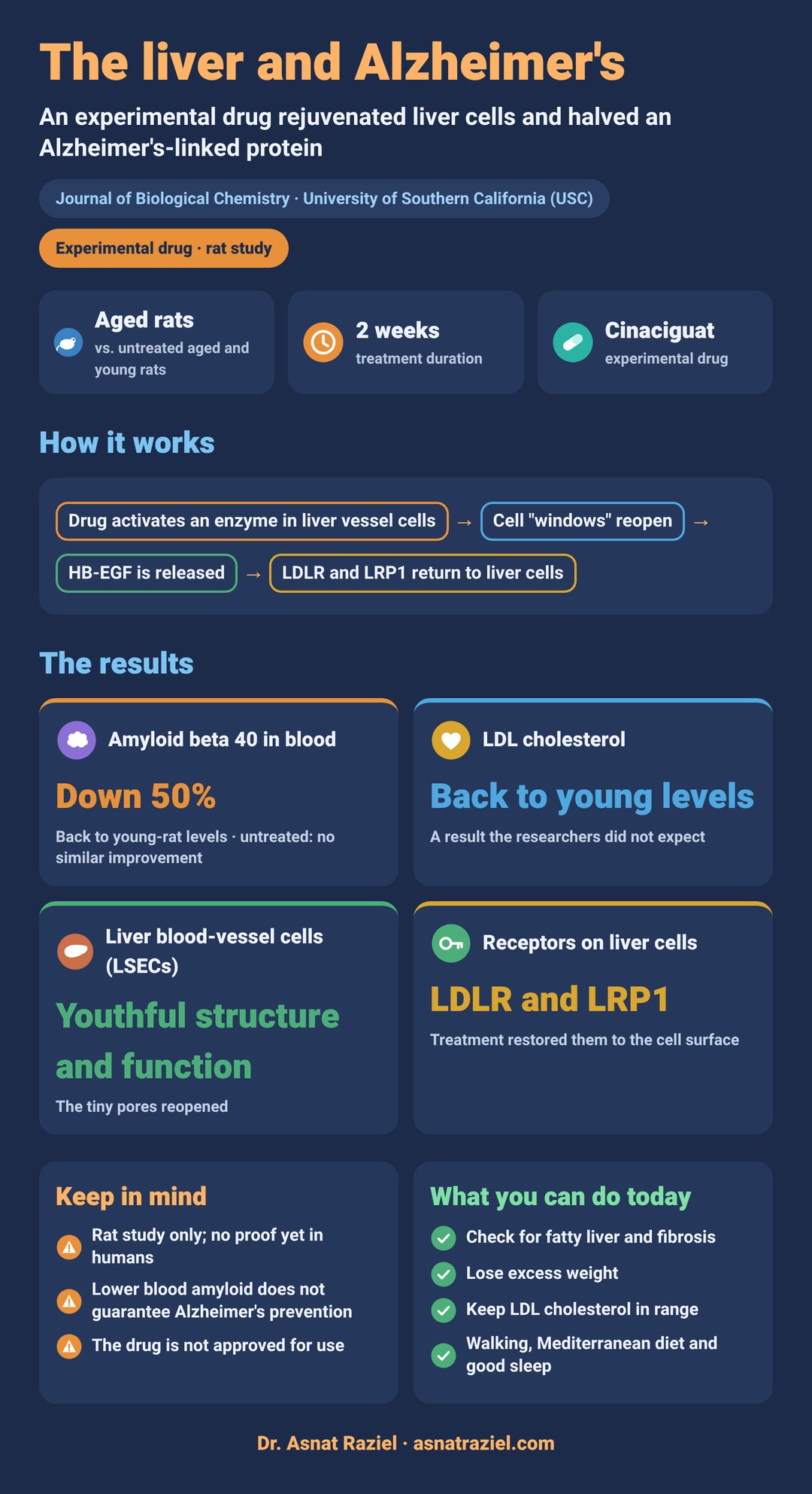
The liver and Alzheimer’s sound like two separate worlds. However, a new study from the University of Southern California (USC) connects them. Researchers treated older rats with an experimental drug for two weeks. After treatment, blood levels of the protein amyloid beta fell by half and returned to the levels seen in young rats.
In addition, levels of “bad” LDL cholesterol also dropped back to youthful levels, which the researchers did not expect. The study, published in the Journal of Biological Chemistry, points to an intriguing new direction: protecting the brain through the liver.
What clears amyloid from the blood?
Amyloid beta is a protein that builds up in the brains of people with Alzheimer’s disease and forms plaques there. Much of it also circulates in the bloodstream. Most amyloid in the blood rides on large fat-carrying particles called lipoproteins. The liver is the organ that removes these particles from the blood.
Special cells line the tiny blood vessels in the liver: liver sinusoidal endothelial cells, or LSECs. These cells have tiny pores, like little windows. Large molecules pass through them to the liver cells, which then clear them from the blood. With age, however, most of these windows close. As a result, large particles struggle to reach the liver cells, and blood clearance slows down.
The liver and Alzheimer’s study: what the researchers tested
The team, led by Laurie DeLeve and Sam de Leve, gave older rats the experimental drug cinaciguat for two weeks. The drug activates an enzyme called soluble guanylate cyclase in the liver’s blood-vessel cells. The researchers then compared the treated rats with two untreated groups: older rats and young rats.
The results: amyloid and LDL back to youthful levels
First, the treatment reopened the windows in the liver’s blood-vessel cells. The cells regained the structure and function of young cells and cleared substances from the blood better. According to the researchers, this is the first study in which a drug fully restored the structure and function of these cells.
Second, blood levels of amyloid beta 40 fell by half, down to the levels of young rats. By contrast, the untreated older rats showed no similar improvement.
Third, LDL levels also fell to those of young rats. LDL is the “bad” cholesterol that raises the risk of atherosclerosis. This came as a surprise because LDL particles are small. They cross the liver’s blood-vessel lining even when the windows stay shut. So the researchers looked for another mechanism.
The mechanism: a signal from blood-vessel cells to liver cells
The team found that young blood-vessel cells release a growth factor called HB-EGF. This signal tells nearby liver cells to display receptors that capture LDL and amyloid, namely LDLR and LRP1. Aging cells still make the factor but never release it. The treatment restored HB-EGF release, and with it the receptors on the liver cells.
Keep in mind: this is a rat study
This is an early step, and it has clear limits. First, all the results come from rats, and there is no proof yet that they hold in humans. Second, lower amyloid in the blood does not guarantee fewer brain plaques or protection from Alzheimer’s. The researchers themselves stress that they need more studies.
Next, they plan to test whether the drop in amyloid actually protects the rats’ brains. Also, cinaciguat is not an approved drug, and it is not available in the clinic today.
What this means for the liver and Alzheimer’s
Despite these caveats, the finding is exciting. According to an estimate cited in the report on the study, about 98% of Alzheimer’s drugs that act directly in the brain fail in clinical trials. One reason is the blood-brain barrier, which makes it hard for drugs to reach the brain.
That makes the liver an attractive target: it is easy to reach, and it cleans the blood around the clock. Moreover, the finding fits earlier population data. Older age raises the risk of both Alzheimer’s and atherosclerosis, and liver damage is a risk factor for Alzheimer’s. In other words, the link between the liver and Alzheimer’s now has a possible biological explanation.
What you can do today for your liver and brain
This drug is still far from the clinic. Even so, the liver, cholesterol and the brain work together, and each already has proven tools.
Check your liver. Fatty liver is very common in people with obesity, and it is usually silent. It is worth checking, including a simple blood-test estimate of liver scarring (fibrosis), because obesity affects the liver, kidneys and heart together.
Lose excess weight. Weight loss reduces liver fat and improves metabolic health. GLP-1 medications can help with this, and an Israeli study linked them to less dementia.
Keep LDL in range. A blood lipid test and treatment when needed protect your blood vessels, in the heart and in the brain.
Move, eat well and sleep. Daily walking, a Mediterranean diet and good sleep benefit both the liver and the brain. Read more about exercise and the brain.
The bottom line on the liver and Alzheimer’s
In rats, two weeks of treatment returned aging blood-vessel cells in the liver to youthful function. As a result, blood amyloid fell by half, and LDL also returned to youthful levels. This is not yet a treatment for people. Still, the study adds a piece to the picture that ties the liver and Alzheimer’s together, and it reminds us that a healthy liver is also an investment in the brain.
This article provides general information and does not replace personal medical advice.
Sources
Reversing liver sinusoidal endothelial aging restores clearance of amyloid-beta and LDL
Scientists reverse liver cell aging and cut Alzheimer’s-linked protein in half
Grants from the US National Institutes of Health (NIH) funded the study.