By Dr. Asnat Raziel, bariatric surgeon specializing in obesity treatment, metabolic health and healthy longevity; Director of the Multidisciplinary Center for Obesity Treatment, Assia Medical, Assuta Ramat HaChayal, Tel Aviv
Obesity and the liver: where multi-organ damage begins
Obesity and the liver are closely linked, but the liver is only part of the picture. It gradually harms the kidneys, the heart and the blood vessels too, and it does so at the same time. For years we treated obesity as a risk factor for diabetes and heart disease. However, three lectures at the ObesityWeek conference painted a much broader picture. Obesity is a biological process that damages several body systems at once. So the practical message is clear: don’t wait for complications, and don’t rely on a single normal blood test.
The lectures covered three topics. First, the CKM model and what it means for treatment. Second, the liver as an organ that both suffers from the disease and makes it worse. Finally, the hormone glucagon, which turns out to be far more than a “sugar hormone”.
What is the CKM model?
CKM stands for Cardiovascular-Kidney-Metabolic, meaning the link between the heart and blood vessels, the kidneys and metabolism. The American Heart Association defined the model to describe how the disease progresses in stages. The speakers stressed that the goal is to identify patients early and stop that progression.
The four stages of the CKM model
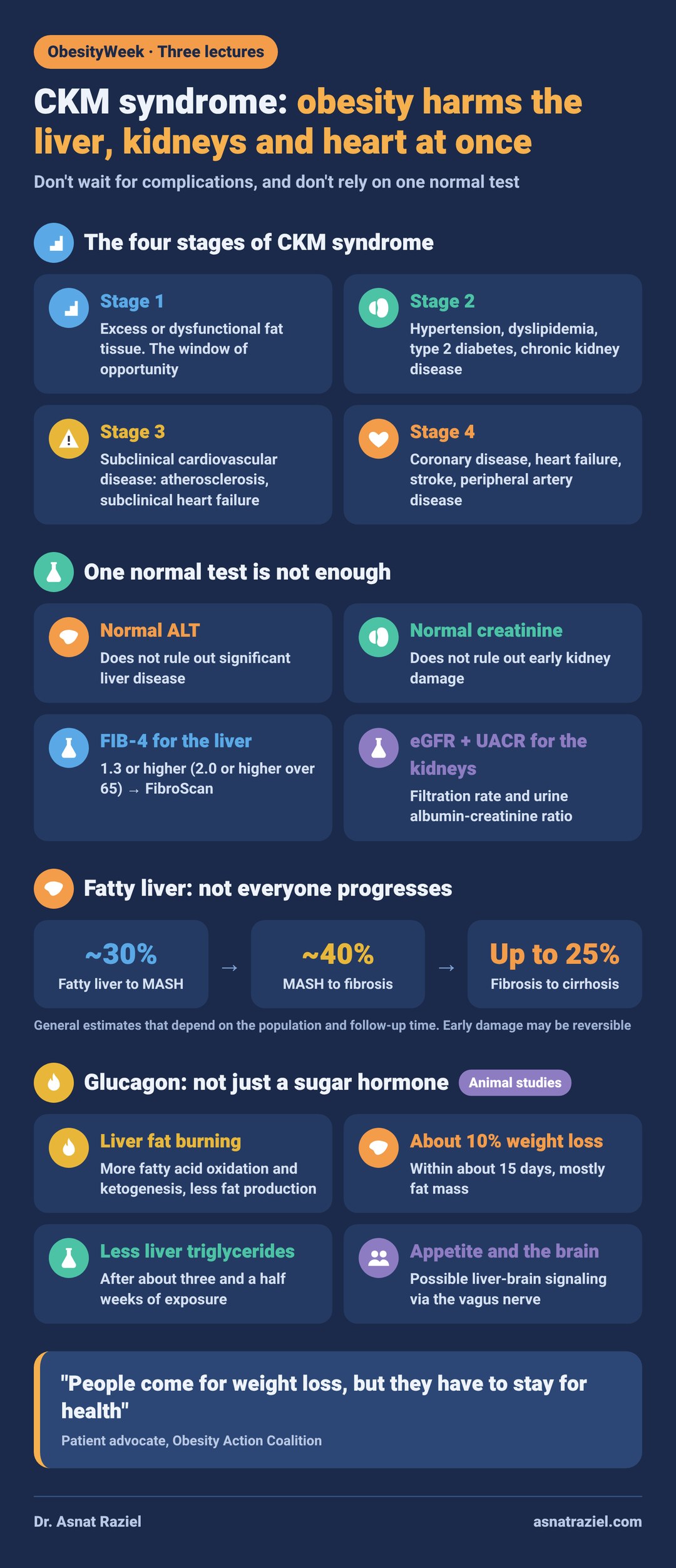
- Stage 1: Excess fat tissue, or fat tissue that doesn’t work properly. This includes abdominal obesity and early problems with blood sugar control. This is the window of opportunity for treatment.
- Stage 2: Metabolic risk factors or kidney disease appear. Examples include high blood pressure, abnormal blood lipids, metabolic syndrome, type 2 diabetes and chronic kidney disease.
- Stage 3: Heart and vascular disease without symptoms, such as atherosclerosis or subclinical heart failure. Very high-risk states also belong here.
- Stage 4: Clinical heart and vascular disease, such as coronary heart disease, heart failure, stroke or peripheral artery disease.
The lecture was clear on this point: don’t wait for heart disease to appear. Instead, start treatment in the early stages.
Not all fat tissue behaves the same way
Sometimes the fat tissue under the skin can expand in a healthy way. In that case it stores the extra energy, and the metabolic profile stays relatively healthy. But when fat tissue loses this storage capacity, free fatty acids spill into other tissues. In addition, the release of adipokines, the hormones made by fat tissue, goes off balance. As a result, fat builds up in organs that were never meant to store it. Researchers call this process Lipid spillover. I have also written about the value of healthy fat tissue.
A chain of organ damage
- In muscle: less glucose uptake and insulin resistance.
- In the liver: more glucose production and more fat released into the blood (VLDL), along with lower insulin clearance.
- In the pancreas: damage to the beta cells that make insulin.
- In the heart and blood vessels: inflammation, vascular damage and extra strain on the heart.
- In the kidneys: pressure on the kidney’s blood vessels, changes in pressure inside the kidney, and activation of hormonal and nervous system pathways.
What does this mean? Two people with a similar BMI don’t necessarily carry the same risk. Fat distribution, how well fat tissue works and how much the organs are affected matter as much as total fat mass.
Obesity and the liver: victim and accomplice
The link between obesity and the liver starts with this “spilled” fat: the liver is one of the first organs to absorb it. The result is fatty liver, known medically as MASLD. Still, the relationship runs both ways. Obesity and insulin resistance contribute to fatty liver. In turn, damaged liver metabolism worsens insulin resistance, type 2 diabetes, blood lipid problems and heart risk. These effects can appear early, long before cirrhosis. Sometimes blood tests don’t even reflect how severe the disease is.
It’s important to remember that not every fatty liver progresses. Not everyone with MASLD will develop fatty liver inflammation (MASH), and not everyone with MASH will develop cirrhosis. The move to MASH involves liver cell damage, “swollen” cells (Hepatocyte ballooning) and inflammation. These changes raise the risk of scarring, or fibrosis.
The lecture presented general estimates of progression rates: about 30% from fatty liver to MASH, about 40% from MASH to fibrosis, and up to 25% from fibrosis to cirrhosis. These estimates depend on the population and on follow-up time, and they are not a personal forecast. The good news is that in the early stages much of this process may be reversible. In contrast, at the cirrhosis stage the chance of full repair is very limited.
Three paths of damage that progress side by side
- In the liver: from fatty liver to MASH with fibrosis, and later to cirrhosis and liver failure.
- In the heart and blood vessels: from early damage to the vessel wall to atherosclerosis, coronary disease, structural heart changes and heart failure.
- In the kidneys: from early albumin protein in the urine to significant albumin loss, declining kidney function and advanced kidney disease.
These paths don’t move forward one at a time. A person with obesity may develop liver disease, kidney damage and heart disease all at once. That’s why finding problems in time, and checking every system together, matters so much.
Obesity and the liver: why one normal test is not enough
ALT, one of the liver enzymes, can be normal even when there is significant liver disease. Similarly, an apparently normal creatinine does not rule out early kidney damage. So the assessment should include several tests:
- For the liver: the FIB-4 score, calculated from age, the liver enzymes AST and ALT, and the platelet count. A value of 1.3 or higher, or 2.0 or higher over age 65, calls for a second test such as FibroScan (Transient elastography).
- For the kidneys: an eGFR calculation, which estimates kidney filtration, and a urine albumin-to-creatinine ratio (UACR), which detects early damage.
If the FibroScan points to high risk, further evaluation is warranted. At low risk, follow-up continues and the risk assessment is repeated after one to three years. The timing depends on the metabolic profile and risk factors.
Keep in mind that FIB-4 does not diagnose fibrosis directly. It helps sort people by risk and decide who needs more testing. According to the data presented, fatty liver affects about a quarter of the population, and many people don’t know they have it. That’s why tracking liver enzymes, or relying on an incidental “fatty liver” finding on ultrasound, is not enough. I explain every step of the workup in my article on fatty liver tests, FIB-4 and FibroScan. These recommendations match the guidance of the American Association for the Study of Liver Diseases and of the European societies.
Glucagon: a hormone that links obesity and the liver
Another lecture invited us to rethink glucagon. Alpha cells in the pancreas make this hormone, and its best-known role takes place in the liver. There it breaks down glycogen stores into glucose (glycogenolysis) and makes new glucose (gluconeogenesis). But the glucagon receptor in the liver has other roles as well:
- Boosting the burning (oxidation) of fatty acids.
- Boosting the production of ketone bodies (ketogenesis).
- Reducing fat production in the liver.
- Increasing amino acid uptake and the urea cycle.
- Possible effects on fullness, food intake and energy expenditure.
Glucagon receptors sit mainly in the liver, but they are also present in the kidneys and pancreas. In addition, they appear at lower levels in other tissues.
Glucagon, hunger and the brain
Glucagon may also help regulate appetite through communication between the liver and the brain. The lecture described a possible pathway through the vagus nerve, the NTS nucleus in the brainstem and circuits in the hypothalamus. However, some of this evidence comes from animal studies. So we can’t yet say that all of these effects work the same way in humans.
Another interesting point: after a mixed meal, glucagon levels may rise alongside glucose and insulin. In obesity, glucagon release and activity may become disrupted. This disruption may contribute to problems with blood sugar control and energy regulation. In other words, what glucagon does depends on the tissue it acts on and the metabolic context.
What animal studies showed
In animal studies, activating the glucagon receptor led to weight loss. One study measured about 10% weight loss within about 15 days, mostly from a reduction in fat mass. In the liver, short exposure to glucagon increased fatty acid burning. Also, longer exposure of about three and a half weeks reduced the amount of liver triglycerides.
These findings explain the biological basis for drugs that activate the glucagon receptor together with other receptors, such as survodutide for fatty liver. It’s important to stress that the data presented in the lecture come from animals, not from results in humans.
Treatment: don’t wait for complications
The speaker described the need for teamwork among family doctors, obesity specialists, cardiologists, endocrinologists, nephrologists and hepatologists. Even so, the message was not that every person with obesity needs several specialists. In fact, the doctor who sees the patient early can spot the process, start treatment and stop it from progressing. In other words, instead of waiting for complications before referring to a specialist, we treat the core problem: excess fat tissue that doesn’t work properly. That way we can act before the organs suffer irreversible damage.
The speakers also warned against fragmented care. Sometimes patients get medication through online services or dedicated programs. Meanwhile, follow-up of the liver, kidneys, diabetes and heart risk happens somewhere else. But successful treatment is more than a prescription or a lower number on the scale. It requires continuity of care, regular reassessment of metabolic risk and attention to overall health. I have also written about the continuum of medication and surgery for obesity.
Come for the weight, stay for the health
At the end of the session, a representative of the patient organization Obesity Action Coalition, who has lived with obesity for decades, spoke. Her message was simple: “People come for weight loss, but they have to stay for health”. Many people seek treatment to lose weight. But to stick with it over time, it helps to understand that the real goal is health, not the number on the scale. Even when weight drops thanks to effective treatment, the disease hasn’t necessarily gone away. Sometimes it’s obesity that is well controlled on treatment. This distinction matters especially in a chronic, relapsing disease.
She also spoke about stigma, including within the healthcare system. Many patients have faced judgment from professionals, and some have come to believe that obesity is a personal failure. That belief can lead people to avoid treatment, or to drop follow-up after regaining weight. Even a small step, like weighing patients in private rather than in front of others, changes the care experience. The better the public and medical teams understand the complex biology of obesity, the more stigma will fade. I wrote more about this in my article on weight bias in healthcare.
Obesity and the liver: what you can do today
- If you have obesity, type 2 diabetes or a metabolic disorder, ask your doctor to calculate your FIB-4 score from your existing blood tests. Also ask for an eGFR and a urine albumin-to-creatinine ratio.
- Normal liver enzymes or creatinine are no reason to stop looking. If you were told you have “fatty liver” on ultrasound, ask whether you need an assessment of fibrosis.
- Weight loss, a Mediterranean diet, physical activity and cutting back on alcohol are the foundation of fatty liver treatment. They matter most in the early stages, when the damage may be reversible.
- Modern obesity treatment, including medication and, when appropriate, surgery, also affects the liver, kidneys and heart.
- If you take medication for obesity, make sure it’s part of your overall medical follow-up.
The bottom line on obesity and the liver
Obesity and the liver are just the starting point: obesity is a multi-system disease that harms the liver, kidneys and heart at the same time. Two people with the same BMI can face very different risks. In addition, one normal test does not rule out damage. The liver is an active partner in the disease, and glucagon is emerging as a hormone with a broad effect on fat burning and energy balance. Ultimately, early detection, assessment of every system and continuous care focused on health make it possible to change the course of the disease.
This article provides general information and is not a substitute for personal medical advice.
References
Cardiovascular-Kidney-Metabolic Health: A Presidential Advisory From the American Heart Association
ObesityWeek lectures: “Rethinking the role of glucagon”; “The liver as a central player in metabolic disease: from obesity to MASH and fibrosis”; “Obesity as a cardio-kidney-metabolic disease: the importance of early intervention and multidisciplinary care”