By Dr. Asnat Raziel, bariatric surgeon specializing in obesity treatment, metabolic health and healthy longevity; Director of the Multidisciplinary Center for Obesity Treatment, Assia Medical, Assuta Ramat HaChayal, Tel Aviv
Mental health after weight loss: the topic few people talk about
Mental health after weight loss rarely gets the attention it deserves. Losing weight improves health, mobility and quality of life. Still, it doesn’t fix everything. At ObesityWeek 2026 near Washington, D.C., a full symposium was devoted to this question. The key message: less stigma, and a sense of worth that depends less on weight, track with psychological health far more closely than the number on the scale.
Three women spoke. Patty Nece, an attorney and longtime patient advocate, shared her own experience. Dr. Gretchen Ames, a clinical health psychologist at Mayo Clinic, talked about the role food plays in our lives. Finally, Dr. Larissa McGarrity of the University of Utah presented follow-up data from bariatric surgery patients.
“If you just lose the weight, your life will be perfect”
Over the years, Patty lost what she calls “another adult.” That is, more than 45 kg. Even so, she prefers not to talk about numbers. For her, the goal is health and well-being, not weight. All her life, she heard that losing weight would make her life perfect. She asked the audience whether weight loss brings a perfect life. Not a single hand went up.
The benefits were real: better health, easier movement and less stigma. However, emotional and relationship struggles did not disappear. In addition, food was no longer available the way it used to be as a way to calm down. Patty had eaten for comfort her whole life. So she had to find new ways to cope with distress. When food stopped soothing her, old feelings surfaced, sometimes as outsized anger over small things.
The inner bully and anger at the new treatment
Internalized stigma stayed, too. Patty said she had become “my own bully,” saying cruel things to herself about her body. What’s more, she was angry at the warmer treatment she got after losing weight. Suddenly people opened doors and started conversations with her, although she was exactly the same person. Weight maintenance also brought new stress. When the weight began to come back, she cut her eating drastically out of panic, and her weight kept rising.
Her conclusion is clear: genuine mental health care should be part of obesity treatment all the way through, including the maintenance phase. She herself has been seeing a psychologist who specializes in obesity for about 10 to 12 years. In her words, this support is essential, yet sorely lacking in the system.
What role does food play in your life?
Dr. Ames opened with an important principle: patients should not have to earn treatment. In the past, patients were expected to fix their eating habits and prove they were ready before surgery. According to Dr. Ames, the three-, six- or 12-month waiting periods that insurers require have little or no effect on outcomes. On the other hand, the longer people wait, the less likely they are to reach care.
She described “Alice” (not her real name), 43, with a BMI of 60, sleep apnea, high blood pressure and knee pain. Alice believed she had to get her emotional eating under control before she “deserved help.” Moreover, when she tried semaglutide on her own, it made her angry, because food no longer comforted her the way it used to.
The first question was about her earliest memory of using food for comfort. The answer: age seven, when her mother became ill and died. From then on, food was her safe place. Instead of demanding overnight change, Dr. Ames worked with her on self-compassion and values. Alice chose three goals herself: ten minutes on the walking pad in her living room, or a walk with her dogs, when stressed; reconnecting with a former therapist; and an hour outside every day, gardening and with her chickens.
How common are these eating patterns?
According to the data she presented, on self-report questionnaires 31% report loss-of-control eating and 38% emotional eating. About 32% identify with “food addiction” concepts, although food addiction is not a medical diagnosis. In clinical interviews, about 13% have a lifetime history of binge eating disorder, and night eating syndrome ranges from about 2% to 9%. Dr. Ames stressed that a questionnaire alone does not diagnose an eating disorder. Screening is meant to open a conversation, not to delay treatment.
Eating for comfort is not a disease in itself, either. It becomes a problem when it is almost the only way to cope with distress. Surgery and medication reduce appetite, meal size and food noise. But the emotional need food served may remain. As she put it, treatment can change what food can do before it changes what a patient needs food to do. That is why mental health after weight loss is worth discussing in advance, not just what goes on the plate.
Mental health after weight loss: what actually happens
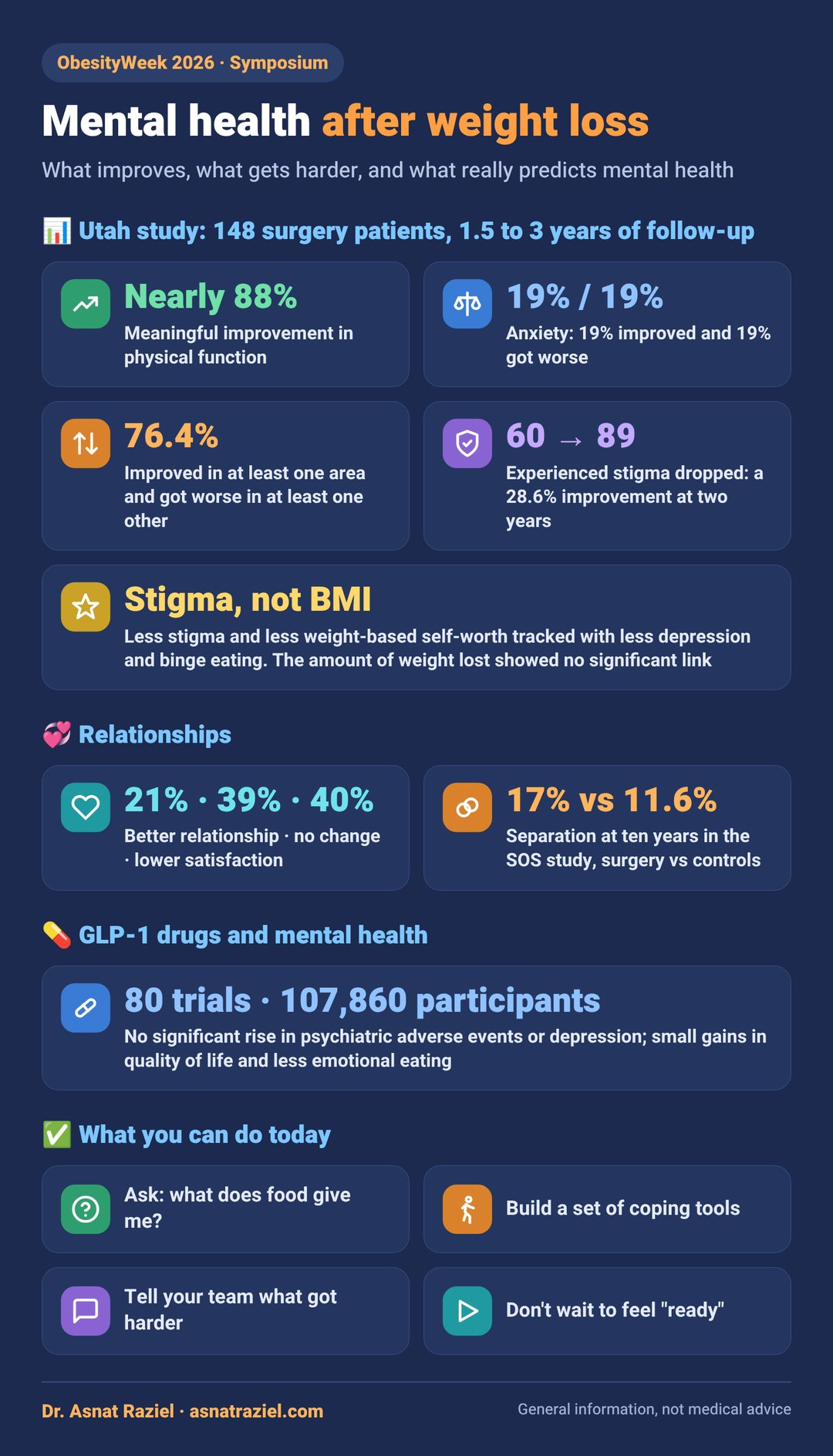
Dr. McGarrity presented a follow-up study from the University of Utah. A total of 148 patients completed questionnaires before surgery and again 1.5 to 3 years later. On average, depression, binge eating, physical function, self-esteem and work-related quality of life improved. In contrast, anxiety did not change on average. Social support and relationship satisfaction actually declined, while social stress increased.
But the average does not tell the whole story. Nearly 88% improved meaningfully in physical function. For anxiety, 19% improved and 19% got worse. Overall, 76.4% of patients improved in at least one area and got worse in at least one other. The median patient improved in four areas and worsened in one. For example, a person may move more easily and feel more confident, while shared meals at home become tense.
Stigma matters more than the number
The stigma patients experienced dropped sharply: the score improved from 60 before surgery to 89 at two years, a 28.6% improvement. Yet stigma did not disappear. In addition, a larger drop in stigma went hand in hand with improvement in depression, anxiety and binge eating. By contrast, the amount of weight lost showed no significant link to these changes. In other words, how others treat a person predicts mental health, not weight itself. I wrote about this in my article on weight bias in health care.
Similarly, the researchers looked at how much self-worth depends on weight and shape. On average, this dependence decreased. Change in it explained an additional 14% of depression after surgery and 13% of binge eating, regardless of the change in BMI. So when self-worth still hinges on weight, a plateau or weight regain can feel like a threat to identity. In that situation, mental health after weight loss needs close support from the care team.
Relationships, body and identity: mental health after weight loss
Among patients who stayed with the same partner, 21% reported a better relationship, 39% no change and 40% lower satisfaction. The reasons: mismatched activity levels, changing shared food routines, questions of intimacy and body image, and partners unsure how to help without monitoring. In the Swedish SOS study, after ten years, 17% of married surgery patients had separated or divorced, compared with 11.6% of matched controls. On the other hand, 34.8% of single surgery patients married or entered a new relationship, compared with 19.4%. I covered this in more depth in my article on weight loss drugs and relationships.
The body also needs time to feel like “mine.” Patients describe freedom alongside grief, excess skin, and an identity that hasn’t caught up yet. For example, some people still scan a restaurant for a sturdy chair, years after they no longer need one. These habits formed over many years, so they change slowly.
Mental health after weight loss in the GLP-1 era
A large meta-analysis of 80 randomized trials with 107,860 participants found no significant increase in serious or non-serious psychiatric adverse events, and no worsening of depressive symptoms. The researchers also saw small improvements in quality of life, less emotional eating and more eating restraint. However, many trials were in diabetes, follow-up was short, and people with significant psychiatric conditions were usually excluded.
Dr. McGarrity raised several open questions. Does stigma shift from weight to the medication, as the “easy way out”? What happens to family meals and intimacy? And what happens when treatment stops because of cost, side effects or weight regain? I wrote about preparing for that stage in my article on stopping GLP-1 without regaining all the weight.
Mental health after weight loss: what you can do today
Here are a few simple steps that came out of the symposium:
- Ask yourself what food gives you. Comfort, pleasure, connection or a sense of safety? What else could give you that?
- Build a set of coping tools in advance. A short walk, a talk with a friend, time in nature or self-compassion and mindfulness.
- Notice what has become harder, too. Not only what has improved. Tell your care team about it.
- Bring your partner into the conversation. Agree together on what support looks like, and what feels like monitoring.
- Don’t wait until you feel “ready.” You don’t need to fix your eating before starting treatment.
- Seek professional help if binge episodes, purging, extreme restriction, compulsive weighing or intense fear of weight gain appear.
At our center, the dietitian is part of the team, and we refer patients as needed to psychologists and other body-and-mind professionals. The language we use to talk about obesity is part of care, too. That is why The Obesity Society gathers resources to end weight stigma.
The bottom line
Emotional changes after weight loss are not a sign of failure. They are part of the journey. Ultimately, most patients gain a lot, but most also have at least one area that becomes harder. The best care looks beyond the scale: it asks what has improved, what has become harder, and what support would help now.
This article is general information and is not a substitute for personal medical advice.
References
Weight stigma and bariatric surgery: Prospective improvements, psychological health, and weight
Glucagon-Like Peptide 1 Receptor Agonists and Mental Health: A Systematic Review and Meta-Analysis
The Obesity Society: End Weight Stigma Resources
This article is based on the symposium “The Unspoken Side-Effects: Navigating the Mental Shifts of Weight Loss” at ObesityWeek 2026.