By Dr. Asnat Raziel, bariatric surgeon specializing in obesity treatment, metabolic health and healthy longevity; Director of the Multidisciplinary Center for Obesity Treatment, Assia Medical, Assuta Ramat HaChayal, Tel Aviv
Eloralintide and tirzepatide: what the new study reported
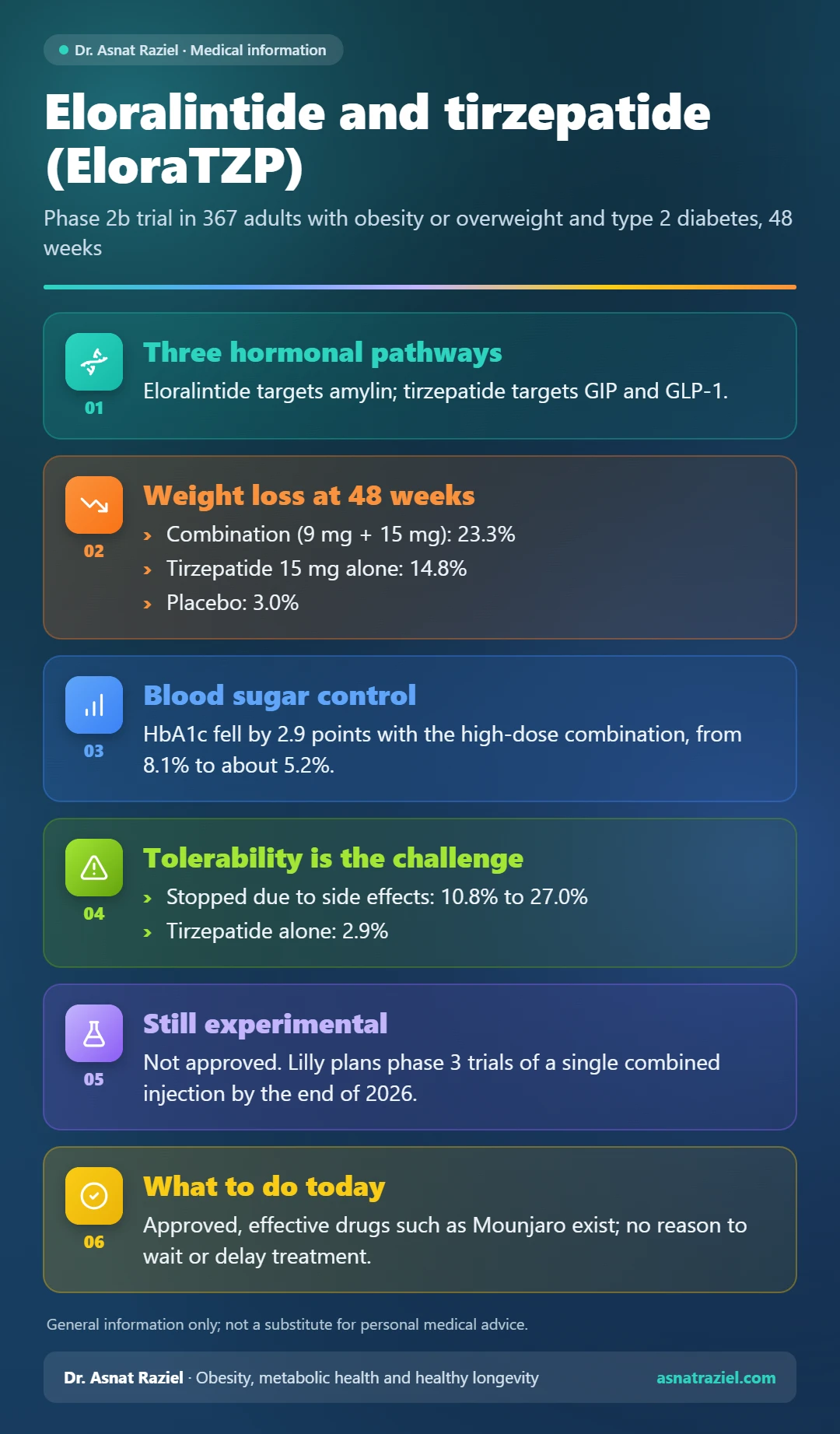
Eloralintide and tirzepatide are the two components of EloraTZP, a new experimental combination that Eli Lilly is developing. On September 30, 2026, the company reported that the combination achieved an average weight loss of up to 23.3% after 48 weeks. The trial enrolled 367 adults with overweight or obesity and type 2 diabetes. However, these results come with a clear challenge: tolerability.
The combination pairs eloralintide, which acts on the amylin pathway, with tirzepatide, the active ingredient in Mounjaro. The results were presented at the annual meeting of the European Association for the Study of Diabetes (EASD) in Milan.
Elora vs. EloraTZP: what is the difference?
To understand what is new here, it helps to keep the names straight. Eloralintide, or Elora for short, is an investigational drug from the amylin receptor agonist family. EloraTZP, by contrast, is its combination with tirzepatide. In both cases, this is an experimental treatment that is not approved for use.
Amylin is a hormone that the pancreas releases after eating, together with insulin. It helps regulate appetite and the feeling of fullness. Eloralintide mainly activates the AMY1R amylin receptor, and in this way it helps reduce food intake. It is given as a once-weekly injection. For a detailed explanation of this hormone, see my article on how amylin works.
How the eloralintide and tirzepatide combination works
Tirzepatide activates two receptors: GIP and GLP-1. Adding eloralintide creates a combination that acts on three complementary hormonal pathways: amylin, GIP and GLP-1. The idea is to broaden the effect on hunger and on blood sugar control by targeting several receptors at once.
This approach is not entirely new. Novo Nordisk also combines amylin with GLP-1 in CagriSema. In addition, a review of the next generation of amylin drugs gives a picture of the field as a whole.
What the phase 2b trial found
This was a randomized, double-blind, placebo-controlled trial that lasted 48 weeks. At the start, participants weighed 105.4 kg on average, and their average HbA1c was 8.1%. HbA1c (glycated hemoglobin) reflects average blood sugar control over the past three months. Here are the main results:
- Eloralintide 9 mg plus tirzepatide 15 mg: 23.3% weight loss and a 2.9 percentage-point drop in HbA1c.
- Tirzepatide 15 mg alone: 14.8% weight loss and a 2.4 percentage-point drop in HbA1c.
- Eloralintide 6 mg alone: 12.3% weight loss and a 1.4 percentage-point drop in HbA1c.
- Placebo: 3.0% weight loss and a 0.3 percentage-point drop in HbA1c.
In other words, people in the high-dose combination group lost, on average, more than a fifth of their body weight. Their HbA1c also fell, on average, from 8.1% to about 5.2%. Note, though, that the trial’s primary goal was to compare the combination with placebo. The comparison with tirzepatide alone was a secondary goal, so we should read it with caution.
Lower-dose combinations achieved weight loss of 13.2% to 19.9%. It is also important to know that these figures are based on an efficacy estimand. That is, the estimate assumes that all participants stayed on treatment throughout the trial, with the option to adjust the dose or pause temporarily.
Eloralintide and tirzepatide: tolerability and persistence
Alongside these results, digestive side effects were common with the combination. Most were mild to moderate and appeared mainly while the dose was being increased. However, the rate of stopping treatment because of side effects reached 10.8% to 27.0% in the combination groups. By comparison, it was 2.9% in the tirzepatide-alone group and 0% to 10.8% in the eloralintide-alone groups. Surprisingly, 16.7% stopped treatment in the placebo group.
So, when we read these results with a clinical eye, we also have to ask how many people can actually stay on treatment. An estimate that assumes continued treatment does not necessarily describe what will happen to everyone who starts it. You can read about ways to ease tirzepatide’s side effects in my guide to Mounjaro side effects.
What we know about eloralintide on its own
The new data add to an earlier study published in The Lancet in November 2025. That study included 263 people with obesity, or with overweight plus a related condition, who did not have diabetes. After 48 weeks, participants in the 9 mg group lost about 20% of their body weight on average, compared with 0.4% on placebo. Nausea and fatigue were the most common side effects.
Still, this was a different study, so we cannot compare the numbers directly. The populations differ, and so do the treatment regimens. In particular, results in people without diabetes do not by themselves predict results in people with diabetes, and vice versa. For more on the drug, see the company’s overview of eloralintide.
What’s next for eloralintide and tirzepatide
In September 2026, Lilly said it plans to start phase 3 trials of a combined product in the fourth quarter of 2026. This product will contain both drugs in a single injection, with an improved dose-escalation schedule. In the current trial, by contrast, participants received two separate injections.
Meanwhile, eloralintide alone is already being tested in a phase 3 program called ENLIGHTEN. One of its trials is studying people with obesity and type 2 diabetes. In addition, a 2026 scientific review notes that eloralintide has a distinctive side-effect profile, including fatigue, headache and reduced appetite.
What this means for people with diabetes and obesity
Today, treatment for people with diabetes and obesity already includes approved, effective medications. One of them is Mounjaro, which I cover in my article on Mounjaro for type 2 diabetes. The experimental combination is still far from the clinic. Therefore, there is no reason to wait for it or to put off an existing treatment.
On the other hand, the data show where the field is heading: combining several hormonal pathways to achieve a bigger effect. In my clinic, I already see that each patient responds differently to each medication. In the future, combinations like this may allow us to tailor treatment to each patient’s response and needs.
The bottom line
The combination of eloralintide and tirzepatide produced substantial weight loss and better blood sugar control in a phase 2b trial. At the same time, it also showed a high rate of treatment discontinuation. Moreover, a drop in weight and HbA1c does not on its own prove fewer heart attacks, preserved muscle mass or longer life. Ultimately, the place of this combination will depend on large trials, long-term safety and patients’ ability to stay on treatment.
This article provides general information and is not a substitute for personal medical advice.
References
What to know about eloralintide: An investigational selective amylin receptor agonist injection
A Study of Eloralintide (LY3841136) in Participants With Obesity or Overweight, and Type 2 Diabetes
New Amylin-Based Agonists for the Treatment of Obesity and Type 2 Diabetes Mellitus
The studies were funded by Eli Lilly and Company.




