By Dr. Asnat Raziel, bariatric surgeon specializing in obesity treatment, metabolic health and healthy longevity; Director of the Multidisciplinary Center for Obesity Treatment, Assia Medical, Assuta Ramat HaChayal, Tel Aviv
Longevity peptides: the big promise of the longevity world
Longevity peptides are one of the hottest topics in the longevity world. Influencers, private clinics and online shops promise young mitochondria, long telomeres and smooth skin. For example, the best-known names are MOTS-c, Epitalon, GHK-Cu and SS-31.
However, the gap between the promise and the evidence is very large. In this article, I separate three groups: peptides approved as drugs, peptides with early evidence, and peptides that rest almost entirely on lab studies.
Approved peptide versus “research” peptide: what is the difference?
An approved drug goes through controlled human trials, strict manufacturing checks and ongoing oversight. By contrast, sellers usually market a “research” peptide with a label saying “not for human use.” In other words, nobody has checked its safety, dose or manufacturing quality.
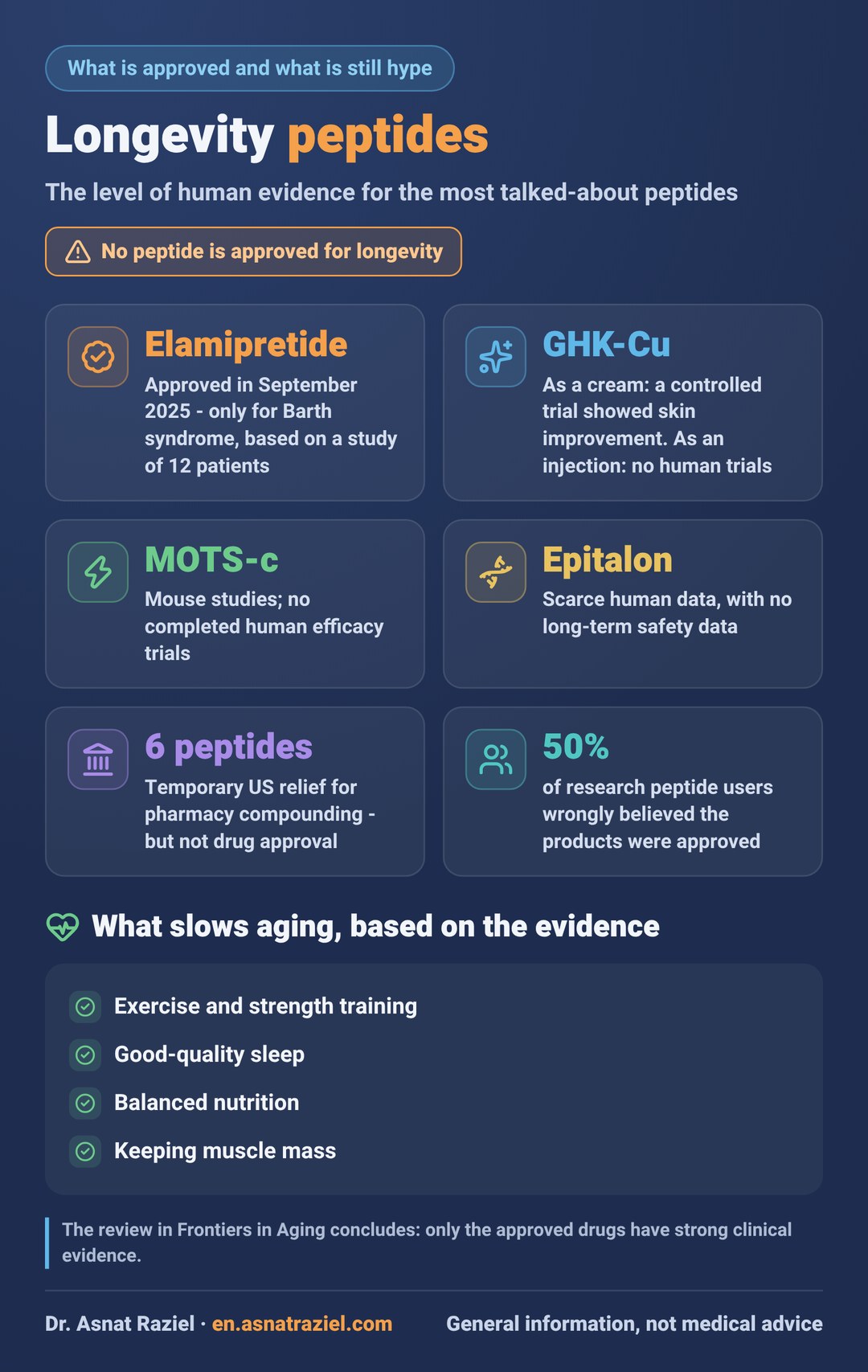
This confusion is very common. According to a Hone Health survey of 2,491 Americans, half of the people using research peptides wrongly believed the FDA had approved them.
The peptide that did win approval: elamipretide
Elamipretide, also known as SS-31, binds to the inner membrane of the mitochondria. After all, mitochondria are the cell’s “power plants.” In September 2025, the FDA granted it accelerated approval under the brand name Forzinity.
But note exactly what the approval covers. The FDA approved the drug for Barth syndrome, a rare genetic mitochondrial disease that affects the heart and muscles. The approval rested on improved thigh muscle strength in a study of just 12 patients. So it has no approval for longevity or for healthy people.
Longevity peptides with early evidence only
MOTS-c
The mitochondria carry the code for MOTS-c in their own DNA, and researchers discovered it in 2015. In mouse studies, it improved insulin sensitivity and the body’s ability to use energy. However, no efficacy trials in humans have finished yet. So any promise about its effect on lifespan comes from animal studies.
Epitalon
Next, Epitalon is a chain of four amino acids. In cell cultures, it switched on telomerase, the enzyme that lengthens the ends of chromosomes. According to a review in Frontiers in Aging, human data are scarce. In addition, there are no long-term safety data, and the clinical experience from Russia has not been independently confirmed.
GHK-Cu (copper peptide)
As a skin cream, however, this peptide has reasonable evidence. A controlled trial showed improved skin thickness and density after 12 weeks. On the other hand, injected GHK-Cu has no human clinical trials. Also, nobody knows a safe injected dose.
What happened in the United States in October 2026
In late October 2026, the US Department of Health and Human Services (HHS) issued an interim policy. Under this policy, authorities will not enforce the law against pharmacies that compound six peptides with a doctor’s prescription. The list includes BPC-157, Epitalon, KPV, MOTS-c, Semax and TB-500.
It is important to understand: this is not a drug approval. The FDA did not test the efficacy or safety of these compounds. In practice, the decision only lets US pharmacies prepare them under certain conditions. In Israel, the Ministry of Health warned against illegal peptides, and some of them appear in the warning by name. I laid out the full picture in my article on what is allowed in Israel, the US and sport.
Why longevity peptides are risky even when they “look natural”
First, product quality. Testing of 6,441 gray market samples found that between 41.6% and 71.1% failed basic quality criteria. Second, self-injection carries a risk of infection and allergic reactions.
Third, some of the mechanisms themselves raise questions. For example, a compound that speeds up blood vessel growth or cell division could, in theory, also feed tumors. The Frontiers review concludes that only the approved drugs have strong clinical evidence. Everything else, therefore, still needs controlled trials.
Instead of longevity peptides: what does slow aging
The good news is that we have tools with much better evidence. For instance, exercise, sleep, nutrition and keeping muscle mass top the list. I gathered the data in my article on 51 interventions tested for slowing aging.
In addition, researchers now test familiar drugs as anti-aging drugs. I wrote about GLP-1 drugs as anti-aging drugs, about the human evidence for rapamycin and about the FDA’s path for anti-aging drugs. If you are interested in supplements like NAD+ and NMN, see my articles on NAD+ regulation and on the NMN supplement.
How to spot an overblown promise
When someone offers you an “anti-aging” peptide, ask a few simple questions:
- Is there a controlled human trial, or only studies in mice and cell cultures?
- Is the compound approved as a drug in Israel, Europe or the US, and for what purpose?
- Who made the product, and is there an independent test certificate for that specific batch?
- What do we know about long-term use, and what happens when you stop?
- Does the doctor who recommends it also sell it?
In short, if the answer to most questions is unclear, that is a sign to stop. Also, keep in mind that in longevity medicine, the goal is healthspan, meaning many years of good health and function, not just extra years.
The bottom line
Longevity peptides are a fascinating field of research, but most of them are still at the lab stage. Moreover, the only peptide on the list that won drug approval, elamipretide, treats a rare disease, not aging. So it makes sense to invest first in proven tools and leave the peptides to controlled trials.
This article is general information only and is not a substitute for personal medical advice.
References
FDA Grants Accelerated Approval to First Treatment for Barth Syndrome
Drug Trials Snapshots: Forzinity
Therapeutic peptides in gerontology: mechanisms and applications for healthy aging
The peptide prescription: Decoding the evidence, from topicals to longevity
HHS Announces Interim Enforcement Discretion Policy for Compounding Six Peptides
50% of peptide users are taking compounds not approved for human use. Most don’t know it
Health Ministry warns against illegal peptides marketed for weight loss