By Dr. Asnat Raziel, bariatric surgeon specializing in obesity treatment, metabolic health and healthy longevity; Director of the Multidisciplinary Center for Obesity Treatment, Assia Medical, Assuta Ramat HaChayal, Tel Aviv
NAD supplements at the center of the longevity world, and regulation is starting to catch up
In recent years, NAD supplements have become one of the symbols of longevity medicine. Capsules and IV drips promise to raise levels of the molecule in the body, improve mitochondrial function, boost energy and perhaps even slow aging. However, on August 12, 2026, Australia’s medicines regulator, the Therapeutic Goods Administration (TGA), published new guidance. The guidance makes it clear that marketing has moved faster than both the evidence and the law. The same commercial push is visible in high-priced longevity gym programs.
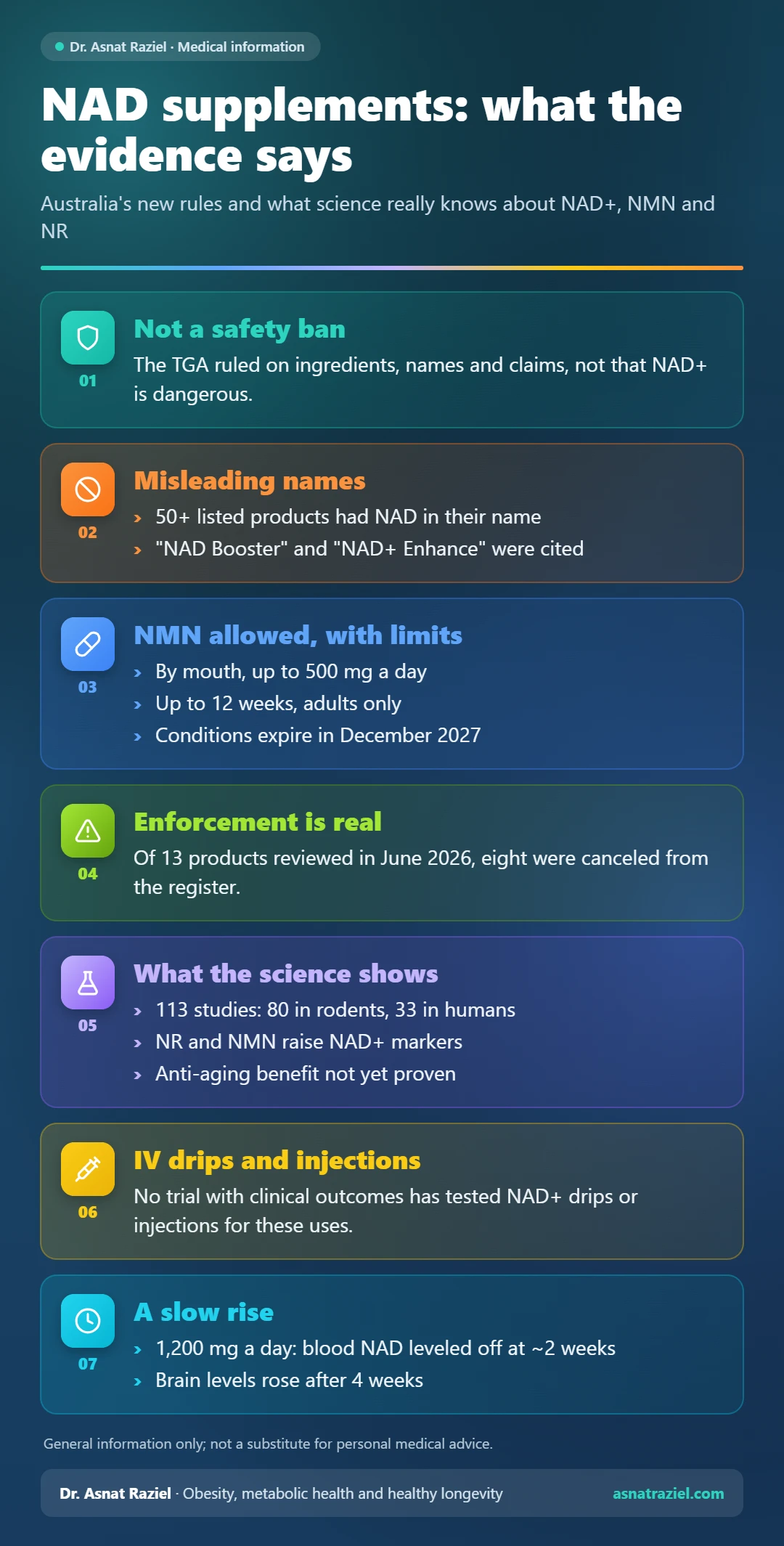
According to the TGA, NAD, NAD+ and NADH are not currently permitted ingredients in listed medicines, the low-risk category of complementary products in Australia. What’s more, even a product name such as “NAD Booster” or “NAD+ Enhance” may be misleading. Consumers might assume the product contains NAD+, or that studies have shown it raises NAD+ levels.
It is important to stress one point. The TGA did not rule that NAD+ or NAD supplements are “dangerous” or that the science behind them is worthless. This is a regulatory decision about permitted ingredients, product names, health claims and how companies present products to consumers.
So what exactly is NAD+?
NAD+, or nicotinamide adenine dinucleotide, is a natural and essential coenzyme that exists in almost every cell in the body. It takes part in energy production, metabolism, mitochondrial activity, DNA repair and the cell’s response to stress. I wrote more about the role of mitochondria in aging in my article on mitochondria and aging.
The interest in NAD supplements comes from the fact that NAD+ metabolism changes with age. In various models, low NAD+ availability goes hand in hand with aging processes. That raised a natural question. If we raise NAD+ levels, could we improve cell function and perhaps also our healthspan, the number of years we live in good health? The biology is intriguing, but clinical proof is still missing.
NAD+ is not the same as NMN and NR
This is one of the most important points in the whole discussion. NAD+ is the molecule the cell ultimately needs. In contrast, NMN (nicotinamide mononucleotide) and NR (nicotinamide riboside) are precursors, raw materials the body uses to make NAD+. Therefore, taking NMN or NR is not the same as taking NAD+ itself.
In December 2025, the TGA added NMN to its list of permitted ingredients, under clear conditions. According to a report in The Medical Republic, the conditions limit it to oral use, at a maximum daily dose of 500 mg. In addition, the recommended duration of use is up to 12 weeks, for adults only, and not for women who are pregnant or breastfeeding. These conditions are temporary and expire in December 2027. I covered this decision in more detail in my article on the regulation of NMN products. Even so, a product containing NMN may not use the name “NAD+” or freely promise that it “boosts NAD+.”
NAD supplements: why the name on the label became a problem
According to an article on NutraIngredients, a search of the Australian register of therapeutic goods turned up more than 50 complementary medicines with NAD or NAD+ in their names. That is despite the fact that these molecules are not permitted ingredients in such products. The TGA gave examples of unacceptable names, including “NAD+ 50,” “NAD Booster” and “NAD+ Enhance.”
The reason is simple. When consumers see “NAD+” in large letters on the box, they assume it is the active ingredient. If the product actually contains something else, such as a precursor, the name creates a misleading impression. Moreover, the regulator looks at the whole picture: the packaging, images, website, advertising, health claims, customer testimonials and even social media.
And this is no longer a theoretical threat
Australia relies heavily on post-market monitoring. In other words, a product’s presence in the ARTG register does not prove that the regulator has already reviewed and approved its name, claims and advertising.
In its June 2026 compliance update, the TGA reported on a review of 13 complementary medicines. The problems the TGA identified included unpermitted health claims about NAD, NAD+, NADH or NMN. As a result of the review, the TGA canceled eight products from the register, and their sponsors may no longer sell them. In addition, the TGA issued a public safety alert about NAD and NMN products sold in the country. The message to the industry is clear: regulators check not only what is inside the capsule, but also what companies promise consumers.
What does the science say about NAD supplements today?
A systematic review published in February 2026 in the journal Ageing Research Reviews examined 113 intervention studies. Of these, 80 involved rodents and 33 involved humans, 28 of them randomized. The picture is complex. In humans, NR and NMN pills consistently raised biochemical markers of NAD+. In other words, we can influence the biological pathway, and participants tolerated the compounds well for weeks to months.
But the important question is a different one. Do NAD supplements, by raising NAD+, make us healthier, stronger or longer-lived? Here the answer is still open. The effects on metabolic markers, physical function and blood vessels were inconsistent, and sometimes there was no effect at all. The researchers concluded that the biological activity is clear, but the effectiveness of NAD+ as an anti-aging or wellness treatment has not yet been proven.
NAD supplements: capsule or IV drip?
Here too, there is a wide gap between popularity and research. NAD+ IV drips have become a fashionable treatment at some longevity clinics around the world. They usually come with promises of more energy, sharper focus, faster recovery and slower aging.
However, the 2026 review did not find a single trial with clinical outcomes that tested intravenous or intramuscular NAD+ for these purposes. In other words, a drip is not necessarily more effective than a capsule, and it is certainly not proven to extend life. I have also written about similar trends in my article on biohacking, NAD and peptides.
How long does it take to raise NAD levels?
A phase 1 study published in January 2026 in the journal iScience looked at how quickly oral NR or NMN raises NAD levels. It included six healthy people and six people with Parkinson’s disease, who took 1,200 mg a day. Blood NAD levels rose slowly and leveled off after about two weeks. After treatment stopped, they fell at a similarly slow pace. In the brain, levels rose measurably after four weeks. In addition, the researchers saw large differences in how individuals responded.
The study does not prove any effect on longevity. Still, it adds important information about how these precursors work in humans.
So should you take NMN or NR?
As of 2026, we can cautiously say the following. The ability of NR and NMN to influence the NAD pathway is well established. By contrast, the claim that they “slow aging” is far from proven. An improvement in a biomarker does not equal an improvement in health, and an improvement in health does not equal a longer life.
To recommend a supplement in evidence-based longevity medicine, we need large, long-term studies. They must show not only a rise in NAD+, but also better physical and cognitive function, metabolic health and independence. The research is not there yet. I review the field more broadly in my article on longevity drugs.
The big lesson for the longevity world
The TGA’s decision reflects a broader problem. Science discovers fascinating biological pathways, and industry quickly turns them into products. Marketing sometimes translates a biological mechanism into a health promise before clinical studies have proven it. The peptide craze is another example of this.
NAD+ is an essential and fascinating molecule. Precursors such as NMN and NR raise markers linked to it. But there is still a long way to go before anyone can claim that NAD supplements or IV drips “rejuvenate the body.” Ultimately, the key rule in longevity is to ask not only whether a treatment changes a mechanism of aging, but whether it has been proven to improve health and add healthy years of life.
The information in this article is general and does not replace personal medical advice.
Questions and answers
Did Australia ban NAD+ because it is dangerous?
No. The guidance deals with ingredients, product names, advertising and health claims. NAD, NAD+ and NADH are simply not currently permitted ingredients in Australia’s listed complementary medicines.
Is NMN banned in Australia?
No. NMN was added to the list of permitted ingredients in December 2025, but with defined conditions and restrictions.
Do NMN and NR raise NAD+?
Studies in humans show that they raise markers linked to NAD+. However, the clinical benefit of this is still unclear.
Has NAD+, NMN or NR been proven to extend life?
No. To date, there is no clinical proof that NAD supplements, NMN or NR extend lifespan in humans.
Has an NAD+ IV drip been proven as an anti-aging treatment?
No. The 2026 systematic review found no trials with clinical outcomes proving that intravenous or injected NAD+ is effective for these purposes.
References
Making NAD, NAD+, NADH or NMN representations for listed medicines
NAD, NAD+, NADH or NMN medicines sold in Australia
Australia’s TGA releases guidance on NMN, NAD+ and NADH product naming
Listed Medicine Compliance Reports – June 2026 update




