By Dr. Asnat Raziel, bariatric surgeon specializing in obesity treatment, metabolic health and healthy longevity; Director of the Multidisciplinary Center for Obesity Treatment, Assia Medical, Assuta Ramat HaChayal, Tel Aviv
NMN supplement: from biological promise to regulated product
In recent years, the NMN (nicotinamide mononucleotide) supplement has become one of the substances most closely associated with the world of longevity. The main reason is its role as a precursor for making NAD+. This molecule is essential for energy production in cells, for metabolism, for DNA repair and for the mechanisms of cellular aging. For years, however, there was a wide gap between the excitement around NMN and its regulatory status. During 2026, that gap is starting to narrow.
EffePharm, the company that makes the raw ingredient UTHEVER, reports regulatory progress in the United States, Europe and Brazil, along with sales in countries in Asia and Latin America. This is the company’s own marketing content. Therefore, it’s important to separate a safety approval or a route to market as a supplement from proof that NMN slows aging or extends life in humans.
Why raise NAD+ in the first place?
NAD+ (nicotinamide adenine dinucleotide) is present in almost every cell in the body and takes part in hundreds of biochemical reactions. It is essential for energy production in the mitochondria. In addition, enzymes such as sirtuins and PARP use it to respond to cell damage and to repair DNA.
With age, NAD+ metabolism changes. This gave rise to a strategy that longevity researchers are now studying. Instead of giving NAD+ itself, you give the body precursors from which it makes NAD+. NMN is one of these precursors, alongside NR (nicotinamide riboside).
Animal studies have generated a lot of excitement, with effects on metabolism, mitochondrial function, inflammation and physical function. But the move from mouse to human is exactly where caution is needed.
What does the new systematic review say?
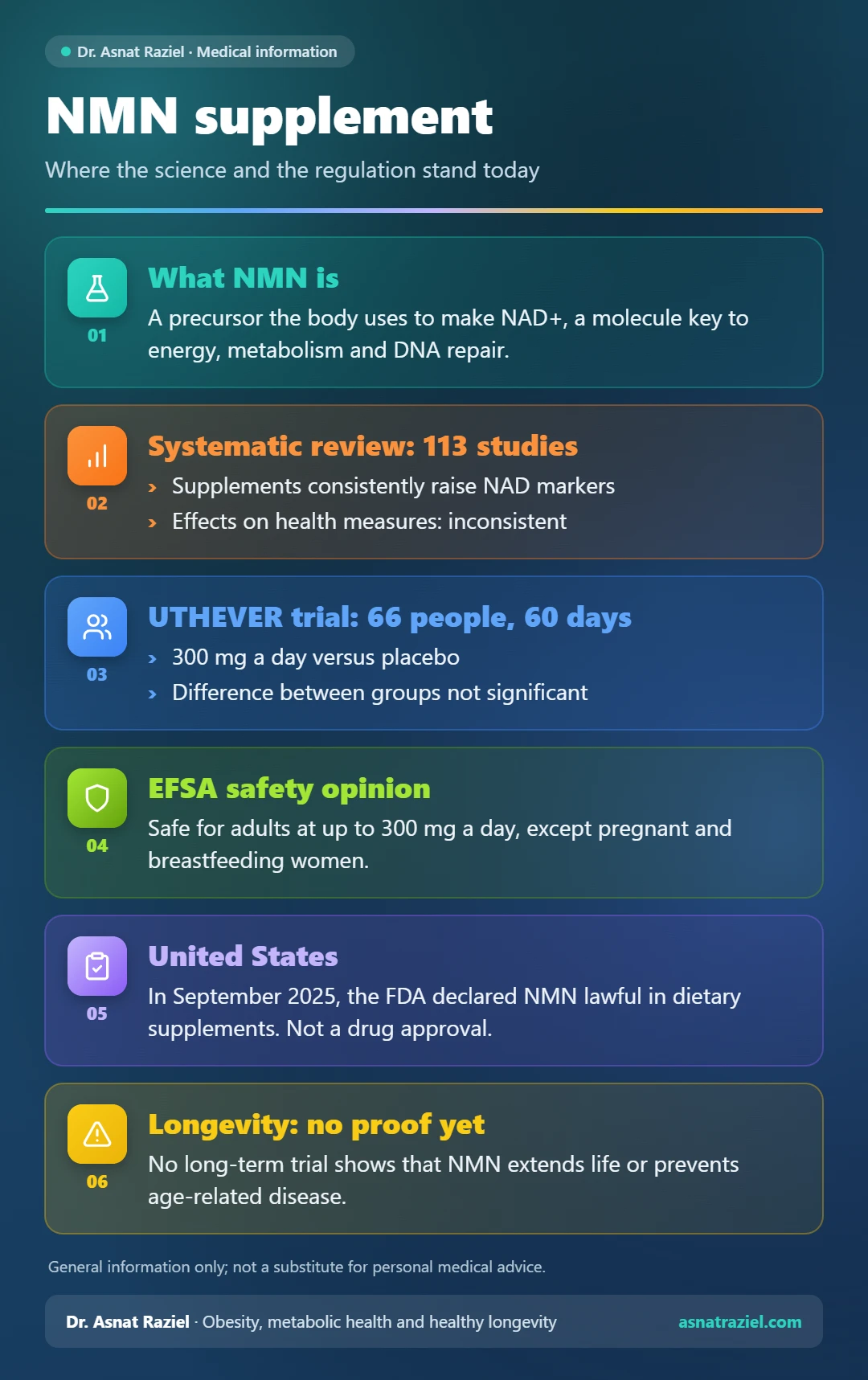
A systematic review in Ageing Research Reviews included 113 studies: 33 interventions in humans and 80 studies in rodents. The conclusion is interesting. Oral supplements such as NMN and NR consistently raise NAD markers in humans, and people generally tolerate them well for weeks to months. However, the effects on metabolic markers, blood vessels, physical function and healthspan, the number of years lived in good health, are inconsistent and sometimes absent.
In other words, we already know quite a lot about the biochemical effect. But we still don’t know whether it slows human aging.
What did the clinical trial of the UTHEVER NMN supplement find?
One of the most frequently cited studies appeared in Frontiers in Aging in 2022. It was a randomized, double-blind, placebo-controlled trial of 66 healthy people aged 40 to 65. The participants took 300 mg of NMN a day or a placebo for 60 days.
After 30 days, the NAD+/NADH ratio in the NMN group rose by 11.3%. After 60 days, the increase from baseline reached 38%, compared with 14.3% in the placebo group. But here comes an important detail. According to the full paper, the difference between the groups did not reach statistical significance. So the 38% figure should not be read as proof that the supplement raised NAD+ by 38% beyond placebo.
The researchers also looked at quality of life, a walking test and metabolic markers. Here too, the difference between the groups was not significant. In addition, no significant safety problems appeared over the short period. Still, this was a small, two-month study, and EffePharm conducted it. It does not answer the big question: does long-term use of an NMN supplement improve health or extend life?
A key development: EFSA enters the picture
One of the most important developments came from Europe. In May 2026, the European Food Safety Authority, EFSA, published a scientific opinion on EffePharm’s β-NMN under the Novel Food procedure. The application concerned β-NMN in food supplements as a source of niacin (vitamin B3), at a dose of up to 300 mg a day.
EFSA reviewed the substance’s identity, production process, composition, specifications, expected exposure and toxicology data. Its conclusion: the substance is safe for adults under the proposed conditions of use, except for pregnant and breastfeeding women. In addition, it is a bioavailable source of nicotinamide. According to a NutraIngredients report, the next step is a discussion by the European Commission and the member states before formal authorization.
It’s important to stress that a positive safety opinion does not prove that an NMN supplement is an anti-aging treatment. Nor does it prove that it prevents disease or extends life. First and foremost, it is a safety assessment of a specific substance, under the conditions of use that EFSA examined.
The picture is changing in the United States, too
The American story of NMN was especially complicated, because of a dispute over its status as a dietary supplement and its link to drug development. In September 2025, the FDA reversed its position and declared NMN lawful in dietary supplements, following pressure and a lawsuit from the Natural Products Association (NPA). In addition, UTHEVER reports that it received a “no objection” letter from the FDA on a New Dietary Ingredient (NDI) notification for its raw ingredient.
Here, too, precision matters. An NDI notification is not “FDA approval” of a supplement as a drug, nor is it approval of claims about preventing aging. It is a completely different route from drug approval. This distinction is especially important in the longevity world, where people sometimes use the word “approved” far too loosely. I also wrote about the regulatory pathways for drugs that target aging in my article on the FDA and anti-aging drugs.
Does the NMN supplement really extend life?
As of today, there is no proof of this in humans. That may be the most important sentence in the whole discussion. Studies of NMN and NR show that we can influence NAD+ metabolism in humans. Some studies also found interesting signals in metabolic or functional markers. However, the systematic review concluded that the clinical results are not consistent enough. Therefore, we cannot say that raising NAD+ with supplements extends healthspan or lifespan.
No long-term clinical trial has yet shown that people who take an NMN supplement live longer, get fewer age-related diseases or maintain better function thanks to it. To answer that, we will need large, long studies with clinical outcome measures, not just biochemical ones.
So why does the regulatory progress still matter?
The world of longevity supplements has another problem beyond the question “Does it work?” The question is what exactly is inside the product. When a substance goes through a proper regulatory process, the authorities examine its identity, purity, production process, stability, exposure and safety.
That’s why NMN’s progress may signal a maturing longevity market. The market is moving from sales based on big promises to systematic testing of the quality and safety of raw ingredients. But regulation is no substitute for clinical science. If you’re interested in drug-based approaches, you can also read about anti-aging drugs.
The bottom line on the NMN supplement
NMN is one of the most interesting longevity substances today. The reason is not that it has been proven to “stop aging.” Rather, it sits at the meeting point of basic biology, clinical research and regulation. We know that NMN is a precursor of NAD+ and that it affects biochemical markers in humans. Short studies also point to a reasonable safety profile at the doses tested. Moreover, 2026 brought significant regulatory progress, especially with the EFSA opinion.
Even so, the most important link is still missing: proof that NMN meaningfully improves human healthspan. In longevity, the distance between a fascinating mechanism and a treatment that extends healthy life can be very large. The NMN supplement moved a few steps forward this year, but it has not yet reached the finish line. In the meantime, it makes sense to measure what we really can improve, such as biological age, through lifestyle and medical follow-up.
The information in this article is general and does not replace personal medical advice.
Frequently asked questions
Is NMN the same as NAD+?
No. NMN is a precursor that the body uses to make NAD+.
Has NMN been shown to raise NAD+ in humans?
Human studies show that NMN supplements affect NAD levels and related metabolites. However, the results and the measures vary from study to study.
Has an NMN supplement been shown to slow aging?
Not yet. There are preclinical data and a few promising human studies. But there is currently no proof that it extends life or prevents age-related disease.
Does the EFSA opinion prove that NMN works?
No. The EFSA assessment deals with safety and with the proposed use as a source of niacin. It is not proof of effectiveness as an anti-aging treatment.
References
Discover UTHEVER® NMN’s Global Regulatory Landscape
The Safety and Antiaging Effects of Nicotinamide Mononucleotide in Human Clinical Trials: an Update
EFSA issues positive safety opinion on EffePharm’s NMN
Amid Pressure from NPA, FDA Declares NMN Lawful in Dietary Supplements
EffePharm, the maker of the raw ingredient, conducted the UTHEVER study.




