By Dr. Asnat Raziel, bariatric surgeon specializing in obesity treatment, metabolic health and healthy longevity; Director of the Multidisciplinary Center for Obesity Treatment, Assia Medical, Assuta Ramat HaChayal, Tel Aviv
Slowing aging as a medical goal
Slowing aging may be the most effective way to add good years to life. That was the core message of a talk I heard this week at LM2026, the annual conference of the American College of Lifestyle Medicine (ACLM) in Orlando. The speakers, Dr. William Hsu and dietitian Ashley Bizzell, work for L-Nutra. So I want to say it up front: L-Nutra sponsored the session, and it did not carry continuing education credit.
Dr. Hsu opened with a question for the audience. Who wants to live to 100? And who would rather reach 90, but free of disease? Most hands went up for the second option. In other words, people are not looking for more years at any cost. They want years of vitality, function and independence.
Life expectancy is no longer soaring
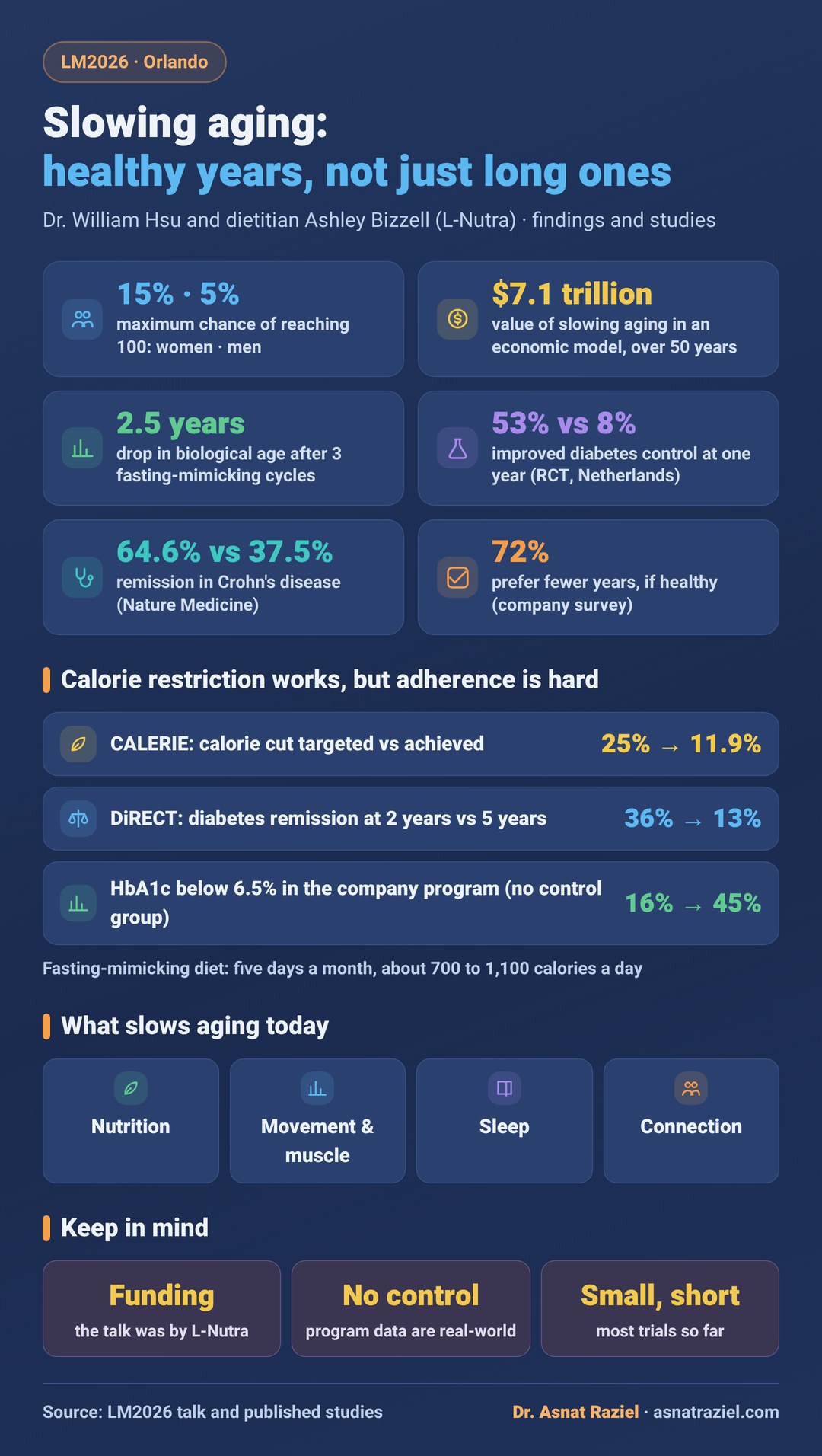
In the twentieth century, life expectancy in developed countries rose by about thirty years. However, a study published in Nature Aging looked at ten long-lived populations and found that this pace has slowed since 1990. According to the researchers, the chance of reaching 100 will probably not exceed 15% for women and 5% for men. Radical life extension this century is therefore unlikely, they conclude, unless we manage to meaningfully slow the biological processes of aging.
Dr. Hsu added that in the United States, gains in life expectancy stalled even before the COVID-19 pandemic. At the same time, health spending keeps climbing. So where is the gap?
Cure one disease, meet the next
Modern medicine works one disease at a time. There is a specialist for every organ, a trial for every drug and a drug for every diagnosis. But Dr. Hsu gave a simple example. A 65-year-old patient recovers from cancer at 72. At 77 he develops heart disease, and at 82 dementia appears. His life grows longer, but aging itself keeps going.
This is called competing risks: when one cause of death is removed, another takes its place. For example, according to US NHANES survey data shown in the talk, 24.2% of adults with obesity have diabetes. By comparison, among people aged 60 and over the rate reaches 27.3%, versus only 3.6% among those aged 20 to 39. In other words, age alone predicts diabetes as strongly as obesity does.
Why slowing aging pays off far more
Geroscience, the field that studies the biology shared by the diseases of aging, offers another direction. Instead of four drugs for four diseases, there is one target: the processes that drive aging. These include senescent cells, chronic inflammation, declining mitochondrial function and nutrient-sensing pathways.
An economic model published in Health Affairs illustrated the difference. In the model, delaying aging added 2.2 years of life, most of them in good health. Delaying cancer or heart disease alone brought a much smaller benefit. The researchers also valued slowing aging at $7.1 trillion over 50 years. Still, keep in mind that this is a simulation, not an outcome measured in patients.
Calorie restriction works, but it is hard to stick with
Dietary restriction extends life in many species, from yeast and worms to flies and mammals. In humans, the CALERIE trial asked 143 healthy adults to cut calories by 25% for two years. In practice, they cut only 11.9% on average. Even so, they lost 7.5 kg, and 71% of the loss was fat. In addition, every cardiometabolic risk factor measured improved, including LDL cholesterol and blood pressure.
The problem is adherence. In the DiRECT trial in the UK, people with type 2 diabetes followed a diet of 825 to 853 calories a day. At two years, 36% were in diabetes remission. At five years, however, only 11 of 85 (13%) remained in remission, even in the group that kept receiving support. That is why Dr. Hsu separated efficacy, whether a treatment can work under ideal conditions, from effectiveness, whether it works in real life.
Short, periodic fasting instead of constant hunger
The solution the speakers presented is the fasting-mimicking diet (FMD): five days a month of a measured plant-based menu, at about 700 to 1,100 calories a day. It is low in protein and sugar, so it does not switch on the cell’s nutrient-sensing pathways, such as mTOR and PKA. For the other 25 days, you return to normal eating. I covered the main findings on biological age, the liver and muscle in a previous article.
According to Dr. Hsu, the body moves through several stages during these days. On day one, sugar stores run down. On day two, fat burning rises. From day three, autophagy begins, a “recycling” process in which the cell breaks down damaged proteins and worn-out mitochondria. A randomized pilot trial in 30 healthy adults found higher markers of autophagy in blood cells after six days of this diet. However, the researchers themselves note that much larger studies are needed.
Two tests for any treatment that promises to slow aging
One of the most important ideas in the talk applies to any product or treatment aimed at slowing aging. According to Dr. Hsu, such a treatment should pass two tests. The first: does it change the biology of aging itself, for example by lowering biological age on a validated measure? The second: does it delay or improve the diseases that kill us, such as diabetes, heart disease and high blood pressure?
One test alone is not enough. A treatment that only improves blood sugar and blood pressure is good, ordinary medicine. On the other hand, a treatment that only improves cellular markers, with no effect on disease, has not yet proven itself. For example, an analysis published in Nature Communications found that three cycles of the fasting-mimicking diet were linked to a 2.5-year drop in median biological age, independent of weight loss. That is the first test. The next question is what happens to the diseases themselves.
What happened in diabetes, the heart and the gut
First, diabetes. A randomized trial in the Netherlands included 100 people with type 2 diabetes treated with metformin or diet alone. Half of them added a five-day cycle every month for a year. In that group, HbA1c, average blood sugar over the past three months, fell by 0.3% compared with controls, even though participants used less medication. Weight fell by 3.6 kg. Overall, diabetes control improved in 53% of the diet group, versus 8% of the control group.
Second, the heart. A cardiac MRI analysis of 82 participants from the same trial showed better relaxation of the heart muscle, a measure that is affected early in diabetes. The E/A filling ratio rose by 0.27, and the improvement went hand in hand with the drop in HbA1c. The heart’s pumping strength did not change.
Third, Crohn’s disease. A randomized trial published in Nature Medicine added three monthly cycles to the usual care of 97 patients with mild to moderate disease. Clinical remission was reached by 64.6% of the diet group, versus 37.5% of the control group. In other words, this diet also affected chronic inflammation outside the metabolic system.
What patients really want
In the second part of the talk, Ashley Bizzell presented an L-Nutra survey of the product’s customers. 72% said they would prefer fewer years, as long as most of them were spent in good health. 37% had given up an experience because they felt too old. In addition, 82% would accept a less lucrative, less stressful job in exchange for ten extra healthy years.
What would they do with those years? 34% would exercise regularly, 34% would spend much more time with family and friends, and 30% would reduce stress. These are exactly the pillars of lifestyle medicine, in patients’ own words. Interestingly, 59% named their physician as the most trusted source of advice on longevity.
Slowing aging as a team effort
Bizzell described a care model in which a dietitian follows the patient for a year while keeping the treating physician informed. The program includes fasting-mimicking cycles, blood tests, personal coaching and monthly sessions on metabolism, muscle and nutrition. There are also dedicated tracks for prevention, for prediabetes and high blood pressure, and for type 2 diabetes.
The first results of the diabetes track were presented in an abstract at the American Diabetes Association (ADA) meeting. In the talk, Bizzell also showed the company’s longer follow-up data: participants lost 10% of their body weight on average over a year. 45% reached an HbA1c below 6.5% at nine months, versus 16% at the start. More than half reduced their diabetes medication in coordination with their physician. Bizzell also described a patient who went from 148 to 125 kg (about 23.6 kg lost). His HbA1c fell from 6.3% to 5.5%, and he stopped his blood pressure and diabetes medication.
What to keep in mind before starting
First, the talk was given on behalf of the company that markets the product, and it funded some of the studies. Second, the program data are real-world data without a control group, and one patient’s story is an example, not proof. Third, the projection that regular cycles will lower mortality is based on a model, not on patient follow-up. Finally, most trials are relatively small and short.
In addition, this diet is not for everyone. Pregnant or breastfeeding women, people who are underweight or have eating disorders, and patients on insulin or other drugs that can cause low blood sugar should consult their physician before any change. Even during weight loss, preserving muscle mass with protein and strength training is an essential part of care.
Bottom line: slowing aging starts today
The big message of the talk is broader than any product. Instead of chasing each disease separately, it is worth looking upstream, at what most of them share: aging itself. Slowing aging does not require futuristic technology. It starts with good nutrition, movement, healthy sleep, stress management and social connection, and sometimes with structured nutrition tools under professional guidance.
In the end, the goal is not just to add years to life, but to add life to years.
This article provides general information and is not personal medical advice. Before any major dietary change, and especially if you take medication, please consult your physician.
References
Implausibility of radical life extension in humans in the twenty-first century
Effect of fasting-mimicking diet on markers of autophagy and metabolic health in human subjects
Fasting Mimicking Diet Program Yields Glycemic and Weight Benefits in Type 2 Diabetes
Disclosure: the conference talk was sponsored by L-Nutra, and the speakers are company employees. Some of the studies cited were partly funded by the company.