By Dr. Asnat Raziel, bariatric surgeon specializing in obesity treatment, metabolic health and healthy longevity; Director of the Multidisciplinary Center for Obesity Treatment, Assia Medical, Assuta Ramat HaChayal, Tel Aviv
What to eat on GLP-1 drugs: the plate changes over time
What to eat on GLP-1 drugs is not one fixed menu. Your needs shift before treatment, at the start, during dose increases and in maintenance. That was the message of Colleen Sloan, a physician assistant and clinical dietitian, in her talk at ObesityWeek in Washington. In her words, the same advice can help at one stage and backfire at another.
Alongside the talk, I draw on a review by Dr. Tair Ben-Porat and colleagues in Advances in Nutrition. Dr. Ben-Porat works at the School of Public Health, University of Haifa. Her co-authors include Dr. Shiri Sherf-Dagan of Ariel University and Assuta Tel Aviv, and Dr. Assaf Buch of Ariel University. So there is an important Israeli voice here too.
Why eating on GLP-1 drugs needs its own plan
GLP-1 drugs such as semaglutide and tirzepatide strongly reduce appetite. According to the review, people on treatment eat 16% to 39% fewer calories. However, eating less is not the same as eating well. In one small study of 69 patients, most did not get enough protein or fiber. They also fell short on iron, magnesium, calcium and vitamins A, D and E.
Muscle is at risk as well. In trials, weight loss on these drugs came with a loss of about 6 kg of lean mass. That is roughly 10% of the starting level. The authors note this matches the muscle loss of about ten years of aging. Therefore, the goal is to protect the body, not only to lose weight.
I wrote in detail about nutritional deficiencies during treatment. Here I focus on what changes at each stage.
Before treatment starts
According to Sloan, step one is to understand the patient, not to hand out a menu. She suggests asking about eating habits and goals. Past diets and daily function matter too. In addition, check finances and access to food.
In her view, a menu at this stage can harm some patients. Examples include people with constipation or low protein intake. A past of severe food restriction is another warning sign. Binge eating disorder also calls for extra care. Blood tests before treatment give a useful baseline.
What to eat on GLP-1 drugs at the start
At this stage, appetite drops fast. Sloan noted that weight can change faster than habits. So structure and skills need to grow alongside weight loss.
Her key point was simple. Do not stack a standard diet deficit on top of the drug. Without medication, the usual advice is a deficit of about 500 to 750 calories a day. But the drug already cuts appetite. Instead of more restriction, check intake, the rate of loss and strength.
How many calories?
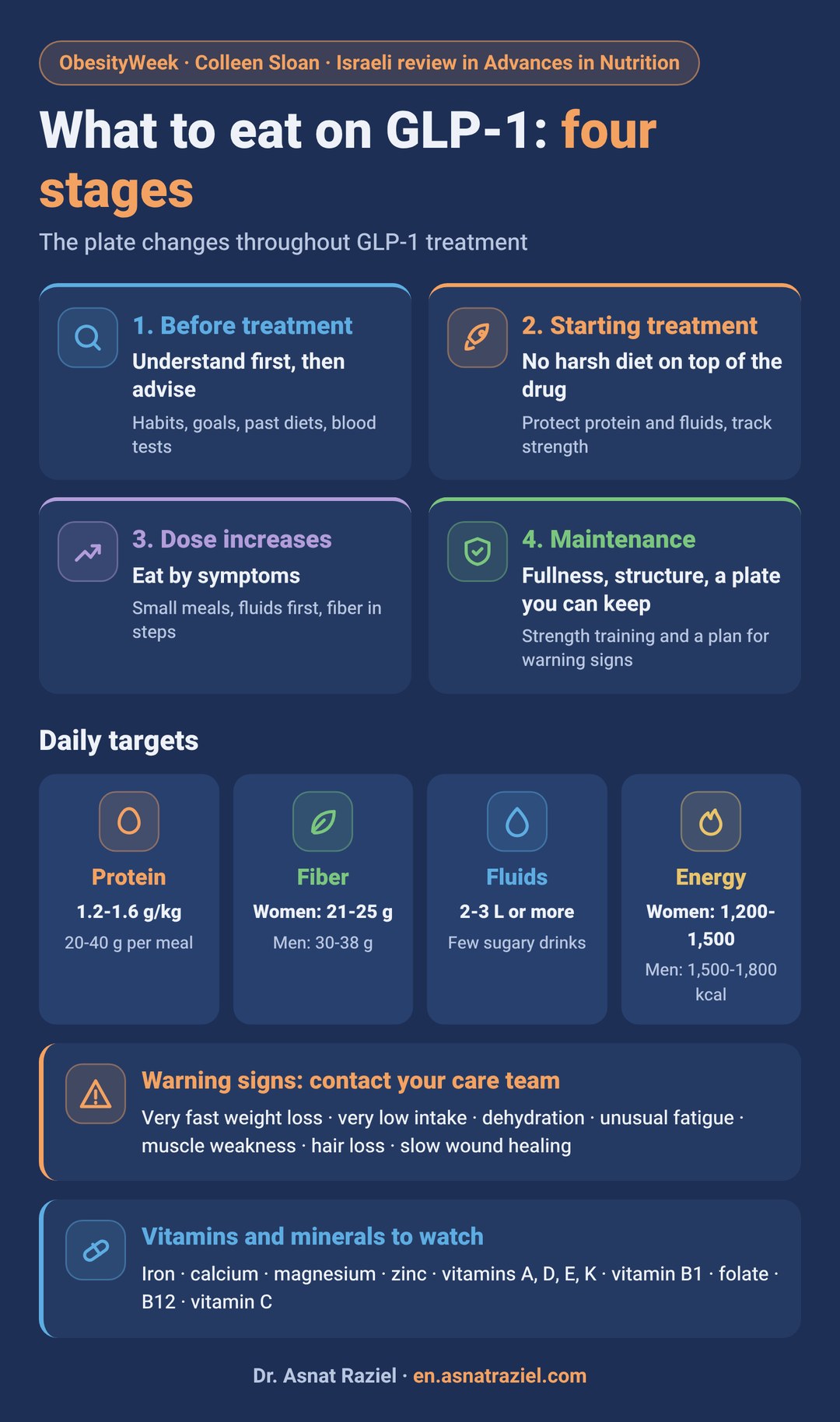
Sloan’s table lists about 1,200 to 1,500 calories a day for women. For men, it lists about 1,500 to 1,800. The review also warns against extreme restriction without supervision. This matters most in older adults, because of the risk to muscle.
Protein, fiber and fluids: the numbers
Both sources agree on the direction. Still, the numbers differ a little:
- Protein: Sloan suggests 1.2 to 1.6 g per kg per day. That is about 80 to 120 g a day, with 20 to 40 g per meal. The review suggests 1.2 to 2.0 g per kg. It also suggests 25 to 30 g of quality protein per main meal.
- Fiber: 21 to 25 g a day for women and 30 to 38 g for men. Increase it gradually.
- Fluids: Sloan suggests 2 to 3 liters a day or more, with few sugary drinks. The review suggests about 1.5 to 2 liters. It advises drinking 30 to 60 minutes away from meals.
- Carbs and fat: 45% to 65% of energy from carbs and 20% to 35% from fat. Keep saturated fat under 10%.
There is no agreement yet on which body weight to use for protein. Options are actual weight, adjusted weight or lean mass. A dietitian can tailor the number to each patient.
Which protein?
The review favors complete protein: eggs, dairy, fish, lean meat and soy. Good plant sources are legumes and quinoa. Protein shakes can help when eating is hard. Strength training two to three times a week also protects muscle. In one meta-analysis the review cites, adding resistance training to a diet cut lean mass loss by 93.5%.
Dose increases: eating by symptoms
Each dose increase can bring side effects. The review lists nausea in 25% to 44% of patients. Diarrhea affects 21% to 30%, and constipation 11% to 24%. Nausea and diarrhea usually pass within ten days. Constipation, by contrast, often lasts longer.
Sloan recommends symptom-guided eating. Think small, frequent meals, fluids first and fiber in steps. The review adds a few simple rules:
- Nausea: four to six small meals a day. Eat slowly and stop at the first sign of fullness. Cold, bland foods help some people. Avoid skipping meals.
- Constipation: raise fiber and fluids slowly, and move more. A stool softener can help if needed.
- Diarrhea: cut insoluble fiber for a while. Add soluble fiber, such as oats and bananas.
- Reflux: finish eating two to three hours before bed. Do not lie down right after a meal.
Also limit fried, fatty, spicy and highly processed foods. Sloan added that a slower dose increase is fine. Staying longer on one dose is fine as well. The real question, she said, is how the plan should change when tolerance changes.
Warning signs
Sloan listed signs that need a check-up. These include very fast weight loss, very low intake, low protein, ongoing dehydration and unusual fatigue. Muscle weakness, heavy hair loss and slow wound healing are also red flags. In such cases, contact your care team.
Vitamins and minerals to watch
When you eat little, it is easy to miss key nutrients. Sloan lists iron, calcium, magnesium and zinc. She also lists vitamins A, D, E and K, vitamin B1, folate, B12 and vitamin C.
The review suggests a daily multivitamin for people who eat little or have ongoing symptoms. Even so, the authors admit these tips come mainly from bariatric surgery and very low-calorie diets. In other words, research on GLP-1 drugs themselves is still lacking.
What to eat on GLP-1 drugs in maintenance
After weight loss, the body pushes back. According to Sloan, hunger rises and energy use falls, partly through muscle loss. The review adds a sobering number. After people stopped semaglutide 2.4 mg, they regained about two-thirds of the lost weight within a year.
So Sloan suggests a “maintenance plate” built on three ideas: fullness, structure and a pattern you can keep. It includes quality protein, colorful vegetables and fruit, high-fiber carbs and healthy fats. Exercise should now focus on strength, muscle and bone.
Moreover, the plan differs for people who stay on the drug and those who stop. She advises setting early warning signs in advance, with a plan for each. Her three steps are notice, reassess and respond. I also cover this in my article on continuing obesity treatment.
The Israeli voice: what the Ben-Porat review adds
The review stresses a topic we rarely discuss: eating behavior and mental health. On one hand, patients report fewer cravings and less food noise. This may make them more open to change. On the other hand, the authors advise watching for eating disorders during treatment and after stopping.
They also suggest setting realistic expectations before treatment, with behavioral and psychological support. Finally, they note that fatigue is common. When it appears, check B12 and iron. In my view, this is exactly why a dietitian is part of the treatment, not an add-on.
What to do in practice
- Before treatment: blood tests, a talk about eating habits and a first meeting with a dietitian.
- At the start: do not add a harsh diet on top of the drug. Start every meal with protein.
- During dose increases: small meals, fluids through the day and fiber in steps. If symptoms are severe, ask your doctor about a slower schedule.
- All along: strength training two to three times a week. Track strength and function, not only weight.
- In maintenance: a filling, regular plate and a clear plan for when weight starts to climb.
At our center, a physician, a dietitian and a psychologist support patients at every stage. You can also read about building a personal nutrition plan.
Bottom line: what to eat on GLP-1 drugs
These drugs change appetite, so nutrition has to change with them. At the start, protect protein and fluids. During dose increases, adapt food to symptoms. In maintenance, build a plate you can keep. In the end, the goal is weight loss that protects muscle, bone and health.
This article is general information and is not a substitute for personal medical advice.
References
Dr. Sherf-Dagan and Dr. Buch reported research funding from Novo Nordisk. According to the authors, the funder had no role in writing the review.