By Dr. Asnat Raziel, bariatric surgeon specializing in obesity treatment, metabolic health and healthy longevity; Director of the Multidisciplinary Center for Obesity Treatment, Assia Medical, Assuta Ramat HaChayal, Tel Aviv
Ketogenic diet vs. Mediterranean: same weight loss, different liver
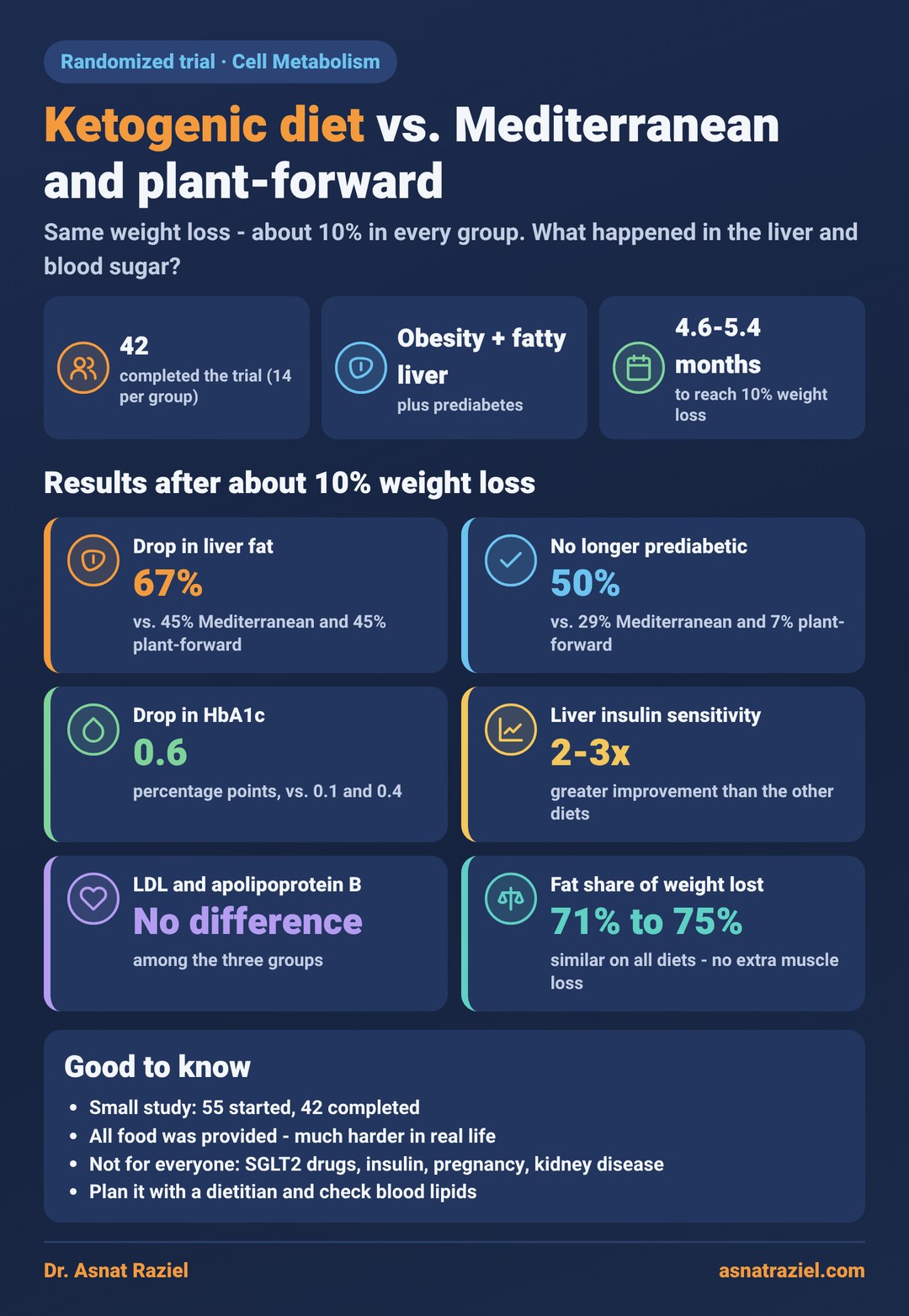
A ketogenic diet cut liver fat by 67% in a new randomized clinical trial, even though every participant lost about the same 10% of body weight. By contrast, liver fat fell by 45% on a Mediterranean diet and by 45% on a low-fat plant-forward diet. In addition, half of the people on the ketogenic diet no longer had prediabetes.
My patients ask me every week which diet is best. This study does not give one answer for everyone. However, it shows something important: even when the scale moves the same amount, what is on your plate changes what happens in your liver and your blood sugar.
What the ketogenic diet study tested
Researchers at Washington University in St. Louis published the trial in Cell Metabolism. They enrolled adults with obesity, prediabetes and fatty liver. In other words, people with “metabolically unhealthy” obesity. Then they randomly assigned them to one of three diets.
In total, 55 people started the trial and 42 completed it, 14 in each group. Their average age was 43, and their average body mass index (BMI) was 38.9. All food was provided as ready-made meals, and participants met with a dietitian every week. As a result, adherence was very high, above 95%.
The three diets
- Ketogenic diet: 4% of energy from carbohydrate, 73% from fat and 23% from protein.
- Mediterranean diet: 50% carbohydrate, 35% fat and 15% protein.
- Low-fat plant-forward diet: 70% carbohydrate, 15% fat and 15% protein.
The goal was about 10% weight loss in every group. In practice, weight loss was almost identical: 10.4%, 10.2% and 10.1%. Participants reached the target after 4.6 to 5.4 months on average. Next, their weight was held stable for three to four weeks before testing was repeated.
Ketogenic diet and fatty liver: the findings
The standout finding involved the liver. An MRI measured the percentage of fat in the liver. In the ketogenic group, it dropped by 67%. In the other two groups, it dropped by 45%. Put in numbers, average liver fat fell from 19.4% to 6.2% in the ketogenic group.
Moreover, the improvement in liver insulin sensitivity was two to three times greater in the ketogenic group than in the other two groups. New fat production in the liver also fell mainly in this group. In plain terms, the liver stopped “making” fat from sugar.
Muscle insulin sensitivity, on the other hand, rose by about 50% in all three groups, with no difference between them. So weight loss itself improved the muscles, while the difference between diets showed up in the liver.
Blood sugar and prediabetes
Glycated hemoglobin (HbA1c), a measure of average blood sugar over the past three months, fell by 0.6 percentage points in the ketogenic group. In comparison, it fell by 0.1 in the Mediterranean group and by 0.4 in the plant-forward group. Blood sugar and insulin levels over 24 hours also dropped most in the ketogenic group.
Finally, the researchers checked how many participants no longer had prediabetes. In the ketogenic group, 50% reached normal values, compared with 29% in the Mediterranean group and 7% in the low-fat plant-forward group. For people with prediabetes, diet plays a role beyond the number on the scale.
Ketogenic diet and cholesterol: what did not change
A common worry is that a ketogenic diet raises “bad” cholesterol. In this trial, however, the researchers found no difference between the groups in LDL, apolipoprotein B or 24-hour triglycerides. Still, this was a short period with few participants. That is why I keep checking a lipid profile in everyone who chooses this approach.
The makeup of the weight lost was also similar. Fat made up 71% to 75% of the weight lost in all three groups. In other words, the ketogenic diet did not cause extra muscle loss.
Limitations to keep in mind
- Small sample: only 42 participants completed the trial, and 13 dropped out.
- Food was provided: every meal was ready-made. In real life, staying at 4% carbohydrate is much harder.
- Short term: the trial looked at the body after weight loss, not at keeping the weight off for years.
- Open question: the researchers themselves write that they cannot tell whether a milder carbohydrate cut, without ketosis, would give similar results.
What you can do today
The good news is that fatty liver is reversible. A 10% weight loss improved the liver on all three diets. So the first step is to start, in a way you can sustain.
Tests worth doing
- Liver enzymes (ALT, AST), HbA1c and fasting glucose.
- A full lipid profile, before and after a change in diet.
- A liver ultrasound and, when needed, an assessment of fibrosis (scarring) with elastography (FibroScan).
Nutrition: who a ketogenic diet suits
A ketogenic diet can be an effective tool for some patients with fatty liver and prediabetes. However, it is not for everyone. For example, it calls for caution in people with diabetes treated with insulin or SGLT2 inhibitors, in pregnancy, in kidney disease and in anyone with a past eating disorder. That is why it should be built with a dietitian and include vegetables, quality protein and healthy fats. People who prefer a Mediterranean diet will improve their liver too, as long as their weight comes down. It also helps to know the pros and cons of each type of diet.
Movement, sleep and stress
Strength training two to three times a week protects muscle during weight loss. In addition, moderate aerobic activity reduces liver fat even without major weight loss. Read more about aerobic vs. strength training. Meanwhile, 7 to 8 hours of sleep and stress management help control hunger and emotional eating.
When diet alone is not enough
In our multidisciplinary center, a dietitian, a psychologist and an exercise physiologist work together. When lifestyle change is not enough, obesity medication can be considered, and when indicated, surgery as well. Both treatments reduce liver fat, as I also described in my article on pancreatic fat.
Bottom line: a ketogenic diet for fatty liver
The trial shows that losing 10% of body weight improves the liver on any diet. However, a ketogenic diet cut liver fat by 67% compared with 45%, and moved half of the participants out of prediabetes. Because the study was small and all food was provided, we need longer and larger trials. Meanwhile, the choice of diet should be personal, tailored and supported by a team.
This article is general information and does not replace personal medical advice.
References
ClinicalTrials.gov: NCT02706262
Keto diet slashes liver fat by 67% in just 4 months
The study was funded by the US National Institutes of Health (NIH) and the Foundation for Barnes-Jewish Hospital.