By Dr. Asnat Raziel, bariatric surgeon specializing in obesity treatment, metabolic health and healthy longevity; Director of the Multidisciplinary Center for Obesity Treatment, Assia Medical, Assuta Ramat HaChayal, Tel Aviv
Types of diets: no single menu fits everyone
Many types of diets promise fast weight loss. The research, however, tells a simple and interesting story: almost any balanced diet works, as long as you stick with it. So the key question is not which diet is “the best”. The question is which diet fits you, your body and your life.
In this article, I have gathered 13 well-known dietary approaches. For each one, you will find what it includes, what the research shows, its pros and cons, and who it suits. I have also added a summary table to help you choose.
What the large studies teach us about types of diets
First, it helps to know a few key trials. In the POUNDS Lost trial, researchers compared four diets with different proportions of fat, protein and carbohydrates. Overall, 811 adults with overweight took part for two years. All the groups lost about 6 kg on average in the first six months. After two years, the differences between the diets were negligible.
Moreover, the most interesting finding in this comparison of types of diets had nothing to do with the menu itself. Every group session participants attended added an average of 0.2 kg to their weight loss. In other words, support and persistence shaped the result.
The DIETFITS trial reached a similar conclusion. A total of 609 adults followed either a healthy low-fat diet or a healthy low-carbohydrate diet for a year. The low-fat group lost 5.3 kg, and the low-carb group lost 6.0 kg. The difference was not significant. In addition, genetic profile and insulin secretion did not predict who would succeed on which diet.
Finally, a large network meta-analysis included 121 trials and 21,942 participants. The researchers found that most diets led to modest weight loss and lower blood pressure after six months. By 12 months, these effects had largely faded. The Mediterranean diet, however, kept its heart benefits over that period.
An important trial was also carried out in Israel. In the DIRECT trial at Ben-Gurion University, 322 adults took part for two years. The low-fat group lost 2.9 kg, the Mediterranean group 4.4 kg, and the low-carb group 4.7 kg.
Types of diets: the low-fat diet
A low-fat diet limits fat to 20% to 30% of total calories, according to the Obesity Medicine Association’s Obesity Algorithm. The menu is based on vegetables, whole grains, legumes, fruit, lean meat and fish. On the other hand, it limits red meat, fried food and ultra-processed food.
Pros: It lowers LDL, the “bad” cholesterol. It also improves blood sugar, insulin and blood pressure when combined with weight loss. And it is easy to fit into an everyday Israeli menu.
Cons: It may lower HDL, the “good” cholesterol. Cutting fat too much may also reduce absorption of fat-soluble vitamins. And “low-fat” products are sometimes high in sugar.
Who it suits: People with high LDL, those who enjoy complex carbohydrates, and anyone who prefers large, filling portions.
The low-carb diet
A low-carb diet is usually defined as less than 130 grams of carbohydrates a day, or less than 26% of calories. For example, the menu includes non-starchy vegetables, leafy greens, nuts, seeds, eggs, fish, meat and natural oils. It limits sugar, white bread, baked goods and processed food.
Pros: It lowers triglycerides, blood sugar and insulin, and raises HDL. In addition, a review of 23 trials in people with type 2 diabetes showed remission rates of 57% versus 31% after six months. However, the difference shrank when the definition required stopping medication, and data at one year are limited.
Cons: In some people, LDL rises. During the first weeks, fatigue, headache and constipation sometimes appear. Anyone taking medication for diabetes or blood pressure needs medical follow-up, since blood sugar or blood pressure may drop sharply.
Who it suits: People with type 2 diabetes, prediabetes, high triglycerides or insulin resistance.
The ketogenic diet
The ketogenic diet is an extreme form of carbohydrate restriction, up to about 50 grams a day. Most calories come from fat. As a result, the body shifts to burning fat and producing ketone bodies.
Pros: Many people feel less hungry, and early weight loss is fast, mostly from fluids. A meta-analysis of 13 trials found an extra loss of 0.91 kg compared with a low-fat diet after a year or more. Triglycerides also fell and HDL rose.
Cons: In the same meta-analysis, LDL rose as well. In addition, a controlled trial at the US National Institutes of Health showed that a plant-based, low-fat diet led people to eat 689 fewer calories a day than an animal-based ketogenic diet. Long-term adherence is hard, and the menu is low in fiber.
Who it suits: For a short period and under medical supervision, people who struggle to control their appetite. It is not suitable in pregnancy, advanced kidney disease or very high LDL.
Types of diets: the Mediterranean diet
The Mediterranean diet gets about 40% of its calories from fat, mainly olive oil. In practice, it is based on vegetables, fruit, legumes, whole grains, nuts, seeds, fish and fermented dairy. It limits red meat, sugar and ultra-processed food.
Pros: This is the diet with the strongest research base for heart health. The PREDIMED trial included 7,447 people at high cardiovascular risk. Major heart events occurred in 3.8% of the olive oil group and 3.4% of the nuts group, versus 4.4% in the control group. In addition, in the CORDIOPREV trial in people with heart disease, the Mediterranean diet outperformed the low-fat diet in preventing repeat events.
Cons: Weight loss is moderate compared with low-carb diets. Olive oil and nuts are also high in calories, so portion size matters.
Who it suits: Almost everyone. Especially people at risk of heart disease, people with diabetes, and anyone looking for a diet for longevity.
The DASH diet for blood pressure
DASH stands for Dietary Approaches to Stop Hypertension. It is rich in vegetables, fruit, low-fat dairy and whole grains, and low in salt and saturated fat.
Pros: In the original DASH trial, the diet lowered systolic blood pressure by 5.5 mm Hg and diastolic by 3.0 compared with a control diet. In people with hypertension, the drop reached 11.4 and 5.5 mm Hg. This happened with no change in weight.
Cons: It was not originally built for weight loss. It also requires home cooking and reading labels to cut salt.
Who it suits: People with high blood pressure and anyone who wants to protect the heart and kidneys.
The MIND diet for brain health
MIND combines principles of the Mediterranean diet and DASH. In particular, it emphasizes leafy greens, berries, nuts, olive oil, legumes and fish.
Pros: It is a healthy, varied menu that is fairly easy to follow. Observational studies have linked it to a lower risk of cognitive decline.
Cons: A three-year controlled trial in 604 older adults found no significant difference in cognitive function compared with a control diet. Both groups received mild calorie restriction and support, and both improved.
Who it suits: Older adults who want a healthy, varied diet with a focus on overall health.
Plant-based types of diets: vegetarian and vegan
A vegetarian diet leaves out meat, and a vegan diet leaves out all animal products. It is based on legumes, whole grains, vegetables, fruit, nuts, seeds, tofu and soy products.
Pros: In a trial of identical twins at Stanford, the twins on the vegan diet lowered LDL by 13.9 mg/dL and lost 1.9 kg compared with the twins on a mixed diet, within eight weeks. In addition, the EPIC-Oxford study found a 22% lower rate of ischemic heart disease in vegetarians.
Cons: In the same study, vegetarians had a 20% higher rate of stroke. There is also a risk of deficiencies in vitamin B12, iron, zinc, iodine and high-quality protein. So planning is needed, and sometimes supplements.
Who it suits: Anyone drawn to it for ethical or health reasons, provided they plan their plant protein sources well.
The paleo diet
The paleo diet supposedly imitates the diet of early humans. In practice, it includes meat, fish, eggs, vegetables, fruit and nuts, and leaves out grains, legumes, dairy and sugar.
Pros: A meta-analysis of four trials with 159 participants found short-term improvements in waist circumference, triglycerides and blood pressure compared with a guideline-based diet.
Cons: The evidence is limited and short-term. Cutting out legumes, whole grains and dairy also lowers fiber and calcium. The menu is relatively expensive, too.
Who it suits: People who enjoy a menu rich in protein and vegetables, as long as they make sure to get fiber and calcium.
The high-protein diet
In a high-protein diet, protein makes up a large share of calories, usually at the expense of carbohydrates. For example, sources include fish, chicken, eggs, dairy, legumes and tofu.
Pros: A meta-analysis of 24 trials with 1,063 participants found an extra loss of 0.79 kg in weight and 0.87 kg in fat. It also preserved 0.43 kg of lean body mass. Many people also report good satiety.
Cons: In advanced kidney disease, protein intake needs to be adjusted with a doctor. A menu built on processed meat is not healthy either.
Who it suits: People losing weight, older adults and people taking weight-loss medication. I explain how much protein you need when losing weight in a separate article.
Types of diets by the clock: intermittent fasting and time-restricted eating
In this case, you do not necessarily change what you eat, but when. With time-restricted eating, you eat within a window of eight to ten hours a day. With intermittent fasting, you cut calories sharply on certain days.
Pros: It is a simple method that does not require weighing food. In a one-year trial in 139 people with obesity, the eating-window group lost 8.0 kg, versus 6.3 kg with regular calorie restriction. The difference was not significant.
Cons: In an alternate-day fasting trial, the dropout rate reached 38%, versus 29% with daily calorie restriction. Meanwhile, weight loss was similar, and LDL rose by 11.5 mg/dL. In addition, the method is not suitable for people with eating disorders or diabetes treated with insulin.
Who it suits: People who are comfortable skipping a meal and eating at fixed times. I wrote about the link to the body clock in my article on intermittent fasting.
Meal replacements and very-low-calorie diets
In this approach, all or some meals are replaced with fortified shakes or bars, at a very low calorie level. Regular food is then reintroduced gradually.
Pros: In the DiRECT trial, participants with type 2 diabetes received 825-853 calories a day for three to five months. After a year, 46% achieved diabetes remission, versus 4% in the control group. In addition, 24% lost 15 kg or more.
Cons: The approach requires close medical supervision. Fatigue, constipation and gallstones may occur, and after the restricted phase there is a risk of regaining weight.
Who it suits: People with obesity and type 2 diabetes who want significant, fast weight loss with team support.
The fasting-mimicking diet
The fasting-mimicking diet is a menu low in calories, sugar and protein and rich in unsaturated fats, for five days a month. Then, on the remaining days, you eat as usual.
Pros: In a controlled trial of 100 healthy participants, three cycles lowered weight, abdominal fat and blood pressure, as well as levels of IGF-1, an insulin-like growth factor linked to aging. The improvement was especially marked in participants with risk factors.
Cons: The studies are small and short. It is also not suitable in pregnancy, diabetes treated with medication, or for people with eating disorders.
Who it suits: Anyone interested in healthy longevity who prefers a short, defined effort over a daily diet.
The low glycemic index diet
The glycemic index measures how fast a food raises blood sugar. Therefore, this diet favors legumes, whole grains, vegetables and whole fruit over white bread, white rice and sweetened drinks.
Pros: A meta-analysis in people with diabetes found a 0.31% drop in HbA1c, the average blood sugar over three months. It also lowered LDL, weight and systolic blood pressure.
Cons: The index changes with cooking method and what else is on the plate. So it is a helpful tool, not a complete method.
Who it suits: People with diabetes, prediabetes and insulin resistance.
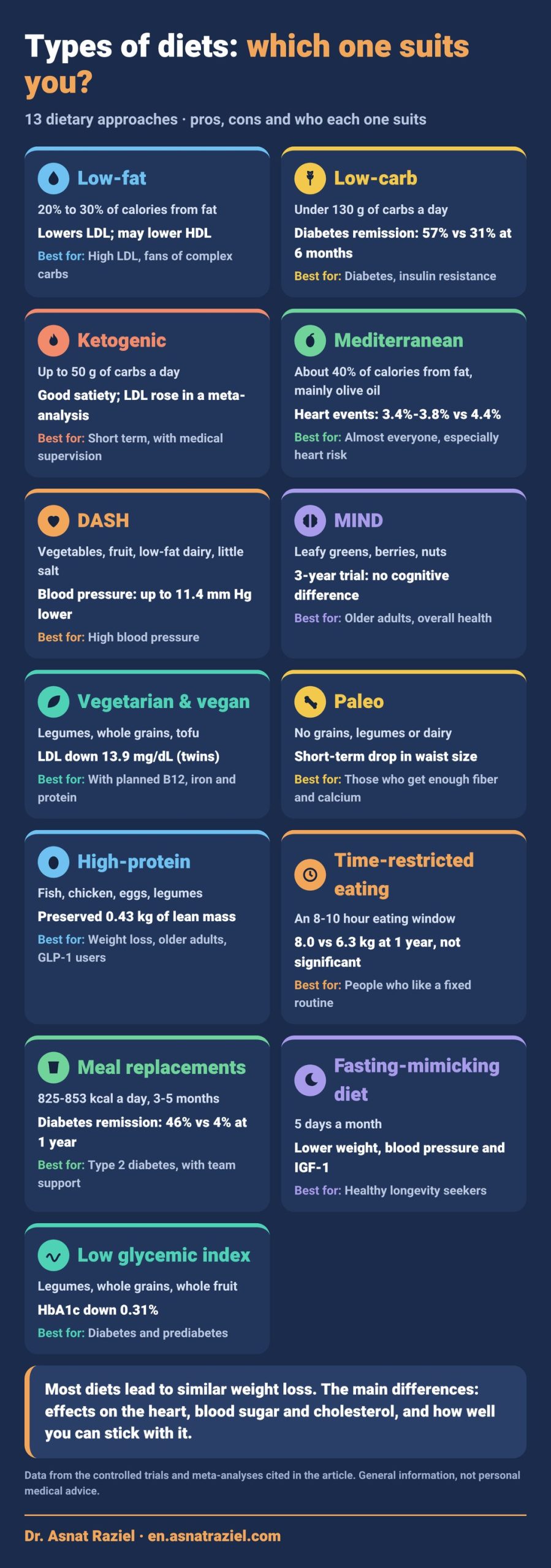
How to choose between types of diets
Before choosing between types of diets, I ask three questions in the clinic. First, what is the goal: weight loss, blood sugar control, blood pressure or heart protection? Second, what is the medical condition and which medications are involved? Finally, what do you enjoy eating, and what fits your routine?
For example, a person with diabetes will usually benefit from cutting carbohydrates. By contrast, a person with high LDL will benefit from a Mediterranean or plant-based diet. Moreover, anyone on weight-loss injections needs a special focus on protein, fluids and fiber.
Also, if you have tried many diets without success, it is not your failure. The body has biological mechanisms that resist weight loss. I wrote about this in my article what to do when a diet does not work. At our center, the dietitian builds a personal menu, alongside physical activity, emotional support and medication when needed.
The bottom line on types of diets
Different types of diets lead to fairly similar weight loss. The differences show up mainly in their effects on the heart, blood sugar and cholesterol. So the best diet is the one that fits your health and that you can keep up for years. The Mediterranean diet remains a safe, good choice for most people.
This article provides general information and is not personal medical advice. Before making a major change to your diet, especially during drug treatment, talk to your doctor or dietitian.
References
Studies on diet composition and weight loss
Obesity Algorithm – Obesity Medicine Association
Comparison of weight-loss diets with different compositions of fat, protein, and carbohydrates
Weight loss with a low-carbohydrate, Mediterranean, or low-fat diet
Studies on the heart, brain, plant-based diets, fasting and diabetes
A clinical trial of the effects of dietary patterns on blood pressure
Trial of the MIND Diet for Prevention of Cognitive Decline in Older Persons
Cardiometabolic Effects of Omnivorous vs Vegan Diets in Identical Twins: A Randomized Clinical Trial
Paleolithic nutrition for metabolic syndrome: systematic review and meta-analysis
Calorie Restriction with or without Time-Restricted Eating in Weight Loss