By Dr. Asnat Raziel, bariatric surgeon specializing in obesity treatment, metabolic health and healthy longevity; Director of the Multidisciplinary Center for Obesity Treatment, Assia Medical, Assuta Ramat HaChayal, Tel Aviv
When diets don’t work: first of all, it’s not your fault
What should you do when diets don’t work? It is one of the questions I hear most often in my clinic. People come to me after years of meal plans, calorie counting and “foolproof” programs. At first the weight drops, then it stalls, and in the end most of it comes back. So it is important to understand one thing: in most cases, the problem is not willpower but biology. The body protects its weight, and to succeed you need a plan that takes this into account.
Why the body fights weight loss
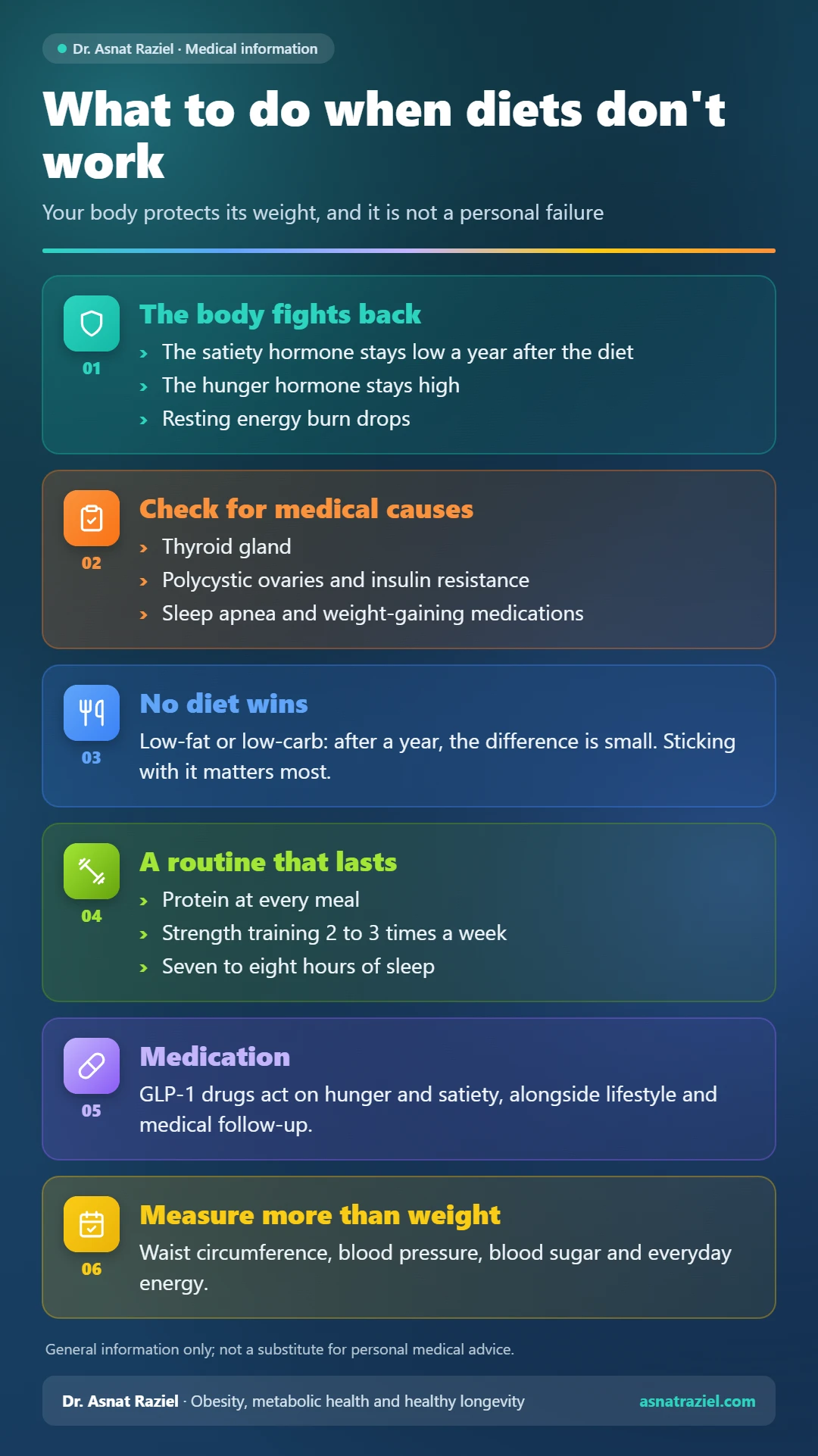
After weight loss, the brain interprets the situation as a threat. In response, it increases hunger and reduces energy use. This is not just a subjective feeling, but a process that can be measured.
Hunger and satiety hormones
A study published in the NEJM followed 50 people with excess weight who went on a low-calorie diet for 10 weeks. On average, they lost 13.5 kg. However, a year after the weight loss, levels of leptin, the satiety hormone, were still low. At the same time, levels of ghrelin, the hunger hormone, remained high, and the participants reported stronger hunger than at the start. In other words, the body “pushes” back toward its previous weight.
Metabolism slows down
In addition, the rate at which you burn energy at rest drops after weight loss. The famous study of contestants on the reality show “The Biggest Loser” illustrates this well. The researchers examined 14 contestants six years after the competition. On average, they had regained 41 kg of the 58 kg they had lost. Even so, their bodies burned about 700 fewer calories a day at rest than before the competition. These are extreme cases, but the principle applies to everyone: the faster and more aggressive the weight loss, the stronger the body’s resistance.
When diets don’t work: look for the reasons
Before you switch meal plans yet again, it is worth stopping to check what is standing in your way. First, there are medical reasons that make weight loss harder:
- An underactive thyroid gland.
- Polycystic ovary syndrome and insulin resistance.
- Sleep apnea, which disrupts appetite hormones.
- Medications such as steroids, some antidepressants and psychiatric medications that cause weight gain.
Second, lifestyle factors have a strong effect on hunger. Short sleep increases appetite, so improving sleep quality is part of the treatment. Chronic stress, emotional eating and skipping meals can also cancel out your efforts. Sometimes it is simply a weight-loss plateau, a natural stage that calls for adjustment, not despair.
When diets don’t work, don’t switch methods every month
Many people search for “the right diet.” However, studies show that the differences between diets are small. In the DIETFITS trial, for example, Stanford researchers assigned 609 adults to either a low-fat or a low-carbohydrate diet. After one year, the average weight loss was 5.3 kg versus 6.0 kg, a difference that was not statistically significant. Genetic tests also did not help predict who would succeed on which diet.
Food quality may matter as well. Ynetnews reported on a UK study in which participants lost almost twice as much weight on home-style, minimally processed meals as on ultra-processed meals.
The practical conclusion is simple: the best diet is the one you can stick with for years. That is why I recommend slow, safe weight loss rather than extreme regimens. Constantly switching between diets also hurts your chances, as the frustrating cycle of yo-yo dieting shows.
When diets don’t work: practical steps
Instead of yet another fresh start, it is worth building a routine that lasts. These are the steps I recommend to my patients:
- Protein at every meal, to increase fullness and preserve muscle mass.
- Plenty of vegetables, legumes and whole grains, and little processed food.
- Strength training two to three times a week, along with a daily walk.
- Seven to eight hours of sleep a night, at regular times.
- Planning meals ahead for busy days.
Planning is especially important for working people. A long workday, in any field, invites random snacking. So it is worth preparing meals in advance and blocking out time for exercise in your calendar. In addition, measure your success with other markers, too: waist circumference, blood pressure, blood sugar and everyday energy.
When diets don’t work over time: medical treatment
Obesity is a chronic disease, so sometimes medical treatment is needed, just as with any other disease. An approach of obesity treatment without extreme diets combines nutrition, exercise, emotional support and sometimes medication. If you have made several sincere attempts without success, it is time to see a doctor.
Medication
The new medications act precisely on the mechanisms that diet alone cannot overcome: hunger and satiety. In the STEP 1 trial, semaglutide at a dose of 2.4 mg a week led to an average weight loss of 14.9% after 68 weeks, compared with 2.4% in the control group. In the SURMOUNT-1 trial, tirzepatide at a dose of 15 mg led to an average weight loss of 20.9% after 72 weeks, compared with 3.1% in the control group. You will find detailed information about the options in my guide to medication for obesity.
However, medications are not a substitute for a healthy lifestyle. They make the change easier, while your lifestyle preserves the results and your muscle.
Bariatric surgery
In cases of severe obesity, usually with a BMI of 35 or higher, and sometimes at lower values when diabetes is present, bariatric surgery is an effective option. The decision is made after a thorough evaluation and a discussion of the benefits and risks.
The bottom line
If you are asking what to do when diets don’t work, the answer begins with understanding that your body fights weight loss. So it is worth checking for medical causes, choosing a way of eating you can stick with, and adding exercise and good sleep. When that is not enough, effective and safe medical treatments are available today. At our center, we build a personal plan for each patient, and you can read about me here, along with my approach.
The information in this article is general and does not replace personal medical advice.
Questions and answers
What should I do when diets don’t work after a few weeks?
A plateau after a few weeks is natural. It is worth checking your portion sizes, adding protein and strength training, and improving your sleep. If your weight has not budged for months, it is a good idea to get a medical evaluation.
Is a low-carb diet better than a low-fat diet?
Not necessarily. In the DIETFITS trial, the difference between the two approaches after one year was small and not significant. The right approach is the one that suits you and that you can stick with.
When is medication considered?
Usually with a BMI of 30 or higher, or 27 or higher with a related condition such as diabetes or high blood pressure. The decision is made with a doctor, after a personal assessment.
Does the weight come back after stopping the medication?
For many people, the weight goes back up after stopping, because obesity is a chronic disease. That is why it is important to plan the maintenance phase in advance, together with your care team.
Sources
Long-term persistence of hormonal adaptations to weight loss
Persistent metabolic adaptation 6 years after “The Biggest Loser” competition
Once-Weekly Semaglutide in Adults with Overweight or Obesity