By Dr. Asnat Raziel, bariatric surgeon specializing in obesity treatment, metabolic health and healthy longevity; Director of the Multidisciplinary Center for Obesity Treatment, Assia Medical, Assuta Ramat HaChayal, Tel Aviv
Zone 2 training: a revolution that turns out to be half the story
Zone 2 training has been one of the biggest hits in the longevity world in recent years. The idea is simple: train slowly, at a pace where you can still talk, and rack up the hours. In recent months, however, that advice has come under sharp criticism. Even Dr. Peter Attia, one of the method’s best-known champions, has updated his position.
The bottom line: easy training is an important foundation. But most people need to add harder efforts and strength training on top of it. Business Insider recently published an in-depth piece on the debate, with interviews with doctors, researchers and coaches. Here I’ve summarized the key points and added meta-analyses and studies from the past two years.
What is Zone 2 training?
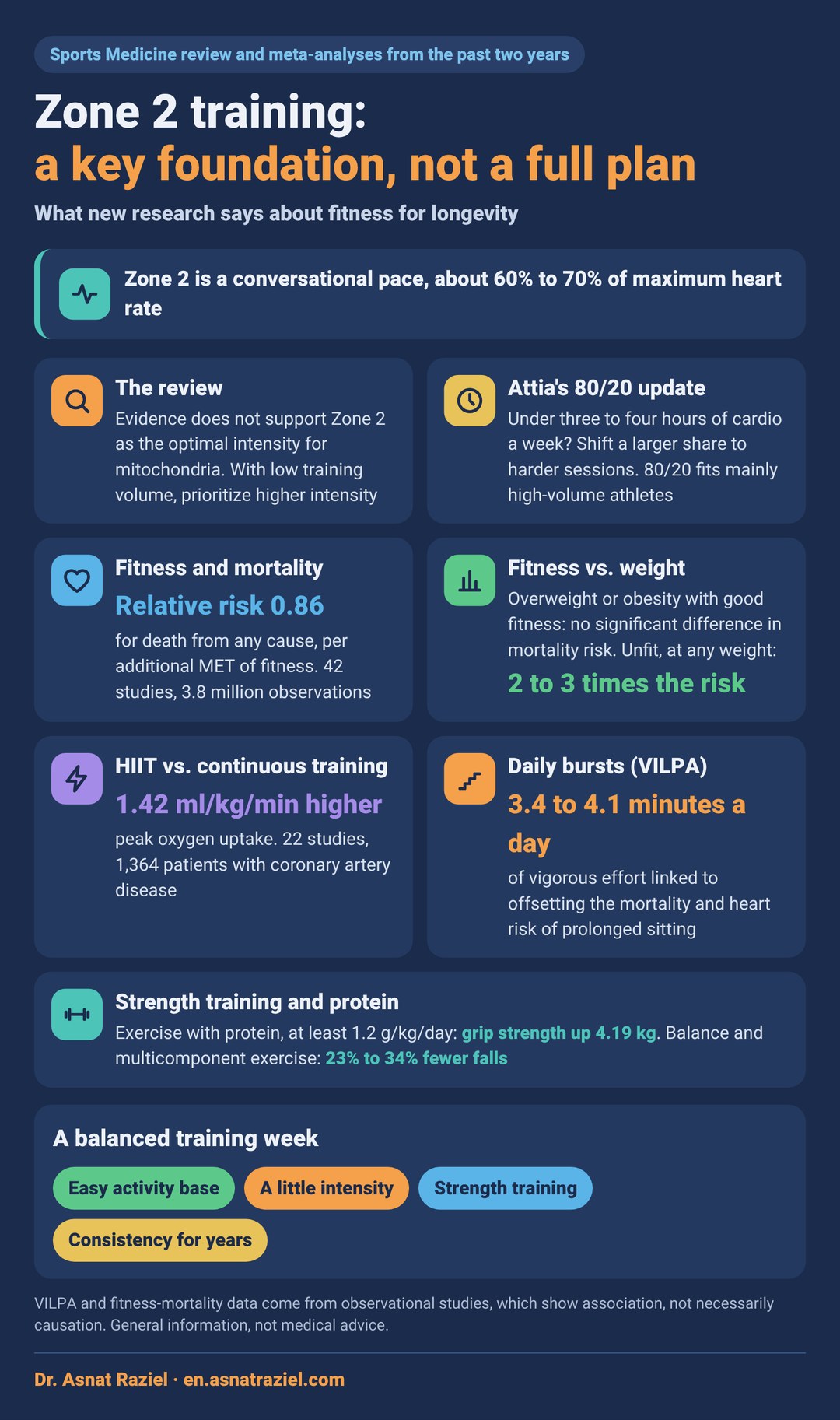
Heart rate zones divide exercise intensity into five levels. Zone 1 is the easiest, and Zone 5 is an all-out effort. Zone 2 training is exercise at a conversational pace, roughly 60% to 70% of your maximum heart rate. In scientific terms, it is effort below the lactate threshold, meaning below the point where lactic acid starts to build up in the blood.
The trend took off in late 2019, when Attia interviewed exercise physiologist and coach Iñigo San Millán. Both avid cyclists, they described the benefits of Zone 2 for fat burning, endurance and metabolic health. Since then, Attia has promoted the method as longevity exercise, especially for the health of the mitochondria, the powerhouses of our cells.
How Attia’s view of Zone 2 training has changed
For years, Attia talked about an 80/20 split. That is, about 80% of aerobic training volume at low intensity and about 20% at high intensity. Endurance athletes with large training volumes follow this split. In late October, however, Attia announced on social media that he wanted to “recommunicate” some of his messages.
According to Attia, his practice’s view has evolved over the past two years. His team no longer describes Zone 2 as uniquely beneficial for the mitochondria. Instead, total training volume, at Zone 2 and above, is the main driver. So the time worth spending in Zone 2 depends on how much time you have to train each week.
For people with less than three to four hours a week for cardio, Attia now recommends a larger share of high-intensity training. In his view, the 80/20 split remains the gold standard mainly for athletes and people who train a lot.
What the review found about Zone 2 training
Researchers in Canada recently published a review in the journal Sports Medicine that examined the evidence. First, they pointed to where the recommendation came from: observational data from elite endurance athletes. These athletes log many hours in Zone 2, and they have unusually high mitochondrial capacity.
On the other hand, a large body of research supports higher-intensity exercise for improving mitochondria and cardiometabolic health. The researchers’ conclusion is clear: the evidence does not support Zone 2 as the optimal intensity for improving mitochondrial function or fat use. Moreover, they say it makes sense to prioritize intensities above Zone 2, especially when training volume is low.
Brendon Gurd, a professor of muscle physiology at Queen’s University and the review’s senior author, explained this to Business Insider. The public message, he said, has been that this intensity gives you a special benefit. Based on the review, he doesn’t think that’s true.
Why elite athletes choose Zone 2 training
Manuel Sola Arjona, an endurance athlete and coach, is a big supporter of low-intensity training, in the right context. In his view, the mistake is copying the pros without understanding why they train that way: they train an enormous number of hours. In other words, Zone 2 is not a magic intensity. It is simply the intensity that lets you train for many, many hours without injury or overtraining.
Arjona uses a food analogy. Zone 2, he says, is like vegetables: the base of a balanced diet, and you can eat as much as you like. But a salad on its own still leaves you hungry. He also notes that five minutes in Zone 4 produce far more adaptation than five minutes in Zone 2.
VO2 max: the fitness marker that predicts longevity
VO2 max, or maximal oxygen uptake, measures how much oxygen your body can use during maximal effort. It is a key marker of cardiorespiratory fitness, the ability of your heart, lungs and muscles to work together.
A large meta-analysis of 42 studies and 3.8 million observations looked at the link between fitness and mortality. The researchers measured fitness in METs, where one MET equals 3.5 ml of oxygen per kilogram per minute. Each additional MET of fitness was linked to a relative risk of 0.86 for death from any cause, and 0.84 for death from cardiovascular disease. Put simply, that is a roughly 14% and 16% lower risk, respectively.
Another meta-analysis, published in BJSM, is especially relevant for people with excess weight. The researchers analyzed 20 studies with 398,716 observations, looking at fitness and body mass index (BMI) together. Fit people with overweight or obesity showed no significant difference in mortality risk compared with fit people of normal weight. In contrast, unfit people at any weight had a two- to threefold higher risk.
High-intensity training: more results per minute
Dr. Brittany Busse, a marathon runner and precision medicine physician, says high-intensity training delivers faster results. Bursts of hard work with short rests challenge the body, and it adapts and improves, for example by raising VO2 max. The longer the work interval and the shorter the rest, she says, the bigger the improvement.
Studies from the past two years support this. A meta-analysis of 22 studies included 1,364 patients with coronary artery disease. Compared with moderate-intensity continuous training, high-intensity interval training (HIIT) increased peak oxygen uptake by 1.42 ml/kg/min. Six-minute walk distance also rose by 18.6 meters.
A new network meta-analysis compared types of exercise in people aged 60 and older, across 57 trials with 3,655 participants. HIIT ranked first for improving HbA1c, the glycated hemoglobin test that reflects average blood sugar over recent months. Strength training led for lowering triglycerides and BMI, and combined training led for lowering systolic blood pressure and fasting blood sugar. However, the researchers stressed that confidence in some of these results is low.
The cost of too much intensity: consistency wins
High-intensity training has a price, too. Zones 4 and 5 carry a high mental and physical cost, and extreme training can backfire. Dr. Howard Luks, a sports medicine specialist, trail runner and cyclist, sees many athletes burn out from training too hard, too often.
In his view, the most important variable, for getting fitter and for living longer, is consistency. He likens it to the tortoise and the hare: the intensity junkie who gets injured has to stop. That’s why Luks prefers steady work you can build on over months and years. As he puts it, he doesn’t want his VO2 max to go up over four months, but to keep going up for 40 years.
This approach has a downside, though: it takes a lot of time. According to Luks, to get the most out of low-intensity exercise alone, you would need about 10 hours of training a week. That’s why a little sprinting or other hard effort matters for most of us.
Exercise snacks: a few minutes of effort a day
And what about people who don’t exercise at all? This is where VILPA comes in: vigorous intermittent lifestyle physical activity, short bursts of hard effort lasting up to a minute during the day. Think of climbing stairs briskly, walking fast to catch a bus or active play with your kids. I’ve also written about exercise snacks and smartwatches.
A study published in the European Journal of Preventive Cardiology followed 22,368 adults who did not exercise, for a median of 8 years. According to the findings, 4.1 minutes a day of vigorous activity or VILPA may offset the risk of major cardiovascular events linked to sitting more than 11.4 hours a day.
In another study by the same group, of 25,526 adults, the researchers found that 3.4 minutes a day of VILPA was enough to offset the link between prolonged sitting and mortality. Later, they published data from a nationally representative US sample of 3,293 adults. A median of 5.3 bursts a day was linked to a 44% lower risk of death.
Still, keep in mind that these are observational studies, which show an association, not necessarily cause and effect. When the researchers excluded people with heart disease or cancer, the association weakened. So part of it may simply reflect the fact that sick people move less.
Strength training: the third leg of the plan
The experts recommend adding strength training alongside aerobic exercise. An umbrella review of 41 systematic reviews examined interventions to prevent sarcopenia and falls in older adults. Combining exercise with protein supplementation, at least 1.2 grams per kilogram per day, improved muscle mass, grip strength and physical performance. Grip strength, for example, rose by 4.19 kg.
In addition, balance and multicomponent exercise reduced fall rates by 23% to 34%. If you’re just starting out, my article on strength training and preserving muscle mass is a good next read.
How to fit Zone 2 training into a smart training week
There’s no single perfect template, but the experts agree on a few basics:
Forget the number. Luks recommends focusing on perceived exertion, meaning how hard the effort feels, rather than the heart rate data on your smartwatch.
Build a base of easy activity. Walking, cycling or swimming at a comfortable pace, with a gradual increase in load, so you don’t ask more of your body than it can handle.
Add a little intensity. Luks suggests ending an easy run with a few rounds of uphill sprints or fast strides, 15 to 30 seconds each, with a short rest in between.
Include strength training. Spreading your time across a few types of exercise each week is like building a diversified investment portfolio.
Fit the plan to your schedule. When time is limited, harder efforts are a more efficient way to get fitter.
Start with any movement you enjoy. According to Luks, the greatest jump in longevity comes from going from nothing to something.
Zone 2 training: the bottom line
Zone 2 training hasn’t failed. It is a healthy, accessible and safe foundation, and according to Dr. Busse it quickly improves metabolic health and cardiovascular risk factors. But it isn’t a complete program. If you want to reach optimal fitness, add harder efforts and strength training, and above all, stay consistent for years.
This article provides general information and is not a substitute for personal medical advice. Before starting high-intensity training, especially if you have heart disease, high blood pressure or diabetes, talk to your doctor.
References
Cardiorespiratory fitness, body mass index and mortality: a systematic review and meta-analysis
Device-captured incidental physical activity, sedentary behaviour and all-cause mortality risk