By Dr. Asnat Raziel, bariatric surgeon specializing in obesity treatment, metabolic health and healthy longevity; Director of the Multidisciplinary Center for Obesity Treatment, Assia Medical, Assuta Ramat HaChayal, Tel Aviv
Extreme exercise and memory: the light and shadow of physical activity
The link between extreme exercise and memory is at the heart of a study that raises new questions. We all know the saying “exercise is health,” and rightly so. Light to moderate physical activity strengthens the heart and muscles, and it also improves brain function. However, a study published in the journal Cell Metabolism paints a more complex picture. According to the researchers, when training crosses a certain threshold, the body may respond in a way that harms memory.
Let me say this right away: the study does not claim that exercise is harmful. On the contrary, it reinforces the idea that the dose matters. In this article, I will explain what the researchers found, what is still unknown, and how to train wisely.
What the researchers examined
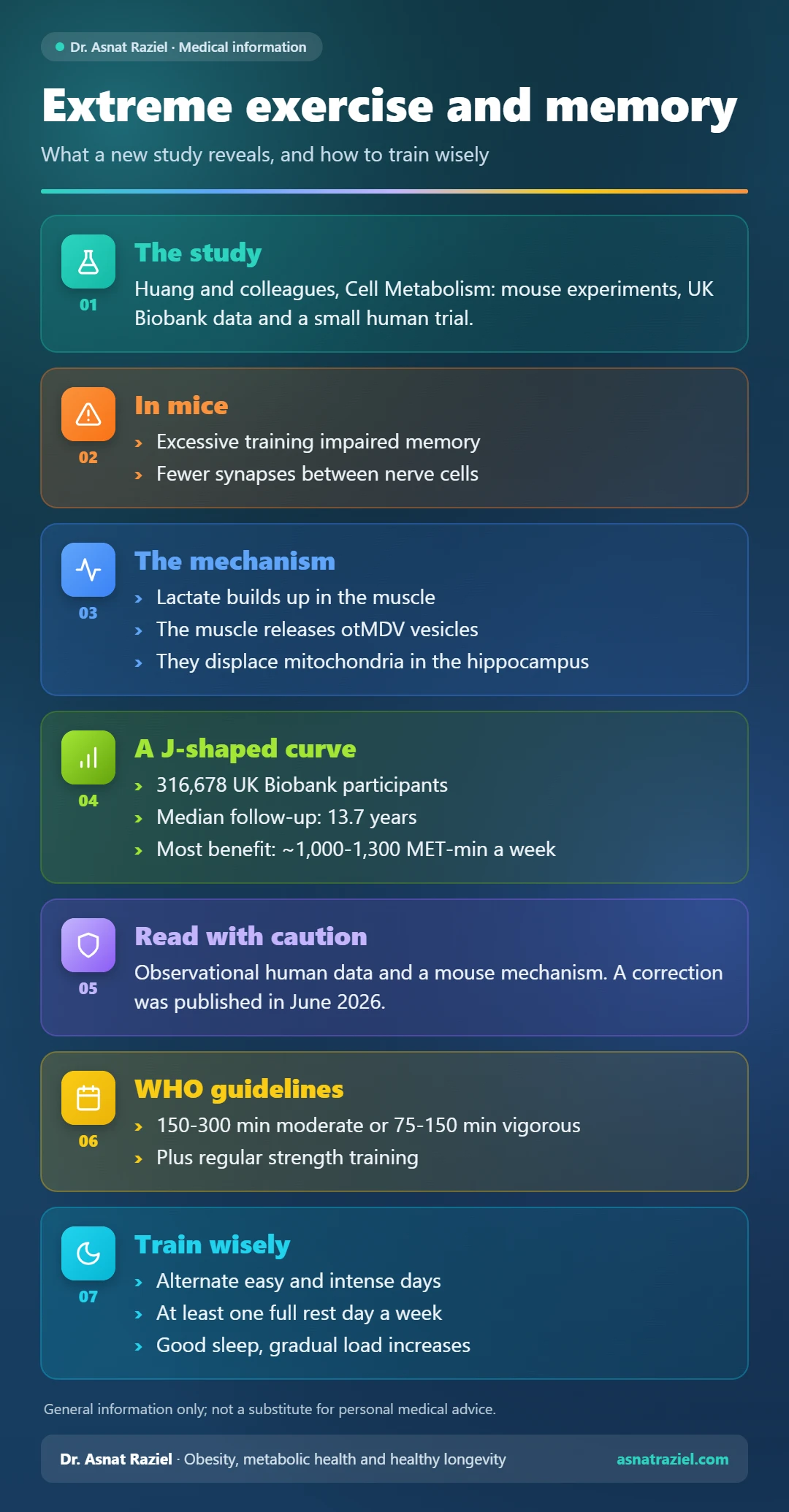
The study by Huang and colleagues from Xiangya Hospital in China was published online in December 2025. The researchers asked a simple question: what happens in the muscle and the brain after especially intense aerobic activity? To answer it, they combined experiments in mice, an analysis of a large database and a small trial in humans.
In mice, the researchers compared moderate training with intense, excessive training. The mice that trained excessively did worse on memory and learning tests. In addition, the researchers saw fewer synapses in these mice, meaning fewer connection points between nerve cells.
The mechanism: “pretenders” that come from the muscle
The most surprising finding concerns the mechanism. During extreme exertion, lactate builds up in the muscle. Lactate is a byproduct of breaking down sugar during effort. According to the study, lactate prompts the muscle to release tiny vesicles that originate in the mitochondria. Mitochondria are the power plants of the cell.
The researchers named these vesicles otMDVs. They are rich in mitochondrial DNA and carry a marker called PAF on their surface. Next, they travel to the hippocampus, the brain region responsible for learning and memory. There they “pretend” to be real mitochondria and take their place. As a result, the synapses do not get enough energy.
Moreover, the researchers identified two pathways of damage. First, the DNA released by the vesicles activates an inflammatory pathway called cGAS-STING. This pathway blocks the transport of healthy mitochondria to the synapses. Second, the PAF marker occupies the mitochondrial “docking sites” at the nerve endings. Finally, in mice, an antibody that blocks PAF prevented both the loss of synapses and the memory impairment.
Extreme exercise and memory in humans: what the data say
To examine the picture in humans, the researchers analyzed data from 316,678 participants in the UK Biobank, a large British health database. The median follow-up was 13.7 years. The link between the amount of activity and the risk of cognitive impairment took the shape of the letter J. In other words, the risk fell as activity rose, and then, at extreme levels, it rose again.
According to the commentary that accompanied the study, the greatest benefit from vigorous activity appeared at around 1,000 to 1,300 MET-minutes per week. MET is a measure of exercise intensity, and MET-minutes combine intensity and time. As a rough estimate, this is about two to two and a half hours of running per week. In addition, the researchers ran a small randomized trial in humans. In that trial, too, excessive training raised blood levels of the vesicles and was linked to lower scores on cognitive tests.
What the study does not prove
Despite the headlines, the findings should be read with caution. The UK Biobank data are observational, so they show an association, not cause and effect. Meanwhile, the full mechanism was shown in mice, and our bodies are different from a mouse’s body. The human trial was small and short.
In addition, in June 2026 the authors published a correction notice for several of the figures in the paper. According to them, the corrections do not change the conclusions. Still, it is a reminder that this is a preliminary finding that requires follow-up studies. Therefore, it should not be seen as a reason to stop exercising.
Extreme exercise and memory: why it matters to all of us
The main lesson is clear: balance matters more than extremes. The World Health Organization guidelines recommend that adults get 150 to 300 minutes of moderate activity a week, or 75 to 150 minutes of vigorous activity. In addition, they recommend regular strength training. Most people are far from the upper limit, so the common problem is still too little movement.
That said, some people train at high intensity almost every day, with no rest days. For them, these findings add to existing knowledge. A consensus statement from sports medicine societies describes overtraining syndrome: fatigue, declining performance and mood changes. According to the statement, the problem arises when a high training load comes without enough recovery.
What this means for patients with excess weight
Many patients who start a weight loss journey want to “make up for it” with intensive workouts. I understand the urge, but it usually leads to injuries, burnout and dropping out. Instead, I recommend building a gradual, personalized plan. For example, you can combine a daily walk, two strength sessions a week and one or two aerobic workouts.
It is also worth reading about the difference between aerobic and strength training and about combining nutrition and exercise for weight loss. If you are taking GLP-1 medications, you will find useful information in my article on GLP-1 drugs and sports performance.
How to train wisely
- Alternate easy days with intense days.
- Keep at least one full rest day a week.
- Get good sleep, because it is part of recovery.
- Watch for warning signs: persistent fatigue, declining performance, sleep problems and irritability.
- Increase the load gradually, not in sharp jumps.
If you work out in the evening, you can read about the link between evening exercise and sleep. And if you want to understand how much energy each workout requires, you will find answers in my guide on how many calories different workouts burn.
The bottom line on extreme exercise and memory
This study adds a new layer to the question of extreme exercise and memory. Health is not built at the extremes, but through the right dose, consistency and listening to your body. Physical activity is a powerful tool, and ultimately, like any tool, it requires precision and tailoring. If you exercise in moderation, you can carry on with peace of mind. If you push yourself to the limit, it is wise to build rest into your plan.
This article provides general information and is not a substitute for personal medical advice.
References
Lactate-driven mitochondrial pretenders hijack hippocampal function after excessive exercise
World Health Organization 2020 guidelines on physical activity and sedentary behaviour




