By Dr. Asnat Raziel, bariatric surgeon specializing in obesity treatment, metabolic health and healthy longevity; Director of the Multidisciplinary Center for Obesity Treatment, Assia Medical, Assuta Ramat HaChayal, Tel Aviv
Weight loss drugs in sport: a new and surprising question
Weight loss drugs in sport are now a topic of serious debate in the competitive world. Medications such as Wegovy and Mounjaro have changed how we treat obesity. Now they raise a new question: can drug-assisted weight loss be considered a competitive advantage?
Until a few years ago, “performance-enhancing drugs” mainly meant anabolic steroids, growth hormone, EPO or stimulants. However, GLP-1 drugs such as semaglutide, and combination drugs such as tirzepatide, raise a different kind of question. The drug does not build muscle, and it does not directly increase oxygen uptake. Even so, it allows an athlete to change body weight and body composition substantially. An article in BBC Future put the issue center stage, and the question is no longer theoretical.
Weight loss drugs in sport: WADA is monitoring semaglutide and tirzepatide
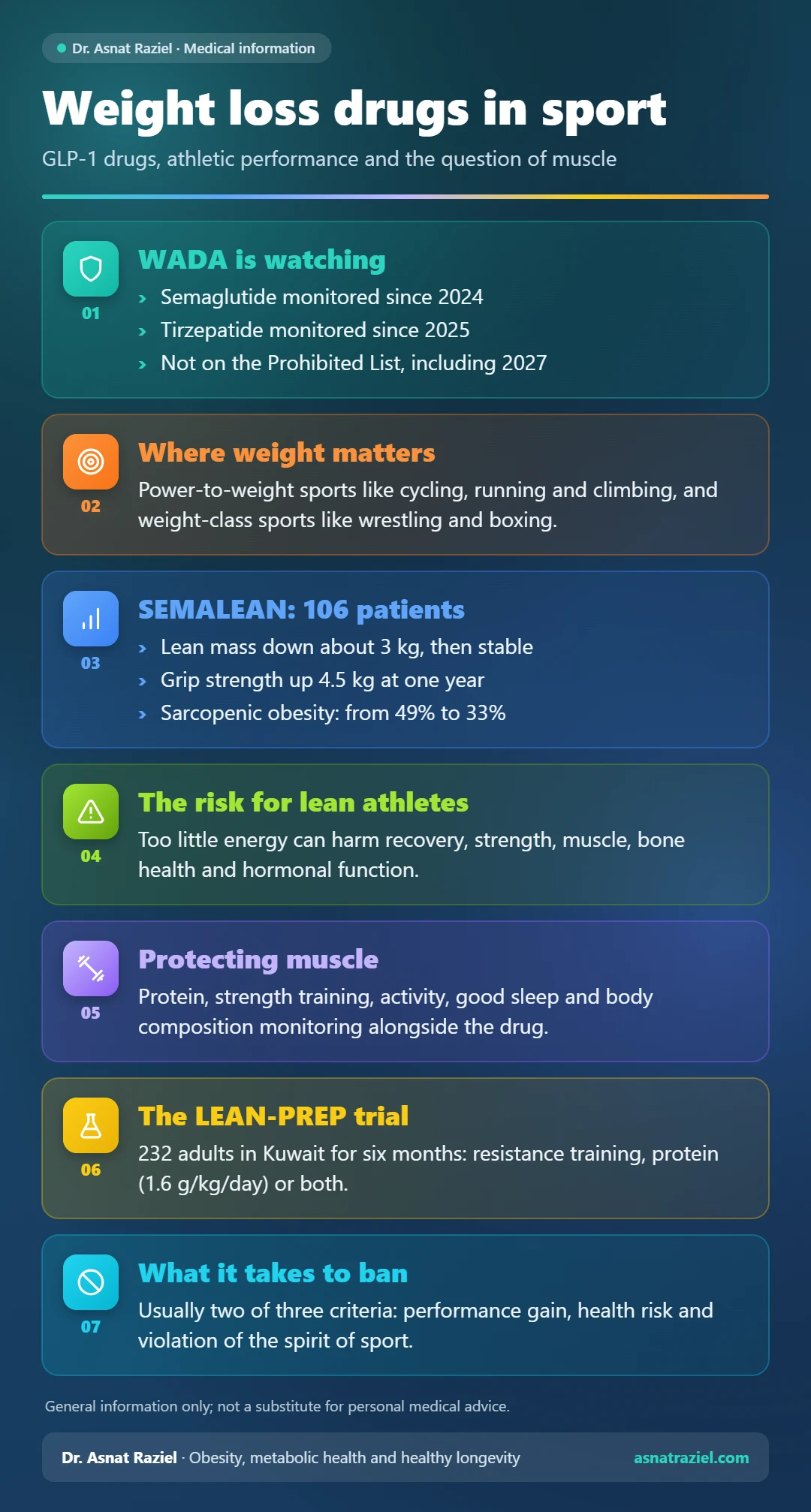
The clearest sign that the sports world takes this seriously comes from the World Anti-Doping Agency, WADA. The agency added semaglutide to its monitoring program in 2024, and tirzepatide in 2025. In its 2026 Monitoring Program, WADA tracks markers of both drugs, both in competition and out of competition.
It is important to stress that these drugs do not appear on WADA’s Prohibited List. The monitoring program is designed precisely for permitted substances, where the agency wants to detect patterns of misuse. In addition, in October 2026 WADA published its 2027 Prohibited List. The status of GLP-1 drugs did not change. According to the agency, there is still not enough evidence that they meet the criteria. One study in athletes is already underway, and WADA has started a second one. The very fact of monitoring shows that the line between medical treatment and a physiological change that affects competition is becoming blurred.
How could a weight loss drug improve performance at all?
GLP-1 is not an anabolic steroid. It does not make a person strong overnight, and it does not directly increase muscle mass. The possible advantage comes from somewhere else.
In some sports, the ratio between body weight and strength or power is critical. Cyclists, distance runners and climbers, for example, may benefit from losing fat mass, provided that strength and muscle are preserved. In weight-class sports such as wrestling, boxing and martial arts, the ability to lose weight efficiently matters even more.
This is where the new drugs come into the picture. They reduce hunger, increase satiety and lower energy intake. In patients with obesity, that is exactly why they work. In an athlete, by contrast, a fast and controlled change in weight could theoretically shift the ratio between body mass and performance.
But less weight does not necessarily mean better performance
Weight loss usually includes some lean mass, not just fat. A 2026 review on preserving lean mass during GLP-1 treatment concludes that semaglutide and tirzepatide mainly reduce fat, including visceral and ectopic fat. At the same time, there is a small but consistent decrease in lean mass.
It is also important not to confuse lean mass, meaning all body tissue that is not fat, with muscle. A DXA scan measures lean tissue that includes other components as well. So a drop in lean mass does not prove a loss of functioning muscle or a loss of strength.
In the SEMALEAN study, for example, 106 patients with obesity completed a year of treatment with semaglutide 2.4 mg. After seven months, lean mass had dropped by about 3 kg, and it then stabilized. Meanwhile, grip strength actually rose by 4.5 kg after one year. The rate of sarcopenic obesity fell from 49% at the start of the study to 33% after one year. In other words, the story is far more complex than the claim that GLP-1 “causes muscle loss.” I discuss this further in my article on why body composition matters more than weight.
Weight loss drugs in sport: the risk for lean athletes
A professional athlete needs plenty of energy, protein, carbohydrates and micronutrients to train and recover. If the drug strongly suppresses appetite, the opposite problem may arise: the athlete simply does not eat enough.
A significant energy deficit can harm recovery, strength, muscle, bone health, hormonal function and the ability to train at high intensity. Therefore, for an athlete who is already lean, taking GLP-1 just to “lose a few more kilos” is completely different from treating a person with obesity and metabolic disease. Put differently, a drug that improves health and function in one person may hurt performance in another.
And what about athletes with obesity?
This is where the ethical debate gets especially interesting. Suppose an athlete lives with obesity or type 2 diabetes and has a genuine medical reason for treatment. Thanks to the drug, their fat mass goes down, their blood pressure and metabolic control improve, and moving and training become easier. Is that “performance enhancement,” or simply treating a disease?
Medicine does this all the time. We treat asthma so an athlete can breathe properly, anemia to correct iron deficiency and injuries so they can get back to running. So the question is not only whether the drug improves performance. The real question is why it is taken, who takes it and what advantage it creates beyond correcting a medical condition.
Serena Williams made the debate tangible
The debate about weight loss drugs in sport got major exposure when Serena Williams returned to tennis. In 2025, she said publicly that she uses Zepbound, that is, tirzepatide, through a telehealth company in which she is a partner. According to Tennis.com, she can continue the treatment during competitions too, because the drug is permitted. In June 2026, she returned to the court in doubles at the Queen’s Club tournament in London.
The fact that one of the greatest athletes in history uses this treatment showed how quickly these drugs have moved from the clinic into conversations about fitness and professional sport. However, it is no proof that the treatment gives a competitive edge.
The real dilemma: losing fat while keeping muscle
In my view, this is one of the most important points, even outside the world of sport. The future of obesity treatment should not be measured only in kilograms. The key question is what kind of weight was lost. If a person loses 15 kg, we want most of that loss to come from fat, especially visceral and ectopic fat. At the same time, we want to preserve muscle and function as much as possible.
That is why modern obesity care includes, alongside the medication, adequate protein intake, strength training, physical activity, good sleep and monitoring of body composition. The topic is so important that in 2026 the LEAN-PREP study protocol was published. The study will recruit 232 adults in Kuwait for six months. It will test whether resistance training, protein supplementation with a target of 1.6 grams per kilogram per day, or a combination of the two preserves muscle during treatment with semaglutide or tirzepatide. You can read more in my article on how to preserve muscle while losing weight.
Will weight loss drugs in sport become “doping”?
It is too early to say. As of October 2026, semaglutide and tirzepatide are permitted in sport, and that will remain the case in 2027. Even so, WADA continues to monitor them. To ban a substance, the agency weighs three criteria: potential to enhance performance, risk to the athlete’s health and violation of the spirit of sport. Usually, two of the three are enough.
At present, there is a lack of high-quality studies showing that GLP-1 drugs directly improve the performance of elite athletes. In fact, under certain conditions, low energy intake and loss of lean mass could do exactly the opposite. But if it turns out that weight loss drugs in sport allow athletes to lose fat selectively, maintain strength and improve their strength-to-weight ratio, the debate will change completely.
The bottom line: these drugs are changing what “enhancement” means
To me, this is the fascinating part of the debate. The new generation of obesity drugs blurs lines that were once clear: between treatment and optimization, between health and performance, and between correcting a disease and upgrading human abilities. GLP-1 is not a steroid, and tirzepatide is not EPO. Still, when a drug changes body composition, appetite, weight and metabolism, it touches variables that are part of athletic ability.
So perhaps the important question is not whether Wegovy or Mounjaro are “performance-enhancing drugs.” The more interesting question is different: in an era when medicine can reshape the body with growing precision, where does medical treatment end and human enhancement begin?
The information in this article is general and does not replace personal medical advice.
References
WADA publishes 2027 Prohibited List
Serena Williams is returning to tennis – and bringing the GLP-1 debate with her
Serena returns: Williams makes a winning comeback in doubles at Queen’s Club with Mboko
Should GLP-1s be considered performance-enhancing drugs? (BBC Future)




