By Dr. Asnat Raziel, bariatric surgeon specializing in obesity treatment, metabolic health and healthy longevity; Director of the Multidisciplinary Center for Obesity Treatment, Assia Medical, Assuta Ramat HaChayal, Tel Aviv
Tirzepatide and prediabetes: what the research shows
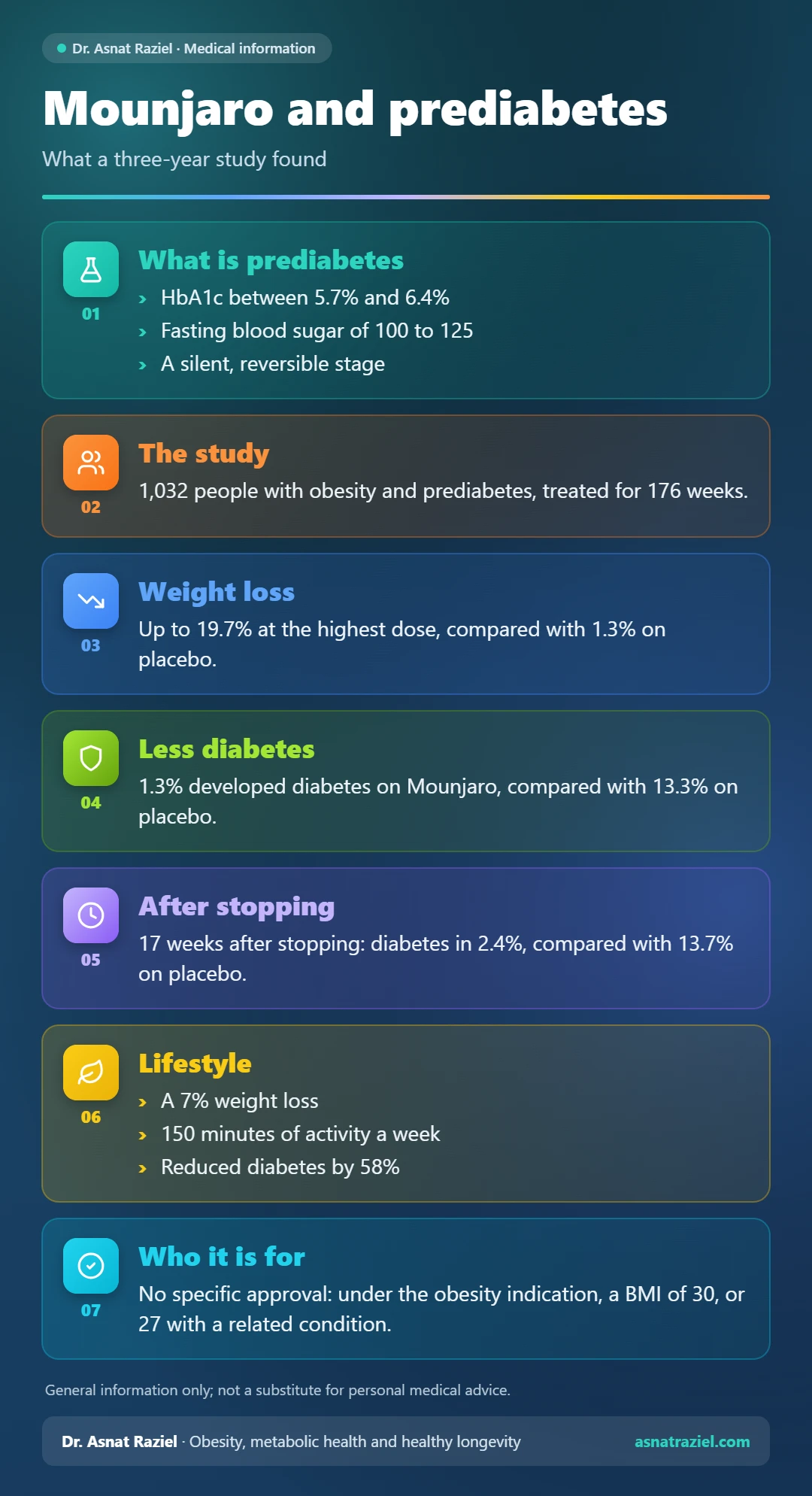
Tirzepatide and prediabetes is a pairing that interests more and more patients with excess weight and borderline blood sugar. In a large study that lasted about three years, tirzepatide, the active ingredient in Mounjaro, sharply reduced the progression from prediabetes to diabetes. Only 1.3% of people on the drug developed diabetes, compared with 13.3% in the placebo group. In this article, I explain what prediabetes is, what exactly the study found and who the treatment is right for.
What is prediabetes?
Prediabetes is a condition in which blood sugar is higher than normal but not yet in the diabetes range. It is a silent stage with no symptoms, so many people do not know they have it. At the same time, it is also a window of opportunity: at this stage, you can stop the progression.
How it is diagnosed
According to the US Centers for Disease Control and Prevention (CDC), these are the ranges for prediabetes:
- HbA1c, the average blood sugar over the past three months: 5.7% to 6.4%.
- Fasting blood sugar: 100 to 125 mg/dL.
- Two hours after a glucose tolerance test: 140 to 199 mg/dL.
Why weight affects blood sugar
Excess fat, especially in the belly and the liver, interferes with the action of insulin. As a result, the pancreas has to produce large amounts of insulin to keep blood sugar normal. Over the years, it wears out, and blood sugar rises. I wrote about this mechanism in detail in my article on insulin resistance.
That is why weight loss is the basic treatment for prediabetes. In the classic DPP study, lifestyle change cut the risk of diabetes by 58%, and metformin cut it by 31%. The goals were a 7% weight loss and 150 minutes of physical activity a week.
Mayo Clinic’s guide to prediabetes makes a similar point. It says healthy eating, physical activity and a healthy weight can help bring blood sugar back down.
Tirzepatide and prediabetes: the SURMOUNT-1 trial
Tirzepatide acts on two gut hormones, GLP-1 and GIP. It increases fullness, reduces food noise and improves the action of insulin. You can also find general information about the drug in the Tirzepatide (Mounjaro) entry.
The SURMOUNT-1 trial enrolled 2,539 people with obesity. Of these, 1,032 had prediabetes and received Mounjaro or placebo for 176 weeks. By the end of this period, average weight loss was 12.3%, 18.7% and 19.7% at doses of 5, 10 and 15 mg. In the placebo group, weight loss was only 1.3%.
The most important finding concerns diabetes. Only 1.3% of people on the drug developed type 2 diabetes, compared with 13.3% on placebo. Put simply, out of 100 people with prediabetes, about 13 in the placebo group developed diabetes, compared with just one in the Mounjaro group.
What happened after stopping treatment
The researchers also followed the participants for 17 weeks after treatment ended. At that point, doctors had diagnosed diabetes in 2.4% of the drug group and 13.7% of the placebo group. In other words, most of the protection held, but it began to weaken. Therefore, any decision to stop should be planned and supervised.
Lifestyle: the foundation that doesn’t change
Even with medication, habits remain the foundation. A long follow-up study showed that lifestyle affects prediabetes over decades. In addition, a diet rich in protein and vegetables, a daily walk and good sleep improve insulin sensitivity. As I wrote about the connection between sleep, the brain and the body, sleep is also part of treatment.
For daily walks, make sure to wear comfortable shoes. In established diabetes, checking your feet is especially important, and the CDC recommends checking your feet every day. All of these are part of a healthy lifestyle that also protects the heart.
Tirzepatide and prediabetes: an update from the American Heart Association meeting
Update, November 11, 2026. A large study presented at the American Heart Association meeting in Chicago supports early treatment. Researchers from Mayo Clinic in Arizona analyzed the records of 256,492 adults with prediabetes and obesity. Half took a GLP-1 drug – semaglutide, tirzepatide, liraglutide or dulaglutide – and half took metformin. Follow-up averaged about three years.
Compared with metformin, GLP-1 drugs were linked to a 1.5 times higher chance of returning to normal blood sugar. In addition, the risk of type 2 diabetes was 31% lower, and death from any cause was 41% lower. The researchers also found 15% fewer heart attacks, 20% fewer strokes, 25% fewer heart failure cases and 8% fewer cases of atrial fibrillation.
However, this is an observational study, presented as a meeting abstract that has not yet been peer reviewed. The researchers did not look at each drug separately, and they could not tell how consistently patients took it. So the finding adds to the picture, but it does not replace a controlled trial. Read the American Heart Association release.
Tirzepatide and prediabetes: who is the treatment for?
It is important to be precise: Mounjaro has no specific approval for prediabetes. Doctors prescribe it under the obesity indication, meaning a BMI of 30 or higher, or 27 or higher with a related condition. Prediabetes is exactly that kind of related condition.
Mounjaro is not the only drug studied in this area. A recent review found that semaglutide at 2.4 mg also reduced progression to diabetes and returned many people to normal blood sugar. Moreover, in the SELECT trial, in which 66.4% of participants had prediabetes, semaglutide reduced serious heart and brain events. As for tirzepatide, the SURMOUNT-MMO trial is still testing its effect on the heart, and as of November 2026 its results have not yet been published. Meanwhile, the choice between the drugs depends on other health conditions, side effects and personal preferences. I compare the options in my article on drugs for diabetes prevention.
In our clinic, we consider medication when prediabetes occurs alongside obesity, especially when changing habits alone has not been enough. You will find more options on my page about medications for obesity and metabolic disease and in my article on medications for preventing diabetes. In Israel, all four health funds (HMOs), Clalit, Maccabi, Leumit and Meuhedet, offer Mounjaro through their supplementary insurance at about half the market price or less, depending on the fund and dose, and the prices appear on the health funds’ websites.
Side effects and what to know
The common side effects are nausea, diarrhea, vomiting and constipation. In the study, most were mild to moderate and appeared mainly in the first 20 weeks, during the dose increase phase. Doctors do not give the drug to people who have, or whose family members have, medullary thyroid cancer or MEN2 syndrome. Also, you should stop it before a planned pregnancy.
Beyond blood sugar, it is also worth tracking blood pressure, blood lipids and the liver. I covered this in more detail in my article on improving metabolic markers.
Bottom line: tirzepatide and prediabetes
Prediabetes is a reversible stage, and the time to act is now. Weight loss and changing habits are the foundation. In people with obesity and prediabetes, Mounjaro cut the risk of diabetes in the study by about 90% over three years. Still, the decision to treat is personal, and you should make it with a doctor who knows the field.
The information in this article is general information and does not replace personal medical advice.
Questions and answers
Is there an official approval for tirzepatide and prediabetes?
No. Mounjaro is approved for type 2 diabetes and for obesity. A person with prediabetes can receive it if they meet the criteria for obesity treatment.
Can you bring blood sugar back to normal without medication?
Yes, many people can. In the DPP study, a 7% weight loss and 150 minutes of activity a week lowered the risk of diabetes by 58%.
Is tirzepatide treatment for prediabetes lifelong?
Not necessarily, but the effect weakens after stopping. That is why you should plan any break together with your doctor.
Who should get tested?
Anyone with excess weight, a family history of diabetes, or a past history of gestational diabetes. You can read more about my approach to treatment on my page about Dr. Asnat Raziel.
Sources
GLP-1 meds linked to lower diabetes, heart risks than standard diabetes prevention med
Tirzepatide for Obesity Treatment and Diabetes Prevention
Reduction in the incidence of type 2 diabetes with lifestyle intervention or metformin