By Dr. Asnat Raziel, bariatric surgeon specializing in obesity treatment, metabolic health and healthy longevity; Director of the Multidisciplinary Center for Obesity Treatment, Assia Medical, Assuta Ramat HaChayal, Tel Aviv
Sleep and brain health: night as maintenance time
The link between sleep and brain health is one of the most fascinating areas of science in recent years. Good-quality sleep is not just rest for the body. While we sleep, the brain maintains, cleans and renews itself. Over the past decade, researchers have discovered that metabolic waste is cleared from the brain at night. A special system does this work: the glymphatic system.
This discovery changed how science views sleep. Rather than passive rest, the night turns out to be a time of vital maintenance work. That work matters for memory, thinking and brain health over the years. This is the first article in my series on sleep.
How the brain’s cleaning system works
The brain is a very active organ. Throughout the day, brain cells produce breakdown products as part of their normal work. These substances have to be cleared efficiently. Otherwise, they build up and may cause harm.
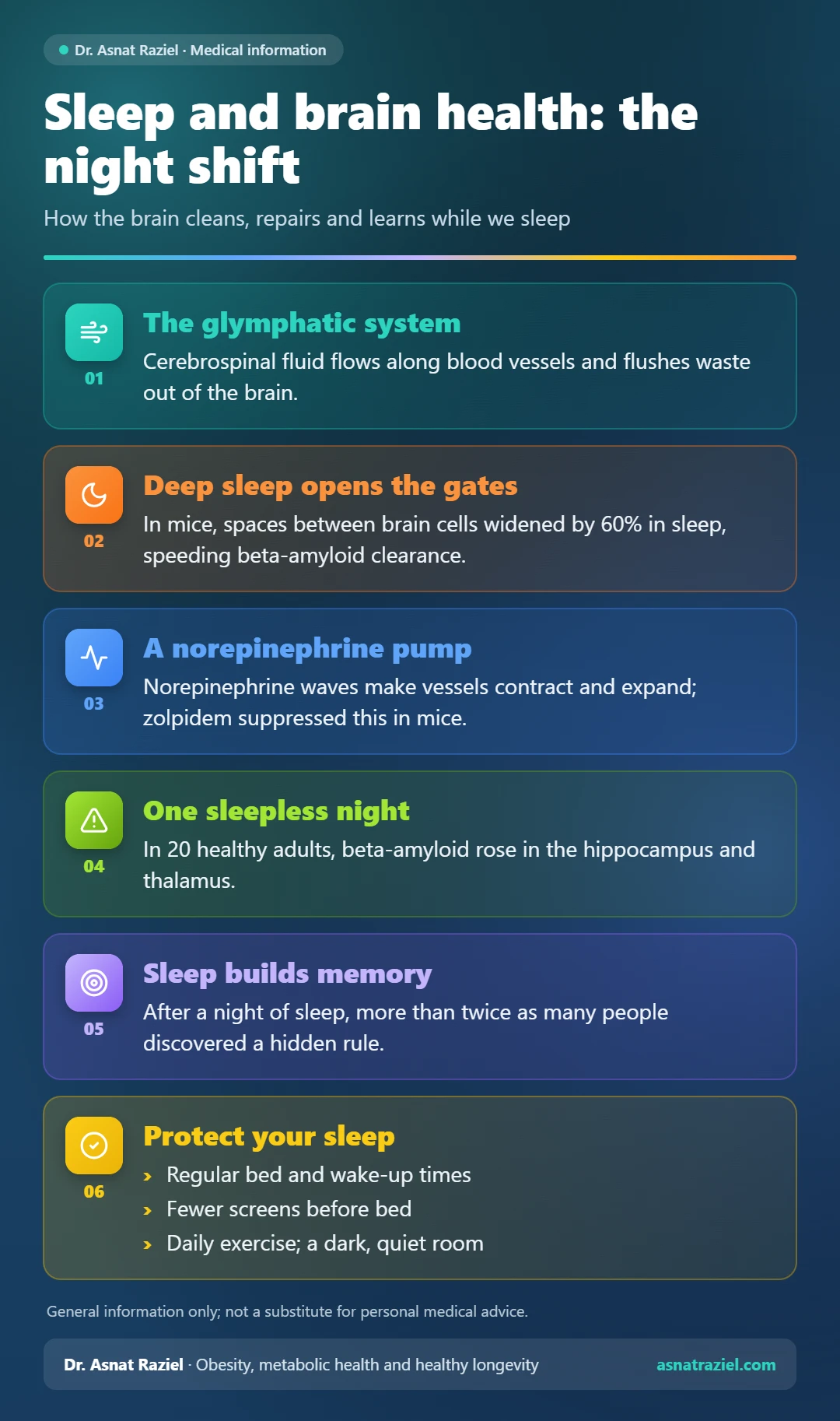
In the rest of the body, the lymphatic system removes waste. The brain, however, has no conventional lymphatic system. So it developed a unique cleaning mechanism. Cerebrospinal fluid flows along the blood vessels, washes through the tissue and flushes out substances the brain no longer needs. The brain’s support cells, called astrocytes, direct this flow. Hence the name, a blend of “glia” (the support cells) and “lymphatic.”
Deep sleep and brain cleaning
The link between deep sleep and brain cleaning was discovered in a groundbreaking study from the University of Rochester in 2013. The researchers studied living mice. During sleep, the spaces between brain cells widened by 60%. As a result, fluid flowed more easily, and the clearance rate of the protein beta-amyloid went up. A buildup of this protein is linked to Alzheimer’s disease.
In 2019, important confirmation came from humans. In an imaging study from Boston University, researchers saw large waves of brain fluid during deep sleep. These waves came right after the slow waves of brain activity. In other words, deep sleep and fluid flow are coordinated.
In January 2025, another piece of the puzzle fell into place. A study in the journal Cell showed that norepinephrine fluctuations during sleep make blood vessels contract and expand. This movement acts like a pump that pushes fluid into the brain. Interestingly, the sleeping pill zolpidem suppressed these fluctuations and the fluid flow in mice. So not all “artificial” sleep is equal to natural sleep.
Sleep and brain health: scientists still debate
Not all researchers agree on this picture. In 2024, a group from Imperial College London published a study in Nature Neuroscience. According to their measurements in mice, clearance from the brain actually decreased during sleep and anesthesia. The scientific debate remains open, and it centers on measurement methods.
Even so, there is also direct data from humans. In a study at the US National Institutes of Health, researchers scanned 20 healthy adults with PET imaging. After a single night without sleep, beta-amyloid levels rose in the hippocampus and the thalamus. These areas are important for memory and information processing. So even if the exact mechanism is still disputed, the practical conclusion is similar: the brain needs sleep.
How sleep affects memory
During sleep, the brain processes information. At night, new memories go through a consolidation process, moving from short-term to long-term memory. At the same time, the brain strengthens what matters and filters out what it doesn’t need.
The stages of sleep play different roles. Deep sleep is especially important for factual memory and learning. By contrast, REM sleep, the dreaming stage, is linked to emotional processing and to making connections between ideas. In an experiment at the University of Lübeck in Germany, participants learned a task with a hidden rule. After a night of sleep, more than twice as many of them discovered the rule, compared with those who stayed awake.
What happens to the brain without enough sleep
When sleep is too short, the brain doesn’t finish its maintenance work. The result is poor concentration, mental fatigue and trouble making decisions. Even one night of short sleep hurts performance. When this goes on for months, the effect on the brain runs much deeper. I have also written in detail about how a short night affects the whole body.
Over the years, chronic sleep disorders are linked to faster cognitive decline. Studies suggest that good deep sleep may help protect the brain from neurodegenerative diseases. In addition, sleep apnea interrupts deep sleep again and again. I wrote about it in my article on obesity and sleep apnea.
Sleep and brain health across the lifespan
Our need for sleep changes with age, but it doesn’t go away. In older age, deep sleep naturally gets shorter. That’s exactly why good sleep habits matter so much at this stage. In addition, chronic illnesses, pain and certain medications disrupt sleep in older adults. Treating these factors is part of protecting the brain. Healthy aging and longevity are topics I return to often.
Sleep, the brain and metabolism
The brain doesn’t work in isolation. Sleep quality also affects hormones and metabolism. A lack of sleep disrupts appetite regulation, which is why tired people often eat more than they need. You can read about this in my article on how good sleep protects your weight and metabolism. Excess weight itself also affects the brain, as I explained in my article on Alzheimer’s and obesity.
How to protect sleep and brain health
Good sleep is one of the simplest ways to protect the brain. First, regular bedtimes and wake-up times support the body clock. Second, less screen time before bed allows normal melatonin release. In addition, regular physical activity during the day improves sleep quality. The timing of workouts matters, too.
Your sleep environment also counts. A dark, quiet room at a comfortable temperature helps the brain enter deep sleep. If you take sleeping pills regularly, it’s worth talking to your care team about it and exploring alternatives.
In summary: sleep and brain health go hand in hand
The link between sleep and brain health is clearer today than ever. At night, the brain processes memories, maintains itself and probably also clears waste. Some details of the mechanism are still debated, but the direction is consistent. When we get enough good-quality sleep, we let the brain do its job. In this way, we protect a sharp memory, good concentration and brain health for years to come.
The information in this article is general and does not replace personal medical advice.
References
Sleep drives metabolite clearance from the adult brain
Coupled electrophysiological, hemodynamic, and cerebrospinal fluid oscillations in human sleep
Norepinephrine-mediated slow vasomotion drives glymphatic clearance during sleep
Brain clearance is reduced during sleep and anesthesia
β-Amyloid accumulation in the human brain after one night of sleep deprivation




