By Dr. Asnat Raziel, bariatric surgeon specializing in obesity treatment, metabolic health and healthy longevity; Director of the Multidisciplinary Center for Obesity Treatment, Assia Medical, Assuta Ramat HaChayal, Tel Aviv
Sleep apnea dangers: when the night becomes a health risk
The dangers of sleep apnea go far beyond annoying snoring. Obstructive sleep apnea is one of the most common complications of obesity, yet also one of the least diagnosed. Many people see it as a “night-time” problem only: snoring, waking up and fatigue. In reality, it is a medical condition with deep effects on the heart, the blood vessels, metabolism and quality of life. The good news is that treating obesity changes the picture from the ground up.
What is sleep apnea?
Obstructive sleep apnea occurs when the upper airway collapses during sleep. As a result, breathing stops again and again. Each pause causes a drop in oxygen levels and a nervous-system response that partly wakes the body. The result is fragmented, unrefreshing sleep, even when the person is not aware of it.
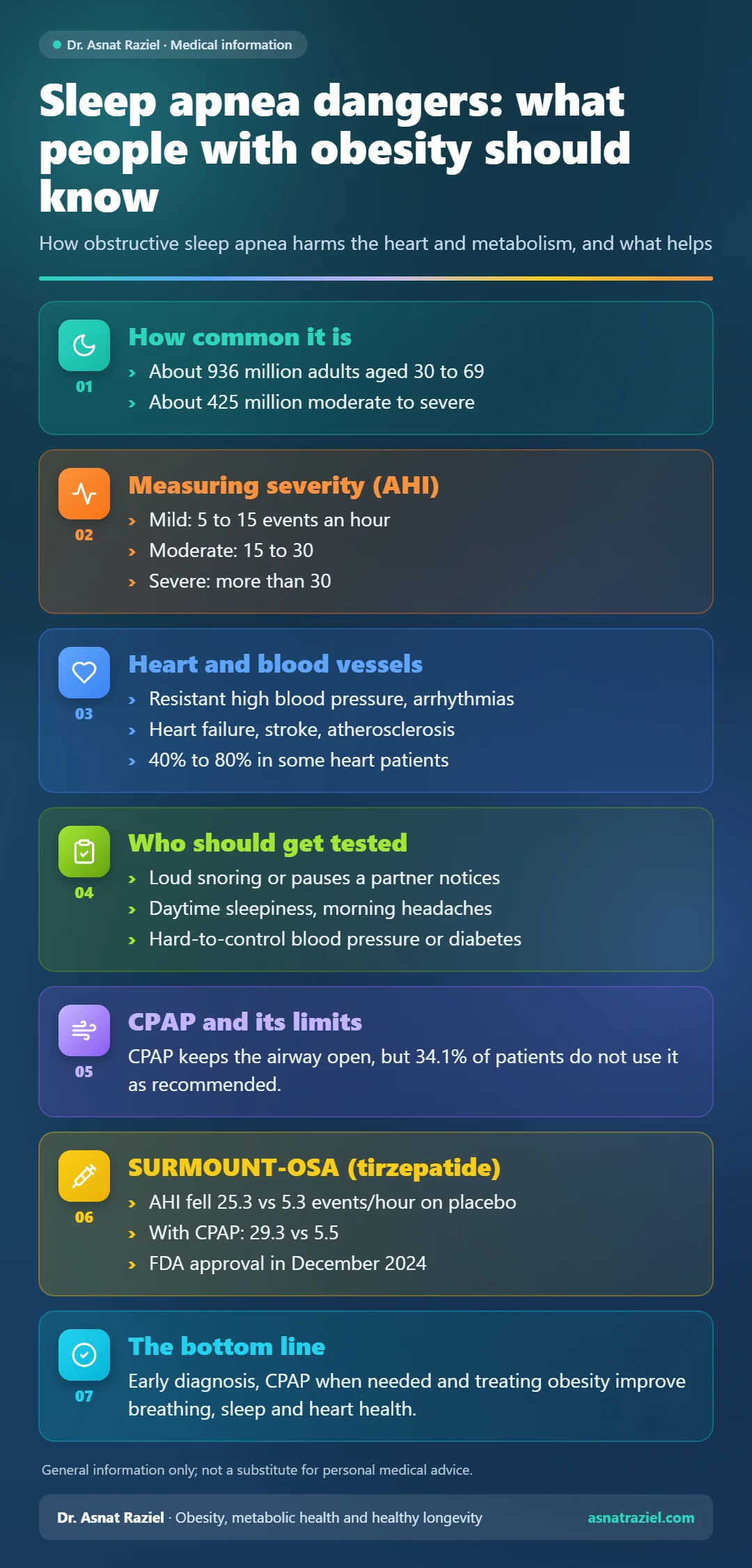
Doctors measure severity with the AHI (Apnea-Hypopnea Index), the number of pauses and slowdowns in breathing per hour of sleep. Between 5 and 15 events an hour is considered mild, 15 to 30 moderate, and more than 30 severe.
The scale is enormous. According to a global estimate published in the Lancet Respiratory Medicine, about 936 million adults aged 30 to 69 have some degree of sleep apnea. Of these, about 425 million have moderate to severe disease.
Why is it so common with obesity?
Obesity is the main risk factor for sleep apnea. It also makes it more severe. Fat around the neck and tongue narrows the airway. In addition, visceral fat in the abdomen reduces lung volume, and chronic inflammation weakens muscle tone.
This creates a vicious circle. Obesity worsens sleep apnea, and sleep apnea worsens obesity. Fatigue, hormonal disruption and increased appetite all push toward eating more. I wrote about the link between sleep and appetite in my article on obesity, sleep and the hungry brain.
Sleep apnea dangers for the heart and blood vessels
Sleep apnea is not a cosmetic or social problem. It is an independent risk factor for cardiovascular disease. The repeated pauses in breathing cause sharp spikes in blood pressure. At the same time, they activate the sympathetic nervous system all night long and increase chronic inflammation.
A scientific statement from the American Heart Association sums up the data. According to it, about 34% of middle-aged men and about 17% of middle-aged women meet the definition of sleep apnea. What’s more, among patients with high blood pressure, heart failure, atrial fibrillation or a previous stroke, the rate reaches 40% to 80%. Even so, in cardiology the condition usually goes undiagnosed and untreated.
Therefore, the dangers of sleep apnea include resistant high blood pressure, heart rhythm disorders, heart failure, stroke and worsening atherosclerosis. In addition, there is a close link between sleep apnea, insulin resistance and worsening diabetes. You can also read about the heart side in my guide to treating high blood pressure through weight loss.
Who should get tested?
People with obesity should watch for the following signs and get tested when they appear:
- Loud snoring or pauses in breathing that a partner notices.
- Daytime tiredness or sleepiness, even after a “full” night.
- Morning headaches and trouble concentrating.
- High blood pressure that is hard to control despite several medications.
- Poorly controlled diabetes or recurrent atrial fibrillation.
A sleep study, either in a sleep lab or at home, confirms the diagnosis. Early diagnosis allows early treatment and prevents cumulative damage. It is important to stress one point here: even people who do not feel tired may have severe sleep apnea.
Standard treatment and its limits
The standard treatment is a CPAP machine, a device that keeps the airway open with positive air pressure. It is effective, but it does not treat the underlying cause. In addition, adherence is far from complete. A review of 82 studies spanning 20 years found that 34.1% of patients do not use the device as recommended. That is why many patients need an additional solution.
Treating obesity as a root-cause solution
This is where obesity treatment comes in. Significant, lasting weight loss greatly improves sleep apnea. In some patients, the severity drops. In others, the symptoms almost disappear. Bariatric surgery has also shown improvement in sleep measures and in the need for CPAP.
The big breakthrough came with the SURMOUNT-OSA trials, published in the NEJM. Two trials tested tirzepatide, the active ingredient in Mounjaro, in adults with obesity and moderate to severe sleep apnea. At the start of the study, the average AHI was about 50 events an hour. After 52 weeks, in the first trial, the AHI fell by 25.3 events an hour, compared with 5.3 on placebo. In the second trial, in patients who also used CPAP, it fell by 29.3 events, compared with 5.5 on placebo.
Following these results, the FDA approved tirzepatide in December 2024 as the first prescription drug for moderate to severe sleep apnea in adults with obesity. According to the company, 42% to 50% of patients reached remission or mild sleep apnea without symptoms, compared with 14% to 16% on placebo. In addition, the drug lowered blood pressure and the inflammation marker hsCRP. I cover the drug itself and the SURMOUNT-OSA results in more depth in my separate article on Mounjaro as a treatment for sleep apnea, while this article focuses on the dangers and on who should get tested.
How treatment reduces the dangers of sleep apnea
Improving sleep apnea has an effect that reaches far beyond sleep itself. Daytime fatigue decreases, concentration and mood improve, and blood pressure and blood sugar become much easier to control. As a result, overall cardiovascular risk also drops. In this sense, treating obesity is also a night-time treatment, one that works while the patient sleeps. Sleep habits and night-time eating are part of the picture too.
The bottom line: sleep apnea dangers can be reduced
Sleep apnea shows clearly how obesity affects the body even in the hours when everything seems to be at rest. The dangers of sleep apnea are real, but today they have an answer. Early diagnosis, CPAP when needed and treatment of the root problem, obesity, improve breathing, sleep, the heart and overall health, around the clock.
The information in this article is general and does not replace personal medical advice.
References
Trends in CPAP adherence over twenty years of data collection: a flattened curve
Tirzepatide for the Treatment of Obstructive Sleep Apnea and Obesity
The SURMOUNT-OSA trials were funded by Eli Lilly, the manufacturer of the drug. The global estimate of sleep apnea prevalence was funded by ResMed.




