By Dr. Asnat Raziel, bariatric surgeon specializing in obesity treatment, metabolic health and healthy longevity; Director of the Multidisciplinary Center for Obesity Treatment, Assia Medical, Assuta Ramat HaChayal, Tel Aviv
Diabetes prevention drugs: what’s new and why it matters
Diabetes prevention drugs are no longer just a theoretical idea. A new study found that the pill Foundayo lowered the calculated risk of type 2 diabetes by up to 57% compared with placebo. However, this is a model’s prediction, not a count of people who actually developed the disease. So it is worth placing the finding alongside other drugs, and alongside what a healthy lifestyle has already proven.
Many people know this moment well: the blood test comes back, and the sugar is a bit high again. The doctor mentions prediabetes, a state in which blood sugar is above normal but not yet diabetes. Right away, a question comes up: can you stop the process? The answer is yes, and there is more than one way to do it.
What the Foundayo study found
Foundayo, whose generic name is orforglipron, is a daily pill that activates the GLP-1 receptor. GLP-1 is a gut hormone that increases fullness and improves blood sugar control. In the United States, regulators have approved it for weight management, together with diet and physical activity.
Foundayo is also becoming easier to obtain. I cover this in my article on wider access to Foundayo and Mounjaro.
The new analysis, published in the journal Diabetes, Obesity and Metabolism, drew on the ATTAIN-1 trial. It included adults without diabetes who had obesity, or overweight with a related complication, and who received treatment for 72 weeks. The researchers then calculated the 10-year risk using three models: CMDS for diabetes, and Framingham and PREVENT for cardiovascular disease.
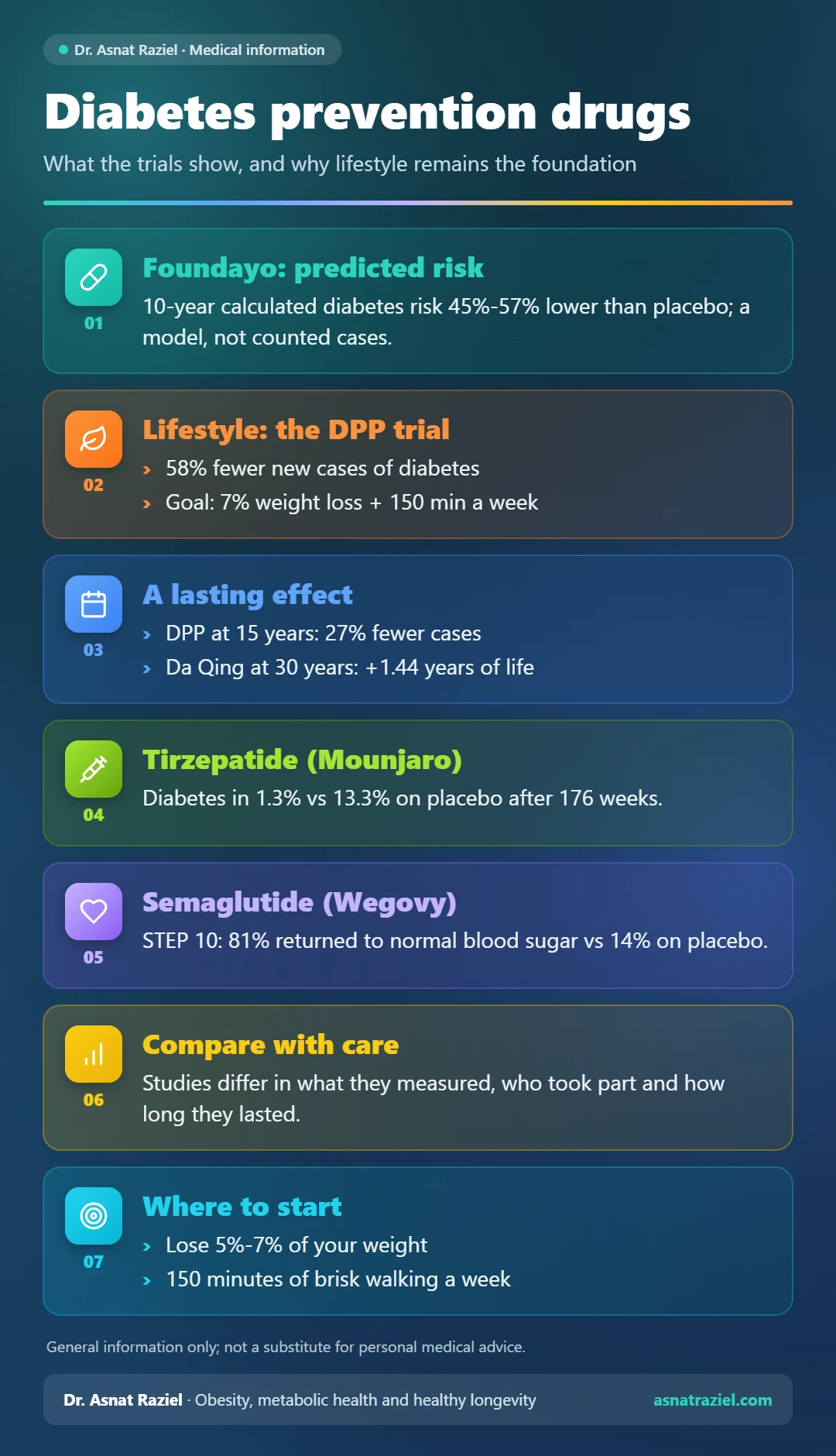
According to data published by Lilly, the calculated diabetes risk fell by 45%, 50% and 57% compared with placebo, at doses of 5.5, 9 and 17.2 mg. At the highest dose, the baseline risk was 17.1%, and it fell by 9.8 percentage points. By contrast, the risk fell by only 1.7 percentage points in the placebo group. In addition, according to the Framingham model, the calculated cardiovascular risk was 13% to 18% lower than with placebo. That is a drop of up to one percentage point in absolute terms.
It is important to remember that the researchers did not follow participants for ten years or count how many developed the disease. In other words, the prediction improved, but actual prevention has not yet been proven. I wrote about the study itself in detail in my article on Foundayo and diabetes prevention.
A healthy lifestyle: the proven foundation
Before any drug, it is worth knowing the study that shaped the field. The U.S. Diabetes Prevention Program (DPP) included 3,234 people with above-normal blood sugar. The goals in the lifestyle group were a weight loss of at least 7% and at least 150 minutes of physical activity a week. After an average of 2.8 years, lifestyle change reduced new cases of diabetes by 58%. Metformin, by comparison, reduced them by 31%.
The effect also lasted over time. At 15 years of follow-up, there were 27% fewer cases of diabetes in the lifestyle group and 18% fewer in the metformin group. Moreover, the Chinese Da Qing study followed participants for 30 years. There, lifestyle change delayed the onset of diabetes by about four years. Lifestyle change also brought 26% fewer cardiovascular events, 26% lower mortality and an average of 1.44 extra years of life.
How do you start? According to the U.S. Centers for Disease Control and Prevention (CDC), the goal is to lose 5% to 7% of your weight and get 150 minutes a week of brisk walking or similar activity. For example, for a person weighing 100 kg, that means 5 to 7 kg. In addition, it helps to combine aerobic and strength training, keep up your daily steps and protect good sleep.
Diabetes prevention drugs tested in clinical trials
Researchers have tested several diabetes prevention drugs in trials that counted actual cases of the disease. However, these studies differ in their populations, length of follow-up and definitions. So this is not a head-to-head comparison but a snapshot.
Metformin: It lowers sugar production in the liver and improves insulin sensitivity. In the DPP, it reduced new cases of diabetes by 31%. It also has the advantage of many years of experience and a low price.
Tirzepatide (Mounjaro): A weekly injection that activates two receptors, GIP and GLP-1. In the SURMOUNT-1 follow-up, 1,032 people with obesity and prediabetes took part. After 176 weeks, 1.3% of treated patients developed diabetes, compared with 13.3% in the placebo group. In addition, patients lost 12.3% to 19.7% of their body weight. I wrote separately about who Mounjaro is for.
Semaglutide 2.4 mg (Wegovy): A weekly injection that activates the GLP-1 receptor. In the STEP 10 trial, 81% of patients with prediabetes returned to normal blood sugar within a year, compared with 14% on placebo. In an analysis of the SELECT trial, 1.5% of patients reached diabetic levels within three years, compared with 6.9%. Moreover, this is the drug that cut major cardiovascular events by 20% in people with cardiovascular disease and overweight or obesity, without diabetes.
Other diabetes prevention drugs
Liraglutide 3 mg (Saxenda): A daily injection from the same family. In the SCALE trial, which lasted 160 weeks, 2% of patients developed diabetes, compared with 6% on placebo. Patients also lost 6.1% of their body weight. However, only about half of the participants completed the study.
Pioglitazone: A pill that improves insulin sensitivity. In the ACT NOW trial, it reduced progression from prediabetes to diabetes by 72%. On the other hand, patients gained 3.9 kg on average, and swelling (edema) was more common.
Acarbose: A pill that slows the absorption of carbohydrates in the gut. In the STOP-NIDDM trial, it reduced the risk by 25%. However, the common side effects were gas and diarrhea.
Orlistat (Xenical): A pill that reduces fat absorption from food. In the XENDOS trial, which lasted four years, 6.2% of patients developed diabetes, compared with 9.0% on placebo. In other words, the risk fell by 37.3%. However, the difference came from participants who had prediabetes at the start of the study.
How do you compare diabetes prevention drugs?
First, check what was measured. Most of the studies described here counted people who developed diabetes over several years. In STEP 10, for example, the researchers measured a return to normal blood sugar. In the Foundayo study, by contrast, they calculated future risk using a model. Therefore, Foundayo’s 57% cannot be compared directly with the results for tirzepatide or metformin.
Second, check what happens after stopping. In SURMOUNT-1, after 17 weeks without treatment, 2.4% of those who had received tirzepatide developed diabetes, compared with 13.7% on placebo. In other words, most of the benefit held, but the follow-up was short. I have written before about what happens when you stop GLP-1 drugs.
Finally, weigh each drug’s added benefits: weight loss, heart protection, how it is taken, side effects and price. Choosing between diabetes prevention drugs is a personal medical decision. It depends on your weight, your other conditions and your ability to stay with treatment.
A daily pill: Foundayo’s strengths and limits
Foundayo’s main advantage is convenience: one pill a day, with or without food. In the ATTAIN-1 trial, patients on the highest dose lost 11.2% of their weight within 72 weeks, compared with 2.1% on placebo. So for people who prefer to avoid injections, this is a new option. The complete guide to Foundayo treatment lays out the steps.
Still, a pill also requires medical follow-up. The common side effects are nausea, constipation, diarrhea, vomiting and abdominal pain. That is why doctors increase the dose gradually. In addition, people who, or whose family members, have had medullary thyroid cancer, and people with MEN 2 syndrome, must not take the drug. The U.S. indication is for weight management, not for diabetes prevention.
What can you do right now?
If you have been told you have prediabetes, you can start with a conversation with your doctor. First, make sure you understand your test results and find out what follow-up you need. Then set a first, modest goal: losing 5% to 7% of your weight and moving regularly. You do not have to wait for a large weight loss to benefit.
A plan you can return to even in a busy week is worth more than an ambitious resolution that is hard to keep. Drug treatment, when appropriate, fits into this plan rather than replacing it. Indeed, in many of the drug trials, participants also received guidance on diet and physical activity.
Bottom line: diabetes prevention drugs are an addition, not a substitute
The Foundayo study adds hope: a daily pill may also improve the predicted risk of diabetes. However, the strongest evidence for prevention over decades still belongs to lifestyle change. Ultimately, diabetes prevention drugs work best when they join smart eating, movement and good sleep.
The information in this article is general and is not a substitute for personal medical advice.
References
Orforglipron, an Oral Small-Molecule GLP-1 Receptor Agonist for Obesity Treatment
Reduction in the incidence of type 2 diabetes with lifestyle intervention or metformin
Prediabetes – Your Chance to Prevent Type 2 Diabetes
Tirzepatide for Obesity Treatment and Diabetes Prevention
Semaglutide and Cardiovascular Outcomes in Obesity without Diabetes
Pioglitazone for diabetes prevention in impaired glucose tolerance
Acarbose for prevention of type 2 diabetes mellitus: the STOP-NIDDM randomised trial
Disclosure from the sources: most authors of the ATTAIN-1 analysis are employees of Lilly, the maker of Foundayo and Mounjaro. The tirzepatide, semaglutide, liraglutide and pioglitazone trials were funded by their manufacturers.