By Dr. Asnat Raziel, bariatric surgeon specializing in obesity treatment, metabolic health and healthy longevity; Director of the Multidisciplinary Center for Obesity Treatment, Assia Medical, Assuta Ramat HaChayal, Tel Aviv
Access to obesity drugs: what changed in the United States
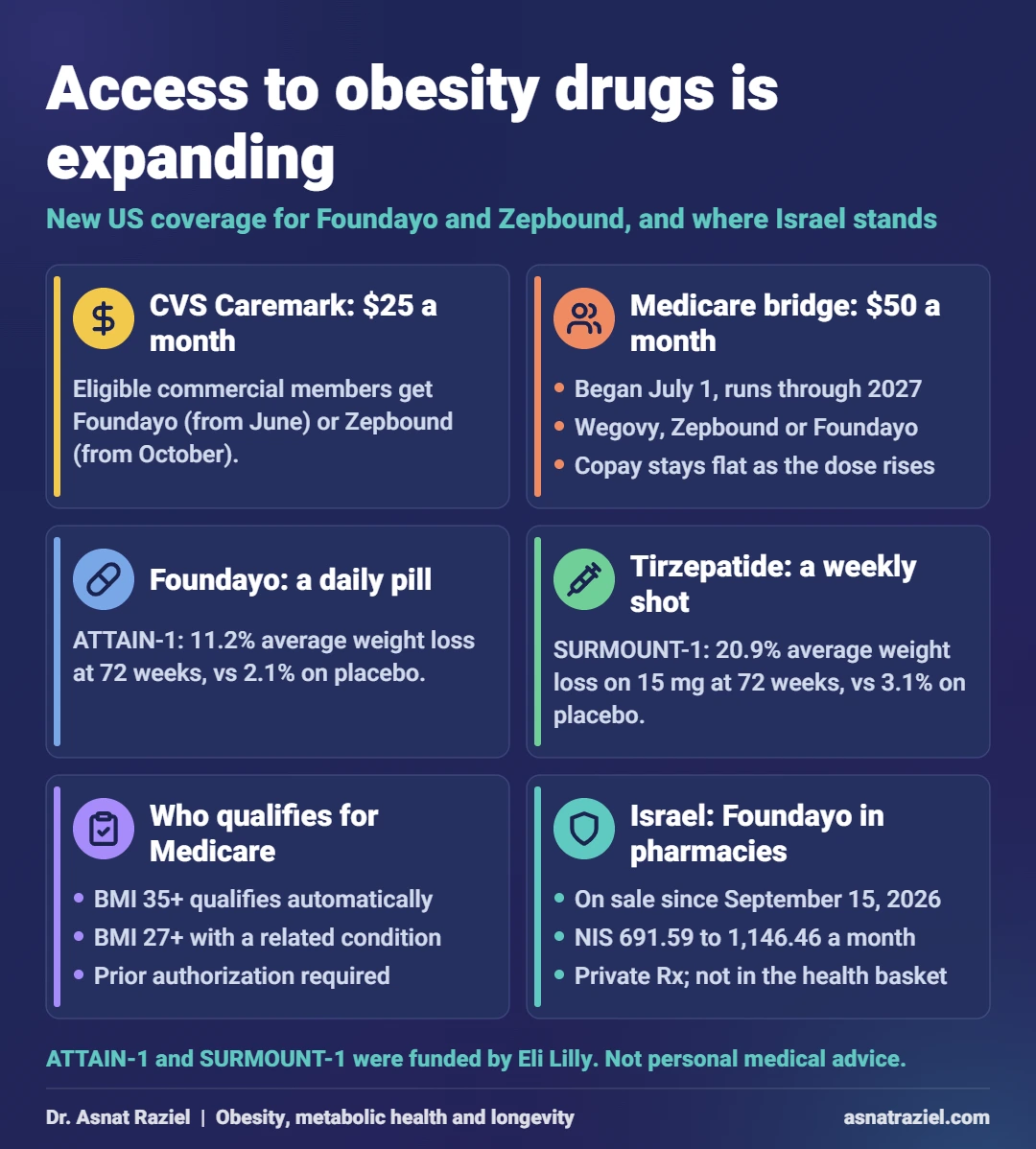
Access to obesity drugs is one of the biggest challenges in obesity medicine, and in the United States it is now taking a major step forward. In May 2026, CVS Caremark announced a significant change. CVS Caremark is one of the country’s largest pharmacy benefit managers, the companies that run prescription drug coverage. Starting in June 2026, it covers Foundayo, Eli Lilly’s weight-loss pill. Then, starting in October 2026, it also restores coverage for Zepbound, the US brand of tirzepatide (the active ingredient in Mounjaro) for obesity.
This matters a great deal. Specifically, eligible commercially insured members can get either drug for just $25 a month. Wegovy, both the injection and the pill, also stays on the preferred list. In other words, for the first time, the company’s members can choose between the two manufacturers’ drugs on similar terms. This move could also shape how the health system treats obesity: as a true chronic disease.
Not just weight loss, but a shift in mindset
For many years, people saw obesity as a problem of willpower or lifestyle. Today, however, the picture is completely different. Medicine now understands that it is a chronic metabolic disease that affects many body systems. It is linked to diabetes, heart disease, fatty liver, sleep apnea, joint pain and even some cancers.
That is why broad insurance coverage for these drugs signals a deep change. This is no longer an “aesthetic” treatment. Instead, it is essential medical care with a long-term impact on public health. You can read more about coverage in general in my article on insurance coverage for obesity medications.
Foundayo: the weight-loss pill that changes the rules
Foundayo is the brand name of orforglipron, and it is one of the most talked-about drugs in obesity care. The FDA approved it in April 2026. It is a once-daily pill that works on the GLP-1 pathway, much like the familiar injections, but without a needle.
Unlike earlier pills, Foundayo requires no fasting, no special drinking rules and no waiting around the dose. This simplicity makes it especially attractive for people who struggle with injections. In the ATTAIN-1 trial, patients on the highest dose lost an average of 11.2% of their body weight after 72 weeks. On placebo, the figure was 2.1%. Among those who stayed on treatment, weight loss reached 12.4%. For a practical guide, see my article on Foundayo treatment.
Mounjaro continues to lead
Alongside Foundayo, Mounjaro continues to establish itself as one of the most effective drugs for obesity and diabetes. Its active ingredient is tirzepatide, which works through a dual GLP-1 and GIP mechanism. This combination has a powerful effect on fullness, hunger, blood sugar control and metabolism.
In the SURMOUNT-1 trial, patients on the 15 mg dose lost an average of 20.9% of their body weight after 72 weeks. On placebo, they lost 3.1%. In the past, weight loss like this was seen almost only after bariatric surgery. In addition, the drug has broad metabolic effects: better diabetes control, less liver fat and improved heart risk factors.
Access to obesity drugs for Medicare members, too
The change is not limited to commercial insurance. On July 1, 2026, the Medicare bridge program began. Medicare is the US government health insurance program for people aged 65 and over. The program will run through the end of 2027. Under it, eligible members get Wegovy, Zepbound or Foundayo for a fixed copay of $50 a month. Moreover, the copay does not go up when the dose increases.
Eligibility depends on medical criteria. For example, a BMI (body mass index, a measure of weight relative to height) of 35 or higher qualifies automatically. By contrast, a BMI of 27 or higher qualifies only with a related condition, such as heart disease or prediabetes. You also need prior authorization through your doctor.
Insurers are starting to see the bigger picture
Until now, the price of these drugs has been one of the main barriers to obesity treatment. In the United States, the monthly cost can reach hundreds of dollars or more. As a result, for many patients the drug was simply out of reach financially, even when it was medically appropriate. Even today, the self-pay price of Foundayo starts at $149 a month for the lowest dose.
Now, insurers seem to understand that treating obesity could save enormous costs down the road. After all, it may help prevent hospital stays, chronic diseases, diabetes complications and heart attacks. You can find a comparison of treatment costs in my guide to the cost of obesity medication.
Access to obesity drugs in Israel
In Israel, too, the situation is changing. Foundayo reached pharmacies on September 15, 2026. The monthly price ranges from NIS 691.59 for the lowest dose to NIS 1,146.46 for the highest. The drug is not part of the national health basket, Israel’s list of state-funded treatments. Instead, patients buy it with a private prescription. You can find more details in my article on Foundayo in Israel.
Meanwhile, many patients ask how much Israel’s health funds (HMOs) contribute to the cost of the injections. I have gathered the latest information in my article on Mounjaro in the health funds, and also in my article on weight-loss drugs and the health basket.
The future: personalized treatment
Obesity medicine is moving toward personalized care. For example, some patients will prefer a weekly injection like Mounjaro. Others will prefer a daily pill like Foundayo. A few will need a combination of drugs. Still others will benefit most from pairing the medication with holistic support, physical activity, good sleep, emotional support and tailored nutrition.
It is important to remember that even an affordable, available drug is not right for everyone. GLP-1 drugs can cause nausea, constipation and diarrhea, especially at the start of treatment. Therefore, treatment should begin with a thorough medical evaluation. Follow-up also includes dose adjustments, blood tests as needed and protecting muscle mass. This way, affordability turns into safe and effective long-term care.
The key message is that medicine no longer talks only about “dieting.” Instead, it talks about comprehensive, science-based, advanced treatment of obesity as a disease.
A new era of access to obesity drugs
What seemed almost unimaginable just a few years ago is gradually becoming reality. Effective, convenient and affordable drugs are starting to reach millions of people. At the same time, awareness of obesity as a disease is growing, and the stigma around drug treatment is fading. Ultimately, access to obesity drugs may change how we treat obesity. It can become part of a broader approach to health, quality of life and longevity.
This article is general information and does not replace personal medical advice.
References
CVS Caremark to put Zepbound back on formulary and add Foundayo
A New Medicare Option for Weight Loss Drugs: What Older Americans Should Know
Orforglipron, an Oral Small-Molecule GLP-1 Receptor Agonist for Obesity Treatment
Tirzepatide Once Weekly for the Treatment of Obesity
No more injections? New weight-loss pill to launch in Israel next week
The ATTAIN-1 and SURMOUNT-1 trials were funded by Eli Lilly, the drugs’ manufacturer.