By Dr. Asnat Raziel, bariatric surgeon specializing in obesity treatment, metabolic health and healthy longevity; Director of the Multidisciplinary Center for Obesity Treatment, Assia Medical, Assuta Ramat HaChayal, Tel Aviv
Weight loss drugs and the national health basket: what was decided and what changed
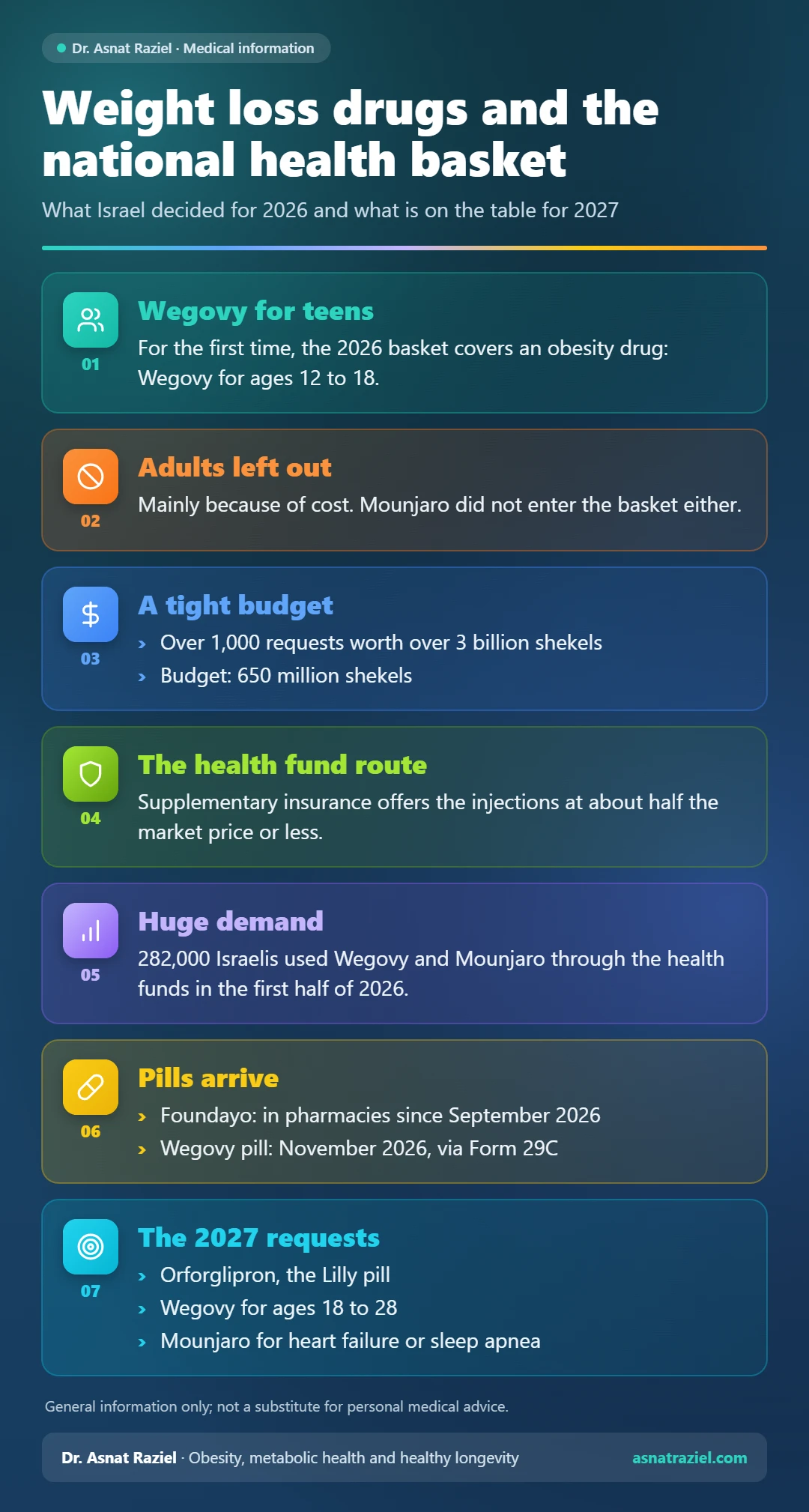
Whether weight loss drugs would enter Israel’s national health basket was one of the burning questions of the year. In February 2026, the committee made its decision: for the first time, an obesity drug entered the basket, the Wegovy injection, but only for teenagers aged 12 to 18. The basket left adults out. Meanwhile, the reality on the ground had already changed. The health funds (HMOs) offer these drugs through their supplementary insurance plans, and tens of thousands of Israelis are using them.
I wrote the original article before the decision. Here, I am updating it to the situation as of October 2026: what entered the basket, what is happening at the health funds and what to expect in the next basket.
How the process worked this year
Every year, the Ministry of Health’s basket committee reviews a huge number of requests. For the 2026 basket, the committee received more than 1,000 requests for drugs and technologies, costing more than 3 billion shekels. By contrast, the budget stood at only 650 million shekels. In other words, the committee could fund only a small share of the requests.
This is a hard process, and there is not enough money for everyone. Weighing life-saving treatments against treatments for chronic disease creates constant tension in the discussions. In addition, this year the government approved the basket well behind schedule, on February 19, 2026, and took effect in March.
Wegovy for teens: what is new in the national health basket
According to reports on the committee’s decisions, Wegovy entered the basket for ages 12 to 18. Committee members considered limiting eligibility to teenagers who already have related conditions. In the end, they decided it was better to provide treatment before those conditions develop. Even so, the reports left one question open: what happens when the teenager turns 18?
The scientific basis for the decision comes mainly from the STEP TEENS trial. It included 201 teenagers with obesity. After 68 weeks, BMI (body mass index, the ratio of weight to height) fell by 16.1% with semaglutide, compared with a 0.6% rise on placebo. You can read more in my article on treating obesity in teenagers.
As I said at the time in an interview, the drug is not meant for mild excess weight or for cosmetic reasons. It is suitable for significant obesity with a health risk, after a structured attempt to change lifestyle. In addition, proper treatment combines a doctor, a dietitian, emotional support and family guidance.
So why were adults left out?
The main reason is cost. The reports put the cost of including adults at tens of millions of shekels. Some committee members expected prices to fall once more competitors enter the market. As a result, Mounjaro did not enter the basket either.
However, doctors now recognize obesity as a chronic disease with serious effects on illness and death. In December 2025, the World Health Organization also published its first guideline on GLP-1 drugs for adults. That is why the gap between scientific knowledge and budget decisions is keenly felt in the clinic.
The health funds did not wait
Alongside the official process, the health funds moved ahead. Clalit, Maccabi, Meuhedet and Leumit all sell the weight loss injections through their supplementary insurance at about half the market price or less, depending on the fund and the dose. According to figures published in August 2026 in Israel Hayom (in Hebrew), Wegovy costs about 270 to 600 shekels a month, and Mounjaro about 450 to 900 shekels, depending on the dose.
Demand is enormous. In the first half of 2026, 282,000 Israelis used Wegovy and Mounjaro through the health funds. Maccabi led with about 123,000 users, followed by Clalit with about 100,000, Meuhedet with 39,000 and Leumit with 20,000. A fund-by-fund breakdown appears in my article on Mounjaro through the health funds.
In September 2026, a pill was added as well. Foundayo reached pharmacies at a price of 691.59 to 1,146.46 shekels a month. At launch, the health funds did not yet include it in supplementary insurance. You can find more details in my complete guide to Foundayo. In November 2026, the Wegovy pill also arrived in Israel, through Form 29C, the Ministry of Health pathway for a medication not yet registered in Israel.
Advanced medicine, widening inequality
The current situation highlights a deep dilemma. On the one hand, there is impressive medical innovation that can change lives. On the other hand, access is uneven. When the basket does not include effective drugs, the health funds and people’s own pockets carry the burden. This creates a two-speed system: those who can afford it get advanced treatment now, and those who cannot must wait.
The problem is not only Israeli. The World Health Organization estimates that by 2030 these drugs will reach fewer than 10% of the people who could benefit from them. Even so, in Israel the supplementary insurance discounts opened a wide door, because more than 70% of residents have supplementary insurance. For more on funding, see my article on insurance coverage for obesity drugs.
The 2027 national health basket: what is on the table
The fight over the next basket has already begun. In July 2026, the Ministry of Health published the list of requests, and obesity stands out in it. First, Eli Lilly’s weight loss pill orforglipron. Second, expanding Wegovy to young adults aged 18 to 28 and to additional indications. Finally, expanding Mounjaro to patients with obesity and heart failure or sleep apnea.
On the other hand, officials expect the budget to remain 650 million shekels, as it was last year. So this year, too, the committee will have to choose among many needs, and weight loss drugs will compete for the same budget.
Looking ahead: weight loss drugs and the national health basket
The debate over weight loss drugs in the national health basket is not only medical, but also social and economic. Covering them broadly could reduce future illness, hospital stays and surgery. Still, it requires a bold decision and a long-term view. The first step, Wegovy for teenagers, is already behind us. Meanwhile, the reality on the ground is clear: the treatment exists, demand is enormous, and the system is moving forward even without the basket’s full stamp of approval. You should always choose the right treatment with a doctor, based on each person’s health.
The information in this article is general and does not replace personal medical advice. Prices and figures are correct as of the date of each source.
References
Israel approves 2026 health basket committee with NIS 650 million budget
The Ministry of Health faces a complex and sensitive challenge (ice, in Hebrew)
A medical revolution: free weight loss injections for teenagers (Behadrei Haredim, in Hebrew)
Once-Weekly Semaglutide in Adolescents with Obesity
WHO issues global guideline on the use of GLP-1 medicines in treating obesity
A nation with obesity: about a quarter of a million Israelis are injecting (Israel Hayom, in Hebrew)
No more injections? New weight-loss pill to launch in Israel next week
The list is out: a weight loss pill, Alzheimer’s and breast cancer, the race for the drug basket begins (Israel Hayom, in Hebrew)
From a weight loss pill to PTSD treatment: the battle over the 2027 drug basket begins (Walla, in Hebrew)




