By Dr. Asnat Raziel, bariatric surgeon specializing in obesity treatment, metabolic health and healthy longevity; Director of the Multidisciplinary Center for Obesity Treatment, Assia Medical, Assuta Ramat HaChayal, Tel Aviv
Insurance coverage for obesity drugs: does insurance recognize what medicine already knows?
Insurance coverage for obesity drugs has become one of the most pressing questions in health systems. Over the past decade, obesity treatment has gone through a true revolution. New medications, including Wegovy and Mounjaro, act on the body’s natural satiety hormones. They lead to significant weight loss, improve related diseases and lower the risk of heart disease. Yet alongside this medical success, a new question has emerged: who will pay for treatment?
In the United States, these drugs can cost thousands of dollars a year per patient. In addition, about 40% of adults there live with obesity. As a result, insurers, employers and the government have to decide how to balance the immediate cost against future health savings.
From a “behavioral” problem to a recognized chronic disease
For years, the American insurance system saw obesity as the result of lifestyle choices. Accordingly, most plans did not cover medications designed for weight reduction. However, science has moved on. The evidence shows that obesity is a chronic disease with biological, hormonal, genetic and environmental components. You can read more in my article on the new definition of clinical obesity.
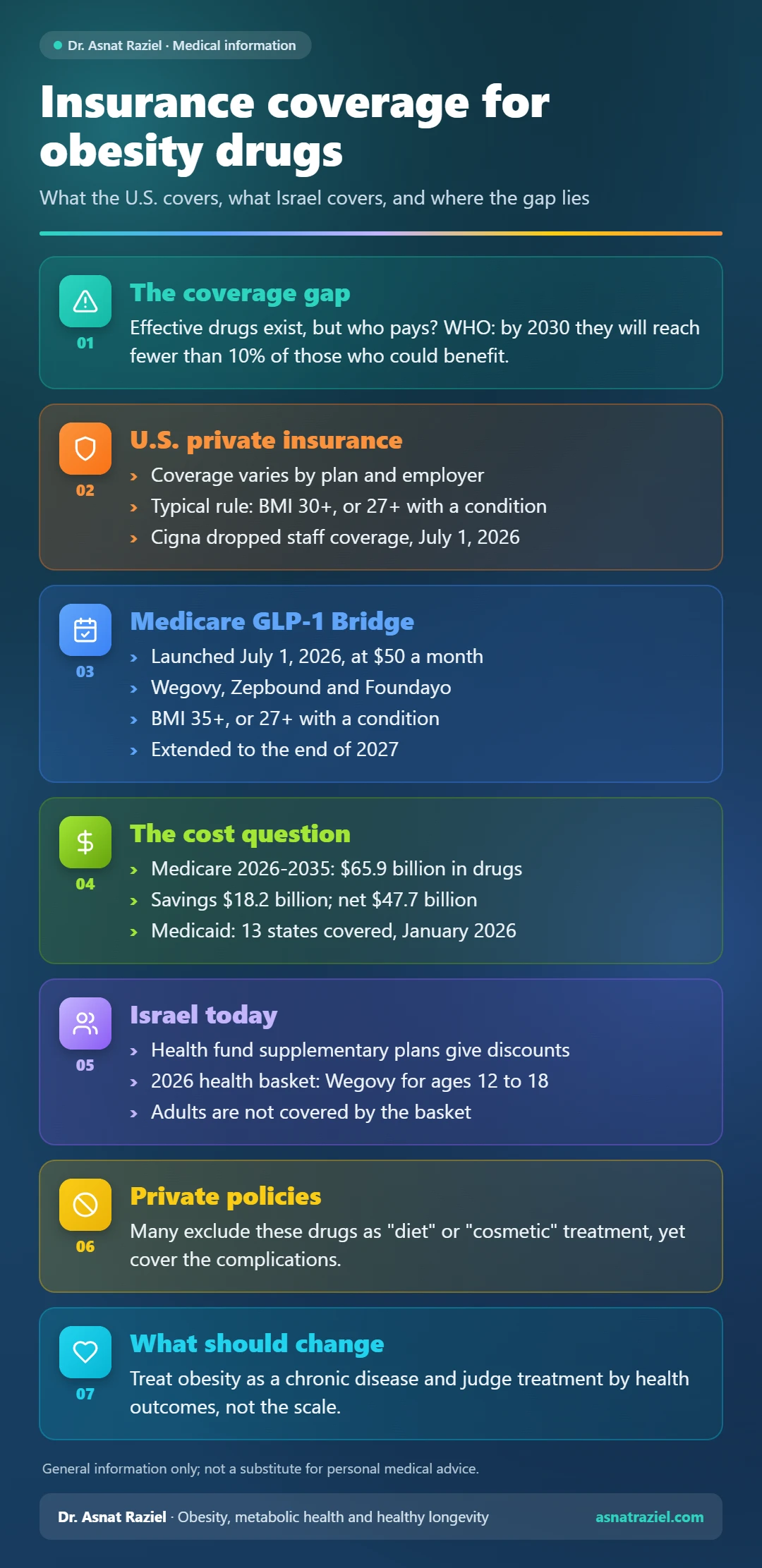
In December 2025, the World Health Organization published its first guideline on the use of GLP-1 medicines for treating obesity. The WHO defined obesity as a chronic, relapsing disease. At the same time, it warned that by 2030 these drugs will reach fewer than 10% of the people who could benefit from them. In other words, the question is no longer only a medical one. It is a question of access and of fairness.
Private insurance in the U.S.: partial coverage and many restrictions
Even today, the United States has no uniform policy. Some employers and private insurers pay for these drugs, while others refuse to cover them at all. Even when coverage exists, it usually comes with strict requirements. For example, a BMI of 30 or higher, or 27 or higher with a related condition. In addition, plans require documentation of previous lifestyle-change attempts and periodic medical approvals.
Over the past year, some employers have even cut back coverage because of the cost. One notable example: the insurer Cigna stopped paying for GLP-1 weight-loss drugs for its own employees as of July 1, 2026. In other words, just when we have the most effective treatments ever, the debate over funding is growing sharper. I discuss this trend further in my article on how employers fund obesity medications.
The Medicare revolution
Another major change came in 2026. On July 1, 2026, Medicare, the federal health insurance program for people aged 65 and older, launched the Medicare GLP-1 Bridge program. Under the program, beneficiaries pay only $50 a month. It includes Wegovy as an injection and as a pill, Zepbound and Foundayo. Eligibility requires a BMI of 35 or higher, or a BMI of 27 or higher with a condition such as heart disease or prediabetes. The program has been extended and will run until the end of 2027.
The goal is clear: to test whether investing in treatment early will save the enormous future costs of diabetes, heart failure and stroke. This is a fascinating economic and health experiment, and it could shape health policy around the world. For more on this question, see my article on tirzepatide and medical costs.
Does insurance coverage for obesity drugs pay off?
This is the central question for decision-makers. Supporters argue that effective obesity treatment will reduce hospital stays, complications and chronic illness. Therefore, they say, it will save money in the long run. Opponents, on the other hand, point out that treatment lasts many years, and sometimes a lifetime.
A study published in JAMA Health Forum estimated the cost to Medicare over the decade 2026–2035. According to the estimate, drug costs would reach $65.9 billion. Health savings would offset only $18.2 billion of that. So the net cost would be $47.7 billion. The picture is also complicated in Medicaid, the state programs for people with low incomes. According to a KFF analysis, only 13 states covered obesity drugs in January 2026. In October 2025 the number was 16, and California, Pennsylvania, New Hampshire and South Carolina then dropped coverage.
What is happening in Israel?
Israel has also made progress. The health funds (HMOs) recognize the importance of drug treatment for obesity. Through their supplementary insurance plans, they offer eligible members significant discounts on drugs such as Wegovy and Mounjaro. In addition, for the first time, an obesity drug entered the 2026 national health basket: injectable Wegovy, for adolescents aged 12 to 18 only. Adults are still not covered by the basket. For more on treating adolescents, see my article on obesity treatment for teens.
When it comes to private insurance coverage for obesity drugs, however, the picture is completely different. As a physician who treats people with obesity every day, I meet many patients who are surprised to discover this. Treatment of the disease itself is not covered, while its complications are covered without difficulty. In many policies, these drugs are excluded under clauses such as “weight-loss treatments,” “diet,” “lifestyle improvement” or “cosmetic treatments.”
A gap between science and the insurance world
This situation raises serious questions. The medical community in Israel and around the world no longer sees obesity as a cosmetic problem. When a person is treated for high blood pressure, no one calls it a cosmetic treatment. Likewise, a diabetes drug is clearly a medical treatment. Yet when a patient gets treatment that corrects the mechanisms of hunger, fullness and metabolism, some policies still see it as treatment “for weight loss” only. Words matter too, as I explained in my article on respectful language toward people with obesity.
A medical decision or a financial one?
The main reason is most likely financial. In Israel, 50% to 60% of adults live with overweight or obesity. Therefore, full coverage for the new drugs could create a heavy financial commitment for insurers. But the medical reality has changed.
Obesity is directly linked to type 2 diabetes, heart disease, high blood pressure, sleep apnea, fatty liver disease and certain cancers. In practice, insurers often pay to treat the complications, but not the disease. That said, surgery also has a place in the economic equation. An Israeli study from Clalit compared 2,721 matched pairs of patients with diabetes and obesity. The monthly cost for GLP-1 patients was $109 higher than for surgical patients, mainly in the first four years.
Insurance coverage for obesity drugs: a question of equity
The current situation raises ethical and public questions. Is it right to define treatment of a recognized chronic disease as a “dietary treatment,” just because the visible result is weight loss? Does it make sense to wait for diabetes, heart disease or advanced fatty liver disease, and only then recognize the need for treatment? These questions will become central as drug use grows and long-term data accumulate.
The bottom line on insurance coverage for obesity drugs
The future seems to be heading in the direction already emerging in the U.S. and Europe: a shift from the number on the scale to health outcomes. When obesity treatment lowers cardiac risk, improves diabetes and slows fatty liver disease, it is hard to see it as cosmetic. So it is time to update the language of insurance as well. Instead of “weight-loss drugs,” let’s talk about “obesity treatment drugs.” Instead of “diet,” let’s talk about treating a chronic disease.
For decades, medicine mainly treated the complications of obesity. Today, for the first time, we have the tools to treat the disease itself. The challenge is no longer whether treatment works, but how to make it available to those who need it. Ultimately, insurance coverage for obesity drugs needs to adapt to the new medical reality.
The information in this article is general and does not replace personal medical advice.
References
Fiscal Impact of Expanded Medicare Coverage for GLP-1 Receptor Agonists to Treat Obesity
A new Medicare option for weight loss drugs is coming. Here’s what to know
Medicaid Coverage of and Spending on GLP-1s
Cigna drops coverage of GLP-1 obesity drugs for its own employees
WHO issues global guideline on the use of GLP-1 medicines in treating obesity
Over half of Israeli adults are overweight or obese, Knesset Health Committee told
Long-Term Health Care Utilization Costs of GLP-1RA Use vs Bariatric Metabolic Surgery




