By Dr. Asnat Raziel, bariatric surgeon specializing in obesity treatment, metabolic health and healthy longevity; Director of the Multidisciplinary Center for Obesity Treatment, Assia Medical, Assuta Ramat HaChayal, Tel Aviv
Clinical obesity: a new definition for an old disease
Clinical obesity is a new concept that is changing the way doctors diagnose obesity. For decades, obesity was defined by one simple number: BMI, the body mass index, or the ratio of weight to height. It is a convenient, accessible and easy-to-calculate measure. However, it does not reflect the true complexity of the disease. Over the past decade, our understanding has shifted profoundly. Obesity is not just excess weight but a chronic, dynamic disease. Its biological, metabolic and functional expressions vary from person to person.
What changed in the definition of obesity?
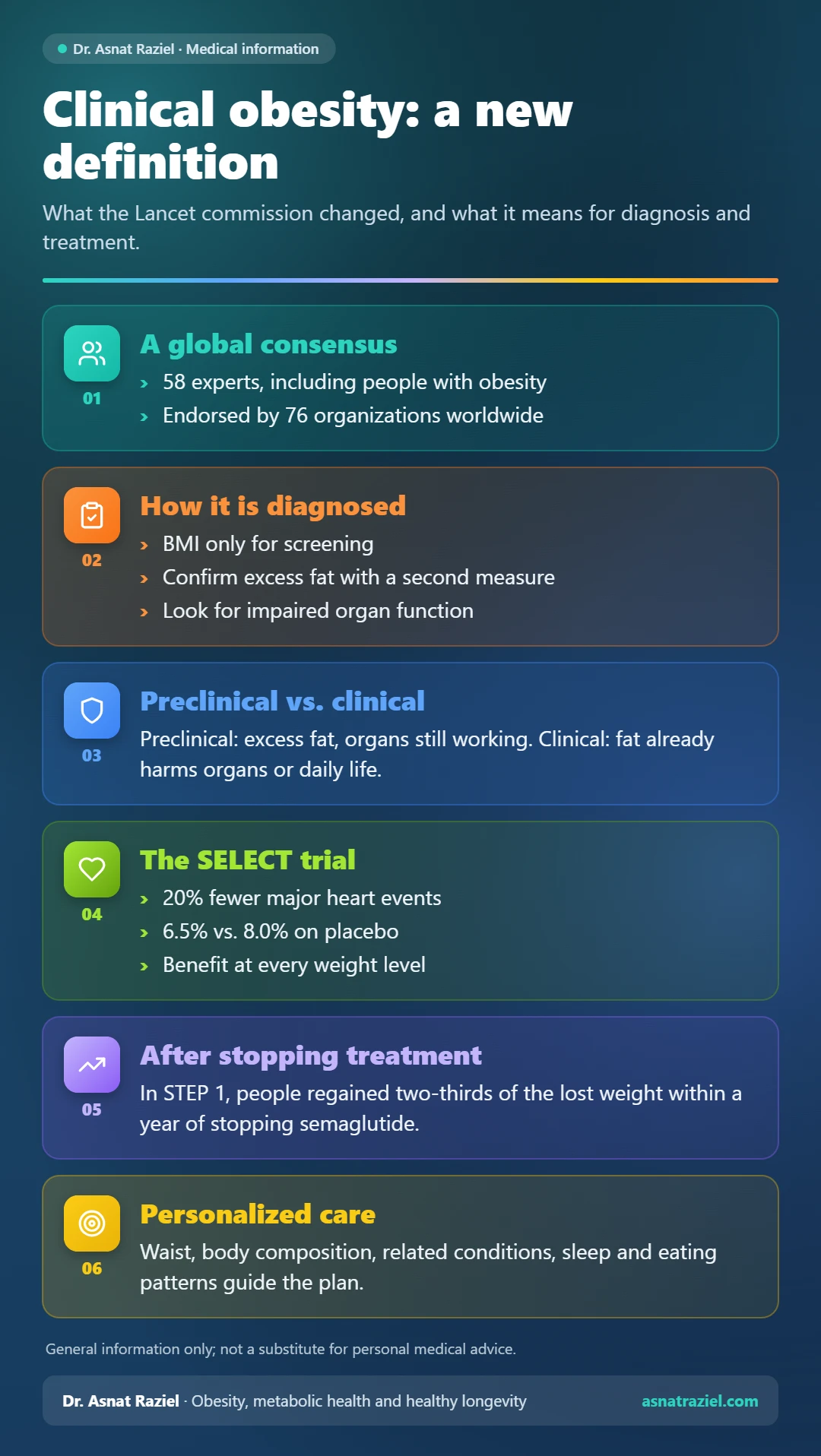
In January 2025, an international commission of the journal Lancet Diabetes & Endocrinology published a new definition. The commission included 58 experts, among them people living with obesity. Later, 76 organizations around the world endorsed its recommendations. The approach moves the focus from weight to function. In other words, the question is not only how much a person weighs, but how their body works.
According to the commission, we should distinguish between two conditions. Preclinical obesity is excess body fat while the organs still function normally, although the risk of disease rises. Clinical obesity, by contrast, is a chronic systemic illness. In this state, excess fat already impairs the function of organs, tissues or the person as a whole.
How clinical obesity is diagnosed
First, the commission recommends using BMI only for screening and population research, not as the sole measure of an individual’s health. Second, excess fat should be confirmed with an additional measurement. Examples include waist circumference, waist-to-hip ratio, waist-to-height ratio or direct measurement of body fat. Above a BMI of 40, we can assume excess fat without further testing. Finally, a diagnosis of clinical obesity requires evidence of impaired organ function or a significant limitation in daily activities.
The clinical meaning is clear. Two people with the same BMI can be in completely opposite states of health. One is active, with good muscle mass and no complications. The other has insulin resistance, fatty liver, high blood pressure and chronic inflammation. That is why the modern definition looks not only at the amount of fat, but also at its effect on health. I wrote about why this matters in my article on why body composition is more important than weight.
Obesity as a biological disease, not a personal failure
One of the most important shifts in medical thinking is the understanding that obesity is not the result of a lack of discipline. It is a biological process that the brain, the nervous system, gut hormones and fat tissue itself manage together. All of these take part in regulating hunger, satiety and energy expenditure. The commission also stated that public health strategies must rest on science, not on blaming the individual. In addition, it identified stigma as a major barrier to care, a topic I covered in my article on obesity stigma.
Research shows that after weight loss, the body activates powerful mechanisms to regain what it lost. In a study published in NEJM, changes in hunger and satiety hormones persisted for a full year after the diet. At the same time, participants felt hungrier. The body “defends” the higher weight as its set point. This explains why dieting alone so often fails over time, and why weight regain is so common.
GLP-1 drugs: far beyond the number on the scale
Against this background, drugs in the GLP-1 family have brought about a revolution. Beyond reducing appetite and slowing stomach emptying, they act directly on the satiety centers in the brain. They also improve insulin sensitivity, reduce inflammation and benefit the heart and blood vessels.
Moreover, the effect of these drugs does not depend on weight loss alone. The SELECT trial enrolled 17,604 people with obesity and heart disease but without diabetes. Semaglutide reduced major cardiovascular events by 20%: such an event occurred in 6.5% of the treatment group, compared with 8.0% on placebo. Furthermore, a follow-up analysis published in The Lancet showed that heart protection appeared at every weight level. It did not depend on how many kilograms people lost. So the goal of treatment is changing: not just to “lose weight,” but to improve health. You can read more about the trial in my article on how Wegovy protects the heart.
Clinical obesity requires long-term treatment
This new view changes how we manage the disease from the ground up. Instead of short-term treatment aimed at shedding kilograms, we need long-term care for a chronic disease. Just like high blood pressure or diabetes, obesity also requires regular follow-up and personalized adjustments. Treatment combines lifestyle, medication and sometimes surgery. In December 2025, the World Health Organization issued its first guideline on the use of GLP-1 drugs. In it, the WHO describes obesity as a chronic, relapsing disease and recommends long-term treatment for adults.
The numbers illustrate this well. In the STEP 1 trial extension, participants stopped semaglutide after 68 weeks. Within a year, they regained two-thirds of the weight they had lost, and most of the improvement in metabolic markers disappeared. For details, see my article on what happens when you stop GLP-1 drugs.
Personalized care instead of a single number
The modern approach emphasizes personalization. Not every patient needs the same treatment, and not every treatment suits every person. The choice of drugs, how to combine them and how long to continue should rest on biological, medical and personal characteristics. These decisions cannot rely only on the number on the scale. In my clinic, for example, we also look at waist circumference, body composition, related conditions, sleep quality and eating patterns. This way, we build a plan that fits the person, not just a number. I described such a framework in an article on personalized treatment according to the European association.
The bottom line on clinical obesity
Moving from a numerical definition to a broad biological view changes the entire conversation, from medicine to society. The distinction between preclinical and clinical obesity helps identify who needs treatment now and who needs monitoring and prevention. Once we understand that obesity is a disease and not a personal failure, the way opens to effective, stigma-free, science-based care. Ultimately, this is the foundation for precise and humane obesity medicine in the coming decade.
The information in this article is general and does not replace personal medical advice.
References
Definition and diagnostic criteria of clinical obesity
Long-Term Persistence of Hormonal Adaptations to Weight Loss
Semaglutide and Cardiovascular Outcomes in Obesity without Diabetes
WHO issues global guideline on the use of GLP-1 medicines in treating obesity
The SELECT and STEP 1 trials were funded by Novo Nordisk.




