By Dr. Asnat Raziel, bariatric surgeon specializing in obesity treatment, metabolic health and healthy longevity; Director of the Multidisciplinary Center for Obesity Treatment, Assia Medical, Assuta Ramat HaChayal, Tel Aviv
Tirzepatide and medical costs: treating obesity as an investment
Tirzepatide and medical costs come up in almost every discussion of the new obesity drugs. The main argument against these drugs is their high price. However, a new study from August 2026 suggests looking at the bill more broadly. In adults over 55 with obesity, ongoing treatment with tirzepatide was linked to much lower medical spending. Among other things, patients needed fewer hospital admissions and emergency room visits.
In the United States, Lilly markets the drug for obesity as Zepbound. Here in Israel, most people know it as Mounjaro. The cost gap grew the longer treatment continued.
A real-world study
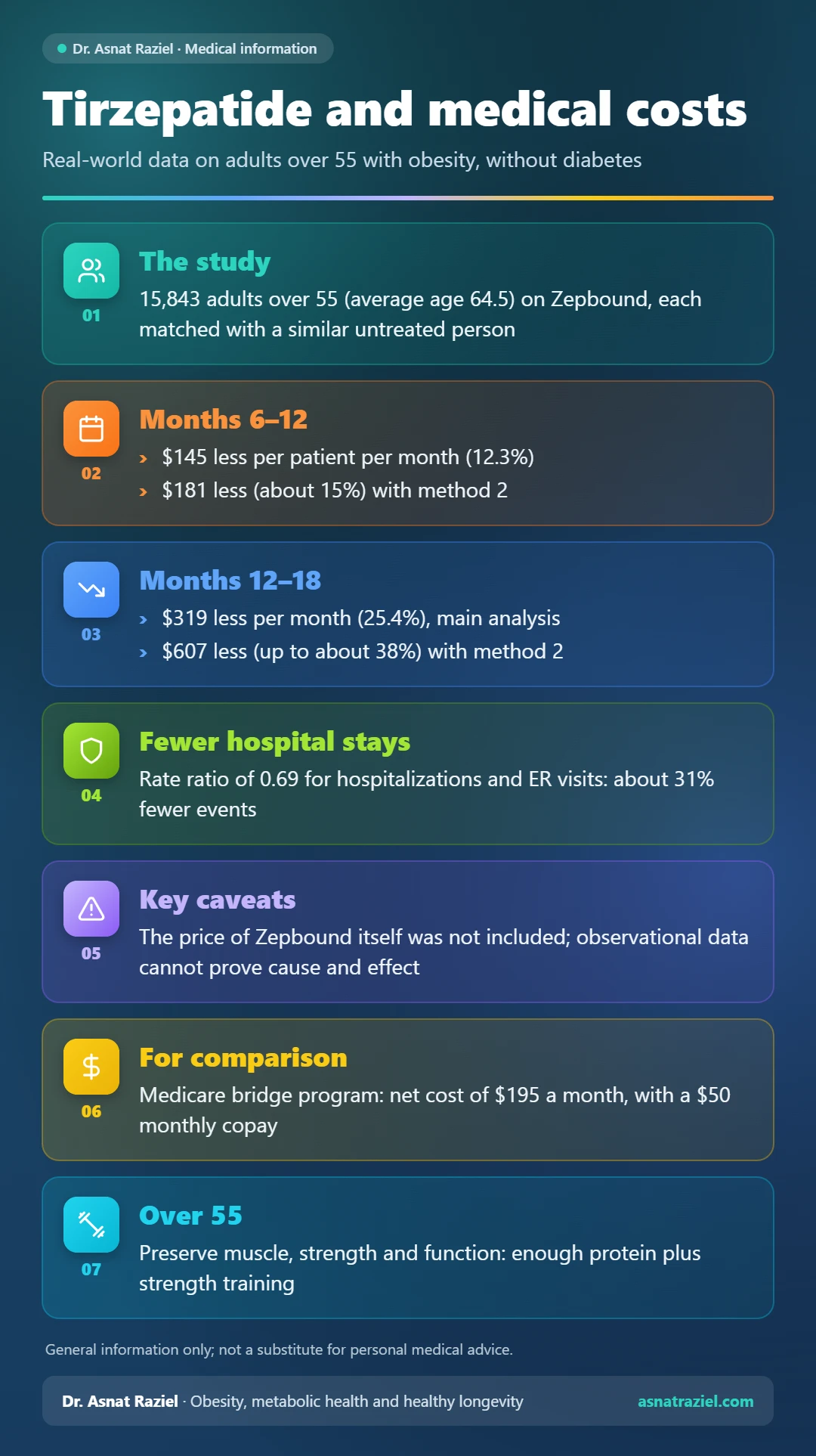
The journal Diabetes, Obesity and Metabolism published the study. Unlike a controlled clinical trial, it is a real-world evidence study, meaning an analysis of data collected during routine healthcare. The researchers used the Komodo database, which holds anonymized claims data on more than 330 million Americans.
Overall, the study included 15,843 patients over 55, with an average age of 64.5. All had a BMI of 30 or higher, or a BMI of 27 or higher with at least one weight-related complication. Moreover, none had type 2 diabetes. The patients started Zepbound between November 2023 and September 2025.
The researchers matched each patient with a similar person who did not receive any drug from the incretin family. The matching took into account age, chronic conditions, obesity complications and patterns of healthcare use.
Tirzepatide and medical costs in the first year
The researchers measured the change in costs with two statistical methods. Both showed the same trend: ongoing Zepbound treatment was linked to lower monthly spending compared with similar people who did not take it.
In months 6 to 12, the gap was $145 per patient per month in the main analysis. That is a difference of 12.3%. With the second method, the gap reached $181 per month, about 15%. But the truly interesting finding came later.
In the second year: up to $607 less per month
In months 12 to 18, the gap grew considerably. The main analysis showed a gap of $319 per patient per month, or 25.4% less. With the second method, the difference reached $607 per month, up to about 38% less than the control group.
In other words, treatment may do more than improve medical markers. The health gains may later translate into less use of expensive services as well. The researchers conclude that the savings grow over time in people who stay on treatment.
Fewer hospital stays and fewer ER visits
Where did the savings come from? Mainly from a drop in hospital admissions and emergency room visits. In months 12 to 18, the rate ratio for hospitalizations and ER visits was 0.69. Put simply, patients on Zepbound had about 31% fewer of these events. On the other hand, according to the company, routine clinic visits were slightly higher.
This is an interesting finding. We may be seeing a shift from “reactive” medicine, with a hospital stay after a complication, to planned, preventive care in the community. Still, an observational study cannot prove that the drug itself caused the drop.
The key caveat: the price of the drug was not included
This may be the most important caveat. The costs in the study do not include the price of Zepbound itself. Claims data do not reveal the net price after discounts and agreements. Therefore, the researchers left the drug out of the calculation.
So it is not correct to say that treatment saves 38% of total spending. The study showed that other medical costs went down, and that these savings may offset part of the drug’s price. For comparison, the researchers cite a net cost of $195 a month under the Medicare bridge program. According to an NPR report, the program runs from July 2026 through the end of 2027, with a copay of $50 a month. It is also important to note that some of the researchers are Eli Lilly employees, and that the company’s announcement highlighted the most optimistic figure, “up to 38%.”
Why tirzepatide and medical costs matter right now
Clearly, the economic question becomes more critical as more people receive treatment. On the one hand, these drugs are expensive. On the other hand, obesity is linked to heart disease, diabetes, sleep apnea, joint disease and fatty liver. Treating those conditions also costs a great deal of money.
That is why the right question is not only “How much does the injection cost?” The question is what the total cost of a person with obesity is over the years, and what happens to it when we treat the disease effectively. In Israel, this question ties directly into the debate over the cost of drug treatment for obesity and how it is funded.
How tirzepatide works, and what it is approved for
Tirzepatide activates two receptors: GIP and GLP-1. As a result, it reduces appetite and improves many metabolic markers. For example, in the SURMOUNT-1 trial, the average weight loss at the 15 mg dose was 20.9% after 72 weeks, compared with 3.1% on placebo.
In the United States, Zepbound is approved for chronic weight management in adults with obesity, or with overweight and a related condition. In addition, the FDA approved it in December 2024 for moderate to severe obstructive sleep apnea in people with obesity. You can read more in my article on obesity and sleep apnea.
What about older adults?
The study focused specifically on people aged 55 and over, and this matters a great deal. At this age, however, the goal is not just a lower number on the scale. It is important to preserve muscle, strength and function, to get enough protein and to include strength training. Otherwise, large weight loss without attention to muscle can be harmful. I cover this in more detail in my article on preserving muscle mass during weight loss.
Bottom line on tirzepatide and medical costs
When we judge obesity treatment only by its monthly price, we mostly see an expense. But when we look at the person over time, the picture may change. In the study, the link between tirzepatide and medical costs grew stronger with time: the gap was small in the first year and much larger in the second. We still need longer, independent studies, and they should include the price of the drug. Even so, the message is clear: effective obesity treatment may be an investment, not just a line item of spending.
The information in this article is general and does not replace personal medical advice.
Frequently asked questions
Did the study prove that Mounjaro saves 38% of healthcare costs?
No. The researchers found a link between ongoing treatment and other medical spending that was up to about 38% lower, with one of the two methods, in months 12 to 18. The price of the drug itself was not included in the calculation.
How many people took part in the study?
There were 15,843 patients over 55 treated with Zepbound. The researchers matched each one with a similar person who did not receive a drug from the incretin family.
What was the gap in the second year?
Depending on the statistical method, the gap ranged from $319 to $607 per patient per month. In the main analysis, that is a drop of 25.4%.
Why were costs lower?
Specifically, one of the main factors was a lower rate of hospital admissions and emergency room visits among patients on Zepbound.
Can we conclude that the drug caused the savings?
Not with certainty. This is a retrospective observational study, not a randomized trial. It shows an association, but it does not prove causation.
What does this mean clinically?
The data support the view that we should measure treatment success not only in kilograms. Illness, function and use of the healthcare system over time matter too.
References
Tirzepatide Once Weekly for the Treatment of Obesity
FDA Approves First Medication for Obstructive Sleep Apnea
Some Medicare beneficiaries can now get popular obesity drugs for $50 a month
Some of the study’s researchers are employees of Eli Lilly, the drug’s manufacturer.




