By Dr. Asnat Raziel, bariatric surgeon specializing in obesity treatment, metabolic health and healthy longevity; Director of the Multidisciplinary Center for Obesity Treatment, Assia Medical, Assuta Ramat HaChayal, Tel Aviv
Heart-healthy nutrition: what’s new in the Israeli recommendations
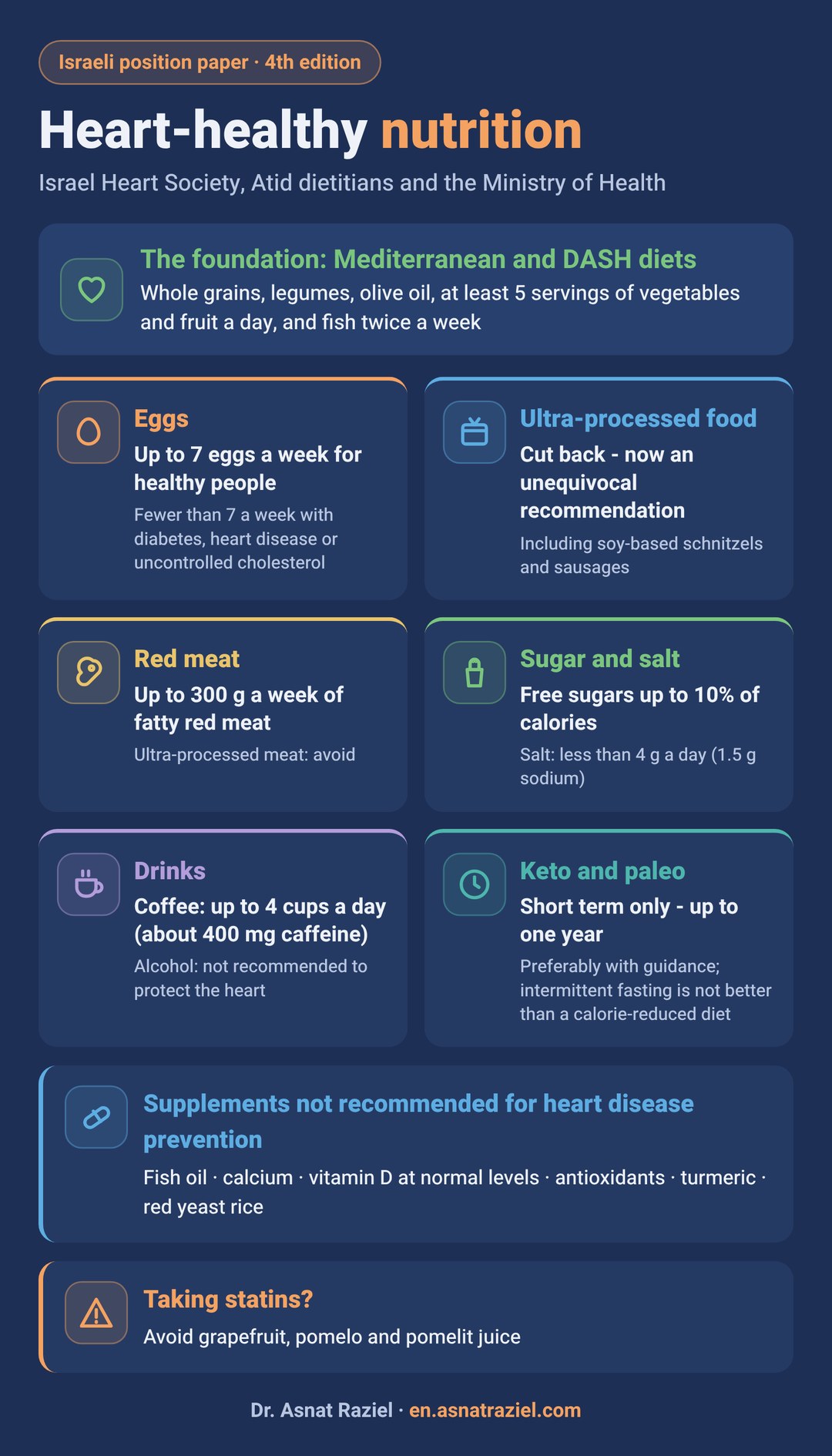
Heart-healthy nutrition just got an official Israeli update. In November, Israeli health bodies published the fourth edition of the position paper “Dietary Recommendations for the Prevention and Treatment of Cardiovascular Disease” (in Hebrew). The core message is simple: your overall eating pattern matters more than any single food. In addition, several long-standing recommendations have changed. For example, healthy people can now eat up to seven eggs a week.
Who wrote the recommendations, and who are they for?
A joint committee of the Israel Heart Society and Atid wrote the document. Atid is the Israeli association of dietitians and nutritionists. The Israel Society for Research, Prevention and Treatment of Atherosclerosis and the Nutrition Division of the Ministry of Health also took part. The Israel Medical Association and the Ministry of Health adopted it.
The recommendations address adults aged 18 and over. They target healthy people, people with risk factors and people with heart disease. However, the document does not attempt to give recommendations for people with other chronic diseases, such as kidney failure or diabetes. Also worth knowing: the committee grades each recommendation by the strength of the evidence behind it.
Mediterranean and DASH: the foundation of heart-healthy nutrition
The committee gives its highest grade of recommendation to the Mediterranean diet. The committee recommends it for preventing and treating heart disease, and also for preventing its risk factors: diabetes, metabolic syndrome, high blood pressure, abnormal blood lipids and obesity. Likewise, it recommends the DASH diet, an eating plan rich in vegetables, fruit and low-fat dairy, for preventing and treating high blood pressure.
In practice, the recommended plate includes whole grains, legumes and olive oil. It also includes at least five servings of vegetables and fruit a day, about 400 grams. You should also eat fish, preferably oily fish, at least twice a week. As for fat, the recommendation is 25%-40% of daily energy. Choose olive oil, avocado, almonds and omega-3 fats over saturated fat.
Alongside these, a balanced vegetarian diet and a plant-based eating pattern are also suitable. On the other hand, the committee found no sufficient evidence that a vegan diet is better than a vegetarian one.
Eggs: up to seven a week for healthy people
This is one of the most notable changes. Unlike past recommendations, healthy people may consider eating up to seven eggs a week. According to the committee, this does not raise cardiovascular risk. By contrast, people with diabetes, heart disease or uncontrolled cholesterol may consider a more moderate intake, fewer than seven eggs a week.
Moreover, a new recommendation addresses older adults and vegetarians with normal cholesterol levels. They may consider up to two eggs a day at most, as a source of high-quality protein. In other words, heart-healthy nutrition does not require giving up eggs.
Ultra-processed food: the recommendation is now unequivocal
The committee links a high intake of ultra-processed food to a higher risk of cardiovascular disease and death. So, it advises cutting back on it. The committee notes that the body of evidence has grown stronger, with new evidence for possible mechanisms.
The recommendation also applies to products that sound healthy. For example, soy-based schnitzels and sausages are a poor substitute for tofu and soybeans. In addition, the committee recommends avoiding ultra-processed meat altogether.
Meat, sugar and salt: where to set limits
First, unprocessed fatty red meat: it is worth considering a limit of 300 grams a week. Lean meat or other low-fat protein sources are better choices instead.
Second, sugar. A new recommendation limits free sugars to 10% of total daily calories. Avoid sweetened drinks too, including fruit juice.
Finally, salt. The recommendation is less than 4 grams of salt a day, which equals 1.5 grams of sodium. This matters especially for people with high blood pressure. Swap salt for spices and fresh herbs. The red front-of-package label helps identify high-sodium products. People with heart failure should ask their doctor about the amount that is right for them.
Keto, paleo and intermittent fasting: short term only
People may consider a ketogenic or paleolithic diet in the short term, up to one year. The goal is weight loss and improved metabolic markers, preferably with professional guidance. However, with no long-term data, the committee advises against them beyond one year.
A low-carbohydrate diet is suitable for the short or medium term. Still, replace the carbohydrates with plant fats, not saturated fat. As for intermittent fasting, you may consider it as a way to cut calories and lose weight. According to the document, though, it is not better than a regular calorie-reduced diet. People with liver cirrhosis should avoid it.
What to drink: water, coffee, green tea and alcohol
Water is the preferred drink, ahead of drinks with sugar or sweeteners. Coffee is good news: up to four cups a day, about 400 mg of caffeine, with no concern of harm to the heart. Green tea may also help, but the recommended amount is unknown. Keep in mind that green tea may affect how some drugs work, such as warfarin and some statins.
On alcohol, the position is clear. The committee does not recommend drinking alcohol to protect the heart. People who do not drink should not start. Those who choose to drink should cut down and avoid heavy drinking.
What to add to your plate
The committee recommends unsalted and unsweetened nuts and almonds, in a personal amount of up to 100 grams a day. However, limit Brazil nuts to two a day. It also recommends fermented dairy products, such as yogurt, cheese and kefir. Choose products with no added sugar and low in sodium.
You may also consider 10-30 grams of dark chocolate a day. Chocolate with a high cocoa content is better than milk chocolate. Garlic, 4-10 grams a day or about three medium cloves, may also slightly reduce risk factors.
Supplements and heart-healthy nutrition: what helps and what does not
The document sends a clear message: it is better to get nutrients from whole foods than from capsules. Therefore, the committee does not recommend these supplements for preventing heart disease:
- Fish oil and omega-3 supplements.
- Calcium, and vitamin D when vitamin D levels are normal.
- Antioxidant vitamins, turmeric and red yeast rice.
- Coenzyme Q10 for prevention or for lowering blood pressure.
On the other hand, there are situations where a supplement may help. For example, you can take a magnesium supplement of up to 600 mg a day if your diet falls short. For mildly high cholesterol, you may consider 1.5-2.5 grams of plant sterols a day with the main meal. They may lower LDL (“bad”) cholesterol by 10%-15%.
There is also another option for people with diabetes or atherosclerotic disease whose triglycerides are 135-499 mg/dL. They may consider the prescription drug Icosapent Ethyl at 4 grams a day, under medical follow-up. Finally, people with advanced heart failure who have symptoms may consider coenzyme Q10 at 100-400 mg a day.
An important warning for people taking statins
People taking statins, especially at high doses, should avoid grapefruit juice, pomelo juice and pomelit juice. These juices block the breakdown of some statins and may increase side effects. By contrast, orange juice and other citrus fruits did not show a similar effect.
How to put heart-healthy nutrition into practice
There is no need to change everything at once. Start with small, steady steps:
- Swap one ultra-processed product a day for fresh food.
- Add a vegetable or fruit to every meal, reaching at least five servings a day.
- Choose olive oil, nuts and fish instead of animal fat.
- Choose water over juice and sweetened drinks.
- Read the front-of-package label before you buy.
Every day in my clinic, I see the value of combining nutrition, physical activity and obesity treatment. What’s more, a dietitian can tailor the recommendations to each person’s medical conditions and medications.
Bottom line: heart-healthy nutrition is a pattern, not a single food
The new Israeli recommendations go back to basics. Fresh, varied food, little processed food, little sugar and salt, and fat from plant sources. They also put old fears to rest, such as the fear of an egg a day. In the end, your daily menu affects your heart far more than any supplement.
The information in this article is general and does not replace personal medical advice. Before a major change in your diet or before taking supplements, talk to your doctor or dietitian.
References
Some committee members reported commercial ties, as detailed in the position paper’s disclosure section.